





Eheringe aus Weißgold – Material, Oberflächen und Gestaltung
Eheringe aus Weißgold verbinden den Wert einer Goldlegierung mit einer hellen, zurückhaltenden Farbwirkung. Dadurch passen sie sowohl zu schlichten, klassischen Ringformen als auch zu modernen und stärker strukturierten Designs. Besonders interessant wird Weißgold durch das Zusammenspiel von Legierung, Oberfläche und Ringgestaltung.
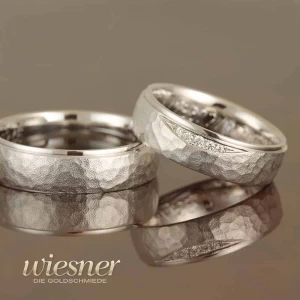
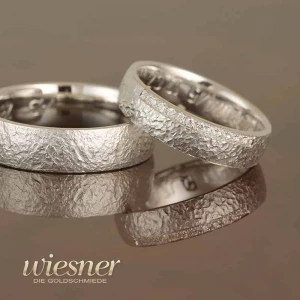
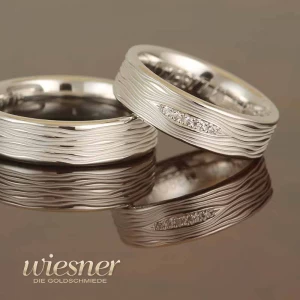
In dieser Kategorie finden Sie Weißgold-Eheringe von August Gerstner in zahlreichen unterschiedlichen Designs. Neben klassischen polierten und matten Trauringen gehören dazu Modelle mit markanten Oberflächenstrukturen sowie Eheringe mit Diamanten.
Was ist Weißgold?
Reines Gold besitzt von Natur aus einen gelben Farbton. Für Weißgold wird Gold mit helleren Metallen legiert, wodurch die charakteristische hellere und kühlere Farbwirkung entsteht. Der tatsächliche Farbton kann sich abhängig von der verwendeten Legierung und der anschließenden Oberflächenbearbeitung unterscheiden.
Damit unterscheidet sich Weißgold nicht nur optisch von klassischem Gelbgold. Die jeweilige Legierungszusammensetzung beeinflusst auch die Materialeigenschaften des fertigen Rings.
Poliert, matt oder markant strukturiert
Gerade bei Weißgold hat die Oberflächenbearbeitung großen Einfluss auf die Wirkung des Rings. Eine polierte Oberfläche reflektiert das Licht stark und wirkt entsprechend brillant. Mattierte Flächen erscheinen ruhiger und zurückhaltender.
Eine weitere Möglichkeit sind ausgeprägte Strukturen. Die verschiedenen Pattern-Oberflächen von Gerstner verändern die Lichtreflexion des hellen Edelmetalls und geben den Eheringen einen deutlich eigenständigeren Charakter.
Eheringe aus Weißgold mit Diamanten
Weißgold und Diamanten ergeben eine besonders harmonische Kombination. Die helle Farbe des Metalls bildet keinen starken farblichen Gegensatz zum Stein, sodass Diamant und Ring optisch miteinander verbunden wirken können.
Je nach Modell reicht die Gestaltung von einzelnen Diamanten bis zu mehreren Steinen oder Diamantreihen. Dadurch sind sowohl sehr zurückhaltende als auch deutlich auffälligere Weißgold-Eheringe möglich.
Weißgold oder Gelbgold?
Der offensichtlichste Unterschied liegt in der Farbwirkung. Gelbgold besitzt den klassischen warmen Goldton, während Weißgold heller und kühler erscheint. Dadurch wirken selbst ähnlich gestaltete Eheringe aus den beiden Goldfarben deutlich unterschiedlich.
Wenn Sie einen wärmeren Goldton bevorzugen, finden Sie in unserer Kategorie Eheringe aus Gelbgold die entsprechenden Modelle von August Gerstner.
Individuelle Gestaltung Ihrer Weißgold-Eheringe
Je nach Gerstner-Modell stehen unterschiedliche Ringbreiten, Profile, Oberflächen und Ausführungen zur Auswahl. Auch Diamantbesatz und persönliche Gravuren ermöglichen eine individuelle Gestaltung. Welche Möglichkeiten konkret bestehen, hängt vom jeweiligen Ringmodell ab.
Gerne beraten wir Sie bei der Auswahl Ihrer Eheringe persönlich in unserer Goldschmiede in Beilstein.
Häufige Fragen zu Eheringen aus Weißgold
Was ist Weißgold?
Weißgold ist eine Goldlegierung. Da reines Gold von Natur aus gelb ist, wird es mit helleren Metallen legiert, um die für Weißgold typische helle Farbwirkung zu erzielen.
Was ist der Unterschied zwischen Weißgold und Gelbgold?
Der deutlichste Unterschied ist die Farbe. Gelbgold besitzt einen warmen Goldton, Weißgold erscheint heller und kühler. Darüber hinaus unterscheiden sich die Legierungen in ihrer Zusammensetzung und können dadurch unterschiedliche Materialeigenschaften besitzen.
Welche Oberfläche eignet sich für Weißgold-Eheringe?
Weißgold kann poliert, mattiert oder mit unterschiedlichen Strukturen versehen werden. Polierte Oberflächen reflektieren das Licht stärker, während matte und strukturierte Oberflächen zurückhaltender beziehungsweise markanter wirken.
Gibt es Eheringe aus Weißgold mit Diamanten?
Ja. Viele Weißgold-Eheringe sind mit Diamanten erhältlich. Je nach Modell können einzelne Steine, mehrere Diamanten oder Steinreihen in die Gestaltung integriert werden.
Sind Weißgold-Eheringe alltagstauglich?
Für Eheringe werden geeignete Weißgoldlegierungen verwendet, die für das tägliche Tragen ausgelegt sind. Wie bei anderen Edelmetallringen entstehen im Alltag mit der Zeit Gebrauchsspuren auf der Oberfläche.
Können Weißgold-Eheringe personalisiert werden?
Je nach Modell können unter anderem Ringbreite, Oberfläche und Diamantbesatz gewählt werden. Zusätzlich lassen sich die Ringe mit einer persönlichen Gravur versehen.
Was kosten Eheringe aus Weißgold?
Der Preis hängt unter anderem von Goldlegierung, Ringbreite, Gewicht, Ausführung und Diamantbesatz ab. Deshalb unterscheiden sich die Preise der verschiedenen Weißgold-Eheringe teilweise deutlich.
Weitere Materialien und Designs finden Sie bei unseren Gerstner Eheringen.
The Mokume Gane wedding rings by Markus Wiesner are unique pieces, which are individually designed and manufactured in dialogue with you. For this reason we would like to invite you to a consultation in our studio or offer a non-binding preliminary consultation by telephone.
What are Mokume Gane wedding rings?
Mokume Gane wedding rings are wedding rings in a centuries-old Japanese forging technique. The basic technique is the welding of different metals, a technique which is known in its origin for the production of knife and sword blades. For the production of the Mokume Gane as the basic material for wedding rings, however, instead of steel, different precious metals, or precious metals of different colors, such as yellow gold, white gold, red gold, platinum, palladium and silver are used.
By using different colors, a beautiful contrast is achieved, which makes the later appearing wood-like structures visible to the eye. After the multilayer Mokume Gane base material has been produced, it is processed into an elongated strand by forging and rolling. By different working methods the later pattern of the Mokume Gane wedding rings can be prepared at this point. By slitting and stretching the slits, rings with an all-round pattern are then produced without any interruption. Both wedding rings are made of one welded strand. For the continuous forming of the metal it is necessary to anneal it repeatedly soft after small working steps.
Quality features of our Mokume Gane wedding rings
The main quality feature of Mokume Gane wedding rings is that both rings of a pair of wedding rings are forged from one strand of welded and twisted metal layers. This is the only way to achieve the highest possible degree of similarity between the two wedding rings. The seamless process gives the Wiesner Mokume Gane wedding rings the beautiful symbolic power of infinity. Furthermore, only this technique creates the typical Mokume Gane pattern, continuous and uninterrupted. This traditional technique is for Mokume Gane wedding rings quality and recognition feature. This means that our rings are seamless in comparison to the often much cheaper rings, i.e. they are not open at the bottom and have to be soldered.
Mokume Gane | jap.: wood patterned metal | Historical development
The error with the damask steel
With the search for an improved material for the blades of weapons, the era of patterned metals also begins. In Damascus, Europeans first find sabre weapons made of unusually high-quality steel. For this reason, the material is also erroneously called Damascus steel by the crusaders. This weapon steel surprises above all by its so far unknown spring force and strength.
Patterned Steel
In addition, his wavy and flamed patterns are fascinating. The Roman scholar Cassiodor describes these weapons in the 6th century as "...forged by volcano..." and "...not the work of a mortal, but the work of a god." If one looks at the development of this new steel, it seems to have taken place independently of each other in very different areas of Europe and Asia.
From Rome to Malaysia
In old Norse legends layered blades appear as well as in archaeological excavations at sites that date back to the 2nd century and are of Roman origin. The Malay dagger "Kris" from the 13th century is made of fire-welded steel. Several alternating layers of soft iron and steel form the dagger blade after multiple folding, forging and etching of the surface.
Damascus steel in China and Japan
Already in the 1st century B.C. layered steel appeared in China. The Japanese Samurai, or rather their armourers, then developed the layered steel to its completion. During the welding process, the steel is enriched with carbon.
First Mokume Gane by Denbei Shoami
The blademaker Shoami (1651-1728) from Akita in Japan made a name for himself with extraordinary works in steel as well as in softer materials alloyed with precious metals. For the first time he welded non-ferrous metals and decorated them artistically. He calls it Mokume Gane (wood-structured metal). The Kizuka sword handle, made in Mokume Gane, is considered his first work. He used silver, gold and shakudo for this. Many old samurai swords have round or oval discs made in Mokume Gane as blade ends and hand protection.
Why is Mokume Gane so distinctive in Japan?
There are several reasons why the technique of Mokume Gane became so well established in Japan. Two of them are certainly the very highly developed art of sword making and extensive knowledge in the metallurgical field. The existence of large schools and an excellent exchange of information also favored the so far-reaching development of the Mokume Gane. Furthermore, there were unique colored metal alloys in Japan, such as, for example, Shakudo | Shibuishi | Kuromido.
Precious metal was in short supply
These mainly copper-containing alloys were created mainly due to the lack of precious metals such as gold and silver, which were very rare in Japan and therefore expensive. There are no other historical Mokume Gane works known outside Japan.
Well guarded secrets
Why was the Mokume Gane technique not known outside of Japan for a long time? Firstly, Japan was an isolated island until 1853. The techniques of Japanese artists and craftsmen were well kept as secrets. In addition, the Mokume Gane was an old tradition in swordsmithing and was therefore only meant for them.
Industrial revolution in Europe suppresses Mokume Gane
Secondly, the industrial revolution developed in Western countries, which meant that alchemistically seeming craftsmanship and emotions were increasingly frowned upon. Rather, everything that could be produced quickly and cheaply in large quantities developed here.
The turning point for the Mokume Gane
It was not until the 1960s that the jewelry industry also made the transition from purely decorative, prestigious investments to a more and more artistic approach. This was the basis for the discovery and development of the Mokume Gane in the USA in the seventies.
There it was Hiroko Sato and Gene Pijanowski who began to work with the Mokume Gane in the seventies. After some unsatisfactory results the two went to Japan to learn the classical Mokume Gane technique. Back in their homeland they developed the Mokume Gane techniques further and made among other things large vessels as well as pieces of jewelry.
1970: soldered metal layers by George Sayer, USA
1978: Mc Cullum from England traveled to Japan to learn the Mokume Gane techniques and worked, back in England, great vessels.
1980: Steven D. Kretschmer, USA, learned the Mokume Gane technique from Sato and Pijanoeski and worked from then on on Gold Mokume Gane bars without the use of solder. As the Mokume Gane requires a considerable amount of time and material, it was initially unable to spread for a long time due to both working time and cost reasons.