
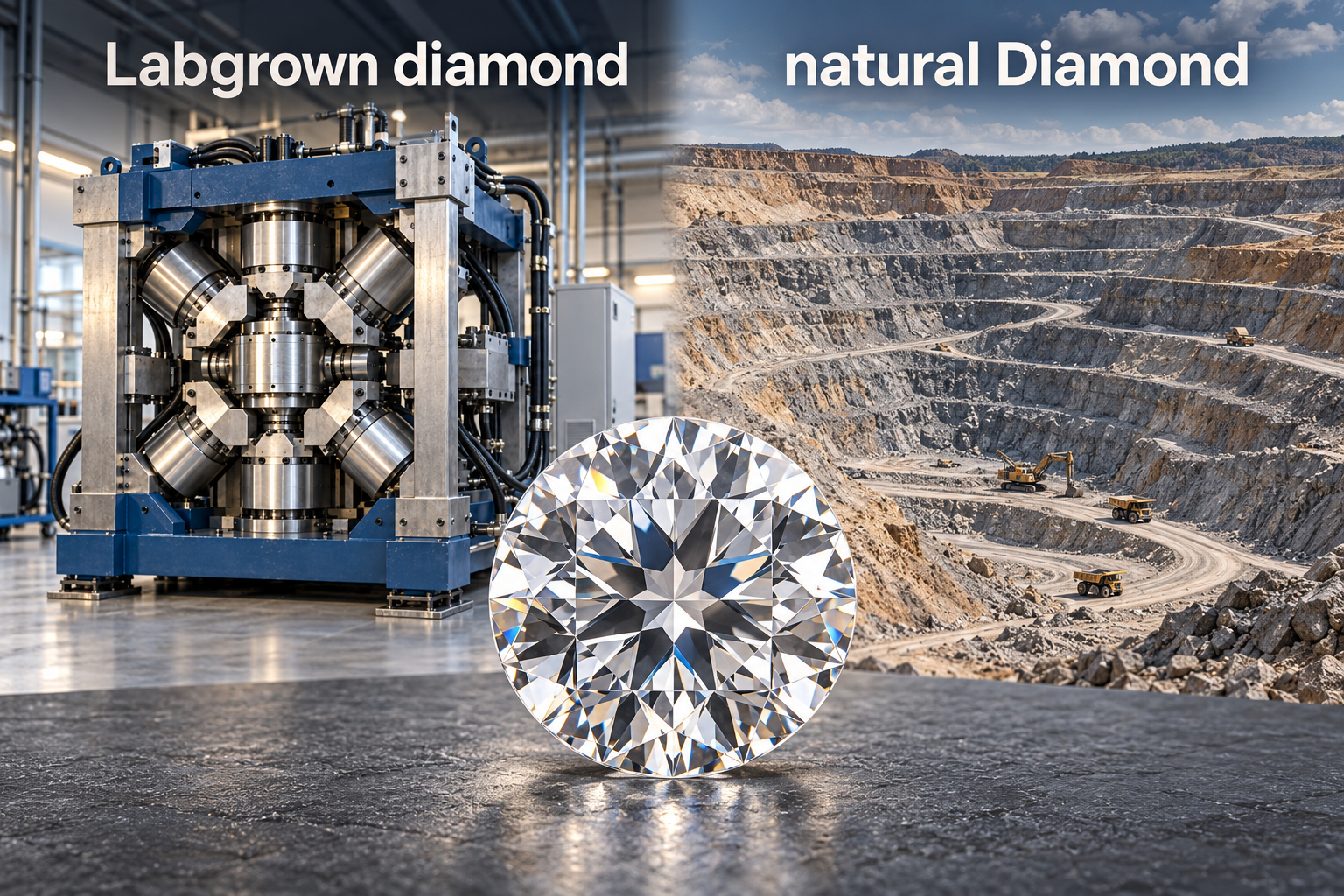
Lab-grown diamond or natural diamond—which is right for your engagement ring?
Thumbnail: AI-generated illustration
Anyone looking for a diamond engagement ring is now increasingly likely to come across terms like “lab-grown diamond” or “lab-grown diamond.” These terms represent another option for choosing the stone for your ring. In addition to natural diamonds, there are diamonds that are grown under controlled technical conditions.
What distinguishes these stones from one another? Are lab-grown diamonds real diamonds? And why are they usually offered at a lower price? These are understandable questions. After all, an engagement ring should not only be beautiful but also align with your personal preferences and budget.
What are lab-grown diamonds?
Lab-grown diamonds are diamonds that are grown in a technical facility. Like natural diamonds, they consist of crystallized carbon. They essentially have the same chemical, physical, and optical properties as their natural counterparts.
The main difference lies in how they are formed. Natural diamonds were formed deep within the Earth under high pressure and at high temperatures. For lab-grown diamonds, suitable growth conditions are created artificially.
The English term “Lab-Grown Diamonds,” often used in German as “Lab-Grown Diamanten,” simply means “diamonds grown in a laboratory.” It therefore refers to the same thing as the term “laboratory-grown diamonds.”
Are lab-grown diamonds real diamonds?
Yes. A lab-grown diamond is a diamond and not a diamond imitation like cubic zirconia. Moissanite is also a different material, even though it is likewise used as a sparkling gemstone.
Nevertheless, the term “laboratory-grown” is an essential part of the description. It makes it clear that the stone was manufactured using technology and is not of natural origin. Anyone choosing an engagement ring should be aware of this origin and be able to make an informed decision.
How are lab-grown diamonds made?
Two main processes are used for production. Both involve growing a diamond, but they differ in their technical conditions.
HPHT – Growth under High Pressure and High Temperature
HPHT stands for “High Pressure High Temperature.” In this process, a diamond grows from a carbon source onto a small diamond seed under high pressure and at high temperature. The technical conditions are modeled after those under which diamonds form deep within the Earth.
CVD – Growth from a Carbon-Containing Gas
CVD stands for “Chemical Vapor Deposition.” A carbon-containing gas is activated inside a technical chamber. Carbon is deposited onto a diamond seed plate, causing the diamond to grow layer by layer.
After growth, the stones are processed and cut. Some also undergo a treatment to improve their color. When selecting a gemstone, therefore, its actual properties and a transparent description are what matter most.
Lab-Grown Diamonds: Differences from Natural Diamonds
In a finished ring, a diamond’s origin usually cannot be reliably determined with the naked eye. A well-cut lab-grown diamond can sparkle just as impressively as a well-cut natural diamond.
Nevertheless, the stones are not completely identical. Their different growth conditions leave behind characteristics that specialized gemmological laboratories can identify using appropriate testing methods. A simple diamond tester is not sufficient to reliably distinguish their origin.
Three factors are particularly important when making a personal decision: whether the diamond is natural or lab-grown, the quality of the specific stone, and its price. Someone who values the geological history of a natural diamond will prioritize different factors than someone who primarily wants a beautiful diamond within a specific budget.
Lab-grown diamonds and their price—why are they usually less expensive?
Lab-grown diamonds are usually offered at a lower price than natural diamonds when comparable in size and quality. They can be produced synthetically and are subject to different production and market conditions than stones from natural deposits.
However, there is no fixed pricing rule. Size, cut, color, clarity, any treatments, and the stone’s documentation all influence the price. That’s why it’s worth comparing specific diamonds with one another rather than focusing solely on the carat weight.
With an engagement ring, the ring itself is also a factor. Precious metal, design, setting, and the amount of craftsmanship involved are all part of the price. A less expensive diamond therefore does not mean that the entire ring will be proportionally cheaper.
Especially with an intricately crafted Mokume Gane ring, a large portion of the work remains the same—regardless of whether a natural diamond or a lab-grown diamond is set into it later.
What matters when it comes to quality?
Even with lab-grown diamonds, it’s worth taking a close look at the individual stone. Origin alone doesn’t determine how beautiful a diamond will look in the finished ring.
- Cut: Proportions and craftsmanship influence how the diamond reflects light and sparkles. A brilliant cut refers to a specific cut shape and, on its own, is not a measure of quality.
- Color: For colorless diamonds, the degree to which any color tint is visible plays a role. The color of the ring metal also influences the overall impression.
- Clarity: Inclusions and other characteristics are evaluated based on their size, location, and visibility.
- Carat: The carat weight describes the stone’s weight. One carat equals 0.2 grams. How large a stone appears from above also depends on its shape and proportions.
For an engagement ring, the overall harmony is crucial. The diamond should complement the ring’s shape, the setting, and the hand. Therefore, the largest stone is not automatically the best choice.
Lab-grown diamonds: Disadvantages and limitations
People searching for “lab-grown diamonds disadvantages” often want to know whether the lower price comes with reduced durability. The fact that a diamond is produced in a technical facility does not inherently make it softer or less suitable for everyday wear.
Diamonds are very hard, but they can still be damaged by severe impacts. This applies equally to natural and lab-grown stones. A suitable setting and careful handling are essential for both.
Other limitations tend to lie more in personal expectations. A lab-grown diamond lacks a natural formation history. Anyone seeking precisely this characteristic will not be able to find its equivalent in a lab-grown stone.
Furthermore, the future resale value should not be equated with the purchase price. Anyone buying a ring should not assume a guaranteed increase in value. For an engagement ring, the focus is on its design, daily wear, and personal significance.
What is the value of lab-grown diamonds?
The term “value” often confuses several different concepts: the price of a new stone, a potential resale price, and the personal value of a piece of jewelry.
A lab-grown diamond has a purchase price that depends on its characteristics and the specific offer. However, this does not allow one to determine a specific future resale price. Similarly, a natural diamond is not a guaranteed investment simply because of its origin.
The personal value of an engagement ring evolves differently anyway. It’s tied to the person giving it, the proposal, and the couple’s shared history.
Are lab-grown diamonds automatically more sustainable?
For a lab-grown diamond, the stone itself does not need to be extracted from a diamond mine. However, this alone does not provide a complete environmental assessment.
The technical manufacturing process also requires energy and resources. For a reliable comparison, factors such as the production process, energy supply, and supply chain must be considered. The term “lab-grown” is therefore not, in and of itself, proof of particularly sustainable production.
Anyone who places great importance on this point should ask for specific and transparent information about the stone being offered. General statements such as “environmentally friendly” or “sustainable” do not replace such information.
An engagement ring with a lab-grown diamond from our jewelry workshop
For the Hanzu engagement ring in Iroko Mokume Gane, we offer both options: a natural diamond or a lab-grown diamond. You can choose from 0.20, 0.25, and 0.50 carats, each in TW/SI clarity and with a brilliant cut. Other diamond sizes are available upon request.
Master goldsmith Markus Wiesner crafts the Hanzu in our own workshop in Beilstein using 500 palladium and 925 silver. The delicate Iroko grain pattern emerges during the handcrafted shaping of the layered metal composite. This gives each ring its own unique lines.
The open design of the band allows the diamond to appear to float almost freely above the ring. Its sparkle creates a beautiful contrast to the satin-matte surface and the silver-gray tones of the Mokume Gane.
The choice between a natural diamond and a lab-grown diamond changes the stone’s origin. The individual design and the intricate handcrafted production of the Hanzu remain the same for both versions.
Buying Lab-Grown Diamonds—What Should You Look For?
If you’d like to buy lab-grown diamonds or a ring with a lab-grown diamond, the lab-grown origin should be clearly stated. Equally important are verifiable details regarding weight and quality. If a gemmological report accompanies the stone, ask for an explanation of the characteristics and any potential treatments it documents.
When it comes to the finished ring, it’s also worth taking a look at the setting, the precious metal used, and the proper ring size. Personal consultation can help you select both the diamond and the ring as a whole.
In our “Engagement Rings from Our Goldsmiths” category, you’ll find additional designs for your proposal. If you’re interested in a specific ring shape and would like a lab-grown diamond for it, we’d be happy to discuss the available options with you.
Frequently Asked Questions About Lab-Grown Diamonds
What does “lab-grown diamond” mean?
The term means “diamond grown in a laboratory.” “Lab-grown diamond,” “laboratory diamond,” and “laboratory-grown diamond” all describe the same type of origin.
Can lab-grown diamonds be identified with the naked eye?
The origin usually cannot be reliably determined with the naked eye. Specialized testing is required for a definitive distinction.
Is a lab-grown diamond the same as cubic zirconia?
No. A lab-grown diamond consists of crystallized carbon and is a diamond. Zirconia is a different material used as a diamond imitation.
Why are lab-grown diamonds less expensive?
They can be produced synthetically and are traded under different market conditions than natural diamonds. The actual price, however, depends on size, quality, and supply.
Is a lab-grown diamond suitable for an engagement ring?
Yes. Its properties make it just as suitable for an engagement ring as a natural diamond. The key factors are the specific stone, a suitable setting, and your personal vision for the ring.
Is the Hanzu available with both natural and lab-grown diamonds?
Yes. For the Hanzu in Iroko Mokume Gane, you can choose between both options in 0.20, 0.25, or 0.50 carats. We’d be happy to discuss other diamond sizes upon request.
A Personal Choice for Your Ring
For some people, the natural origin of a diamond is an integral part of an engagement ring. Others consciously choose a lab-grown diamond and use the price difference to opt for a different stone size or their desired ring design.
Both options can be combined with a handcrafted piece of jewelry. We’d be happy to advise you on choosing a diamond and design a ring that matches your vision.
Further Information
Technical explanations regarding production and differentiation can be found at the Gemological Institute of America: HPHT and CVD methods for diamond production, differences between natural and lab-grown diamonds, and diamond imitations versus lab-grown diamonds. The U.S. Federal Trade Commission (FTC) publishes guidelines on the responsible use of environmental claims.
