
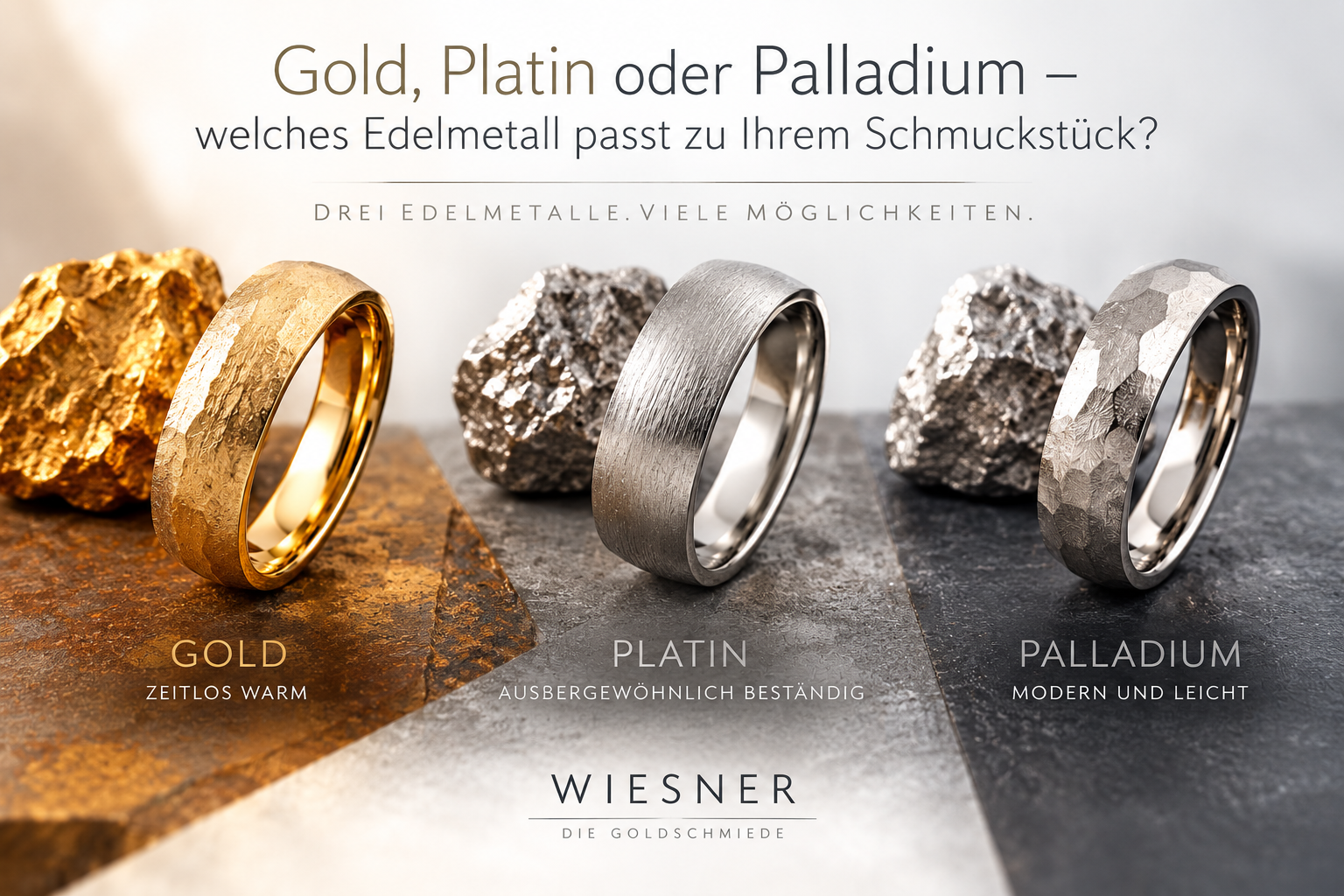
First published on December 11, 2025 · Comprehensively revised and updated on September 21, 2026 · Preview image: AI-generated illustration
Gold, Platinum, or Palladium—Three Precious Metals with Very Different Characteristics
Gold, platinum, and palladium are among the most important precious metals used in high-quality jewelry. At first glance, they differ primarily in color and price. From a goldsmith’s perspective, however, the key differences run deeper: density, fineness, alloy, hardness, malleability, and workability all influence how a piece of jewelry can be crafted, worn, and later modified.
That’s why there isn’t just one “best” precious metal. What matters most is which material suits the piece of jewelry, the desired look, and how comfortable it feels to wear.
A Direct Comparison of Gold, Platinum, and Palladium
| Property | Gold | Platinum | Palladium |
| Typical Jewelry Alloys | 585 / 750 | usually 950 | e.g., 500 / 950 |
| Color | Depending on the alloy: yellow, reddish, or naturally light | naturally light gray-white | naturally light gray-white |
| Density | relatively high, depending on the alloy | very high | significantly lower than platinum |
| Comfort | Classic, depending on the alloy and ring shape | Noticeably heavy and solid | relatively light |
| Special feature | Wide variety of colors and alloys | High fineness and high density | Light-colored platinum with low weight |
These values are intentionally not ranked. Even within a single metal group, different alloys can have significantly different properties. Therefore, fineness alone does not determine which material is best suited for a particular piece of jewelry.
Gold—the Most Versatile Classic
Gold has a special advantage: by alloying it with other metals, its color and technical properties can be adjusted across a wide range. For jewelry, 585 and 750 gold are primarily used.
Yellow gold retains the classic warm character of gold. Red and rose gold derive their reddish color from a higher copper content. White gold, on the other hand, is created by alloying elements that lighten gold’s natural yellow hue.
We explain more about fineness and gold alloys in our guide, “Gold and Fine Gold in Jewelry Making.”
For us in the workshop, gold is particularly interesting because of its versatility. Depending on the alloy, it can be easily forged, rolled, shaped, soldered, and reworked later on. This is important for pieces of jewelry that are meant to be worn for many years and may need to be repaired or altered.
585 or 750 gold—which is better?
585 gold contains 58.5 percent fine gold, while 750 gold contains 75 percent. However, this does not automatically mean that 750 gold is the better choice for every piece of jewelry.
The remaining alloy components influence color, hardness, and workability. Therefore, even two alloys with the same fineness can behave differently.
We explain the numbers on jewelry in detail in our guide “What Do 585, 750, and 950 Mean?”
Platinum—dense, naturally light in color, and exceptionally durable
Platinum is a precious metal in its own right and not a gold alloy. Platinum 950—an alloy containing 95 percent platinum—is frequently used for high-quality jewelry.
Its naturally light, gray-white color is a key difference from white gold. Platinum does not require rhodium plating to appear bright.
Its high density is particularly striking. An otherwise comparable ring made of platinum feels significantly heavier than one made of palladium. Many people find this weight to be a pleasant indication of quality; others deliberately prefer a lighter ring.
Platinum is corrosion-resistant and is very well suited for jewelry worn on a daily basis. However, it is by no means scratch-proof. Like any jewelry metal, platinum develops signs of wear from daily use and, over time, a characteristic patina.
We cover this material in more detail in our guide to platinum.
Palladium – naturally light in color and significantly lighter than platinum
Like platinum, palladium belongs to the platinum group of metals. It also has a naturally light color but a significantly lower density.
You can tell this immediately when looking at the finished piece of jewelry. A solid palladium ring can feel significantly lighter than a comparable platinum ring.
When evaluating palladium, the specific alloy is particularly important. Palladium 500 and Palladium 950 are not simply the same material with different precious metal contents. Composition and processing influence the properties of the finished piece of jewelry.
In our workshop, palladium also plays an important role in Mokume Gane. For example, we use 500 palladium together with silver and gold because this allows us to create striking color contrasts within the forged grain pattern.
For more information, see our guide to palladium.
Gold, platinum, or palladium—which metal is the hardest?
When it comes to jewelry, this seemingly simple question cannot be meaningfully answered by naming a single metal.
Pure metals and jewelry alloys have different properties. Additionally, cold working during rolling or forging alters a material’s strength. The specific alloy composition also plays a decisive role.
Therefore, when it comes to a ring’s suitability for everyday wear, a single hardness value isn’t the only important factor. The design, material thickness, ring profile, and surface finish all play a role in determining how the piece of jewelry will hold up over many years.
Which precious metal gets the fewest scratches?
None of these three precious metals remains permanently free of wear marks when worn daily. A wedding ring comes into contact with doorknobs, tools, countertops, and countless other objects.
Polished surfaces usually show fine scratches sooner than matte or textured surfaces. Platinum often develops a characteristic patina over time. Gold and palladium alloys also develop visible signs of wear.
So the better question isn’t, “Which metal doesn’t scratch?” but rather, “What do I want my ring to look like after a few years of wear?”
Gold, Platinum, or Palladium for Wedding Rings?
When it comes to wedding rings, the material plays a particularly important role because the rings are typically worn every day for decades.
Gold is particularly appealing if you’re looking for a warm color, various shades of gold, or a classic jewelry alloy.
Platinum is a good choice for people who prefer a naturally light-colored ring with a high purity and a noticeably substantial feel when worn.
Palladium is a good choice if you want a naturally light-colored platinum-like metal, but the ring should be significantly lighter.
The specific design remains the decisive factor. Width, height, profile, and finish can influence the feel of the ring at least as much as the choice of metal.
You’ll find an overview of different materials and manufacturing methods in our selection of wedding rings.
And which metal is best suited for diamonds?
Gold, platinum, and palladium can generally be combined with diamonds. When choosing the material, the design, setting, and construction of the piece play a greater role than a blanket ranking of precious metals.
Light-colored metals are often combined with colorless diamonds because the setting and the stone create a harmonious visual unity. Warm yellow gold, on the other hand, can be used to create a deliberate, striking contrast to the diamond.
When it comes to an engagement ring or a ring with larger stones, we therefore always consider the jewelry as a whole and not just the name of the precious metal.
What Makes the Three Metals in Mokume Gane Particularly Interesting
With Mokume Gane, the choice of materials goes one step further. Here, different precious metals are selected not only for their technical properties but also for the color effect they create within the grain pattern.
A good example is our Seraya model, crafted from platinum and yellow gold. The cool platinum and the warm yellow gold create a distinct two-tone contrast.
In various Mokume Gane rings, we combine palladium with silver and gold, among other metals. The different metal colors are what make the structure created by forging clearly visible in the first place.
Our Mokume Gane rings therefore illustrate particularly well just how much the choice of precious metals determines the final appearance of a ring.
So which precious metal is the right one?
Here’s a simple guide to help you decide:
- Do you prefer a classic gold color or a variety of shades? Then gold is the obvious choice.
- Do you want a naturally light-colored and noticeably heavy ring? Then it’s worth taking a closer look at platinum.
- Do you want a naturally light-colored precious metal but prefer something lighter in weight? Then palladium might be worth considering.
- Do you want to combine different metal colors? Then multicolored designs or Mokume Gane open up additional possibilities.
When it comes to a piece of jewelry meant to be worn every day, however, we would never base the decision solely on a chart. A wide platinum ring feels completely different from a narrow gold ring; the profile, material thickness, and finish further alter this impression.
Conclusion from our goldsmiths
Gold, platinum, and palladium are not tiers of quality where one metal is fundamentally superior to another. They are different materials, each with its own strengths.
Gold offers the greatest variety of colors and enormous creative possibilities. Platinum combines a naturally light color with high density and high fineness. Palladium is also one of the naturally light-colored platinum group metals, but feels much lighter due to its lower density.
Ultimately, what makes a piece of jewelry great is the interplay of material, alloy, construction, design, and how it’s worn. That’s precisely why we don’t choose a precious metal based on its name, but rather on what we want the specific piece of jewelry to be.
