
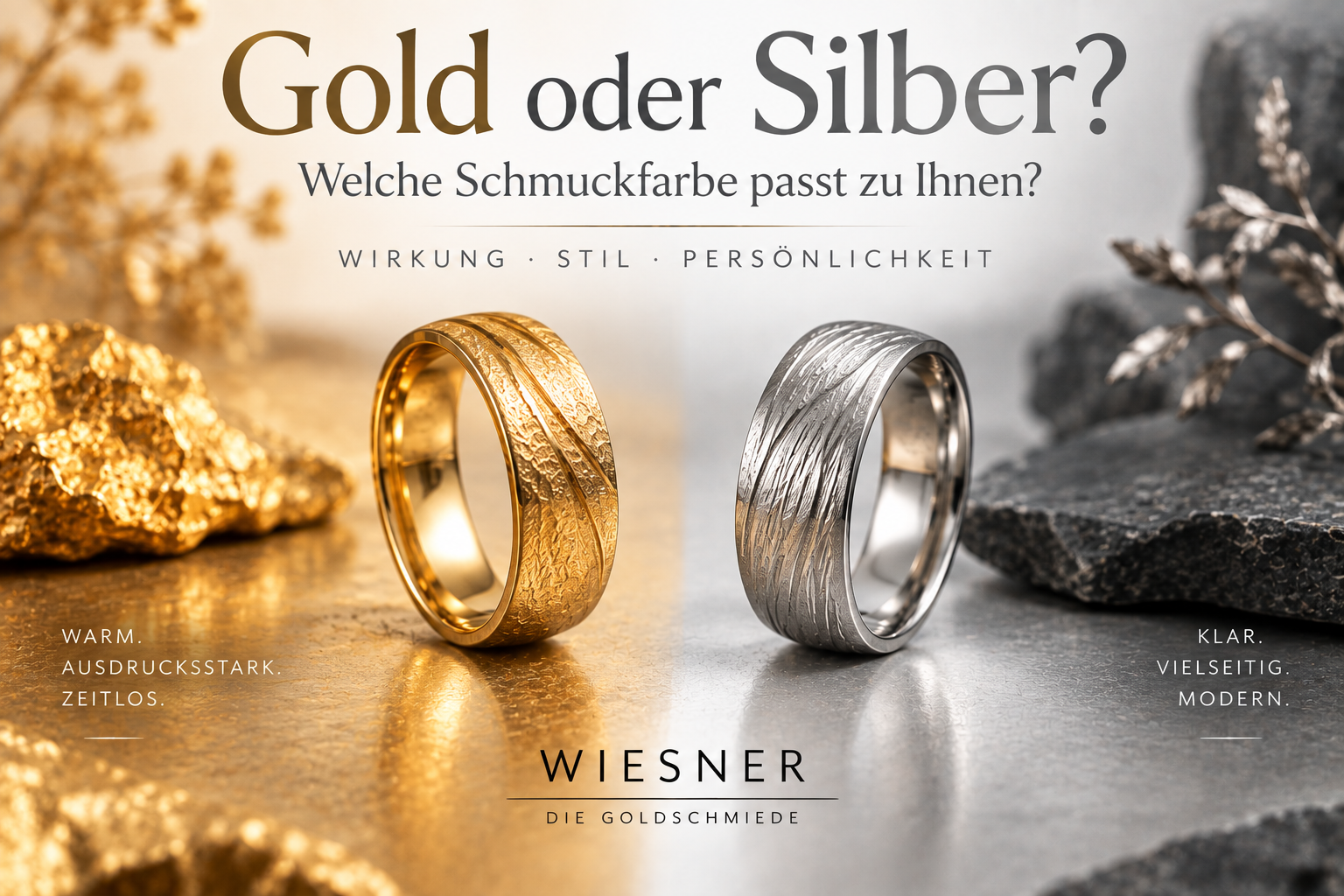
First published on November 14, 2025 · comprehensively revised and fact-checked on September 22, 2026 · Preview image: AI-generated illustration
Gold or Silver—More Than Just a Matter of Taste
Gold or silver? Some people answer this question without a second thought. Others switch between the two metal colors depending on the piece of jewelry, their outfit, or the occasion.
There is no hard-and-fast rule about which people should wear gold and which should wear silver. Nor can a person’s personality or psychological makeup be reliably deduced from their preference for a particular metal color.
Nevertheless, the decision is an interesting one. After all, gold and silver look different, feel different, and—as materials for jewelry—have their own unique properties.
From a goldsmith’s perspective, it’s therefore worth asking not only, “What do I like? ” but also: “Which color looks right on me, how do I want to wear the jewelry, and which material properties are important to me?”
Gold has a warm appearance—silver has a cool appearance
The most obvious difference is the color.
Classic yellow gold has a warm yellow hue. Silver, on the other hand, appears light, whitish, and significantly cooler. For this reason alone, the same jewelry design can look completely different when made from these two materials.
A yellow gold ring can appear warm, classic, and striking. The same design in silver often appears more understated and cooler.
However, this is not a value judgment. Which effect you prefer is a matter of personal taste.
Furthermore, gold is by no means limited to yellow gold. Different alloys result in, among others, red gold, rose gold, and white gold. We explain more about this in our guide to gold and fine gold in jewelry making.
Gold or Silver to Match Your Skin Tone?
You often read the recommendation that warm skin tones should wear gold and cool skin tones should wear silver. This can certainly be a useful guideline—but it’s not a hard-and-fast rule.
Jewelry doesn’t stand alone. Hair color, clothing, glasses, other pieces of jewelry, and—above all—the size and design of the piece influence the overall impression.
A small yellow gold ring can appear much more understated than a large silver ring. A matte piece of jewelry looks different from one with a high-gloss polished surface.
If you’re unsure, you shouldn’t try to determine your skin type based on a chart. Trying on gold and silver jewelry side by side is usually much more revealing.
What exactly is the difference in terms of material properties?
Gold and silver are distinct chemical elements and both belong to the group of precious metals. In jewelry making, however, they are usually not processed in their pure form but rather as alloys.
For gold, for example, 585 and 750 are common finenesses. 750 gold contains 75 percent fine gold, while 585 gold contains 58.5 percent.
For silver jewelry, 925 sterling silver is widely used. It contains 92.5 percent silver and other alloying elements, often copper.
We explain in more detail why jewelry metals are alloyed in the first place and what numbers like 585, 750, 925, or 950 mean in our guide “Fineness in Jewelry: Simply Explained.”
Silver Can Tarnish—Gold Behaves Differently
An important practical difference becomes apparent when wearing the jewelry.
Silver can react with sulfur-containing compounds in its environment. This causes a dark layer to form on the surface. This so-called tarnishing is not a quality defect and does not mean that the piece of jewelry is damaged.
The surface can be cleaned and restored.
Gold is chemically much more stable. However, when it comes to jewelry alloys, its behavior also depends on the other metals it contains and on the fineness.
You can find more information about silver, sterling silver, and proper care in our guide to silver as a jewelry metal.
Is gold of higher quality than silver?
Gold generally has a significantly higher material value than silver. However, this does not automatically mean that every piece of gold jewelry is of higher craftsmanship than one made of silver.
Material value and craftsmanship are two different things.
A carefully designed and superbly crafted silver ring can be of higher quality than an industrially produced piece of gold jewelry.
When evaluating a piece of jewelry, factors such as the alloy, construction, workmanship, finish, gemstones, and craftsmanship—in addition to the precious metal itself—all play a role.
Why, then, do so many people still choose gold or silver without hesitation?
Jewelry is a very personal matter. Habits and preferences develop over the years.
Some people have worn almost exclusively silver since their youth and find yellow gold itself unfamiliar. Others feel more comfortable with warm gold and would hardly ever choose a light-colored silver ring.
Cultural and fashion influences also play a role. Depending on the design, gold can appear classic, luxurious, modern, or very minimalist. Silver can appear sporty, understated, elegant, or extravagant.
That’s why it would be too simplistic to attribute a specific personality to a metal’s color. The design of a piece of jewelry often says just as much about its effect as the metal used.
Can you wear gold and silver together?
Of course. The old notion that gold and silver tones shouldn’t be combined is primarily a stylistic convention.
In fact, the contrast between warm and cool metal colors can be particularly interesting from a design perspective.
In our workshop, we even take it a step further: With Mokume Gane, we permanently fuse precious metals of different colors together. Gold, silver, and palladium can form a layered material whose varying metal colors reveal the characteristic grain pattern.
In the Mokume Gane ring “Andira,” for example, warm 750 yellow gold, palladium, and a light band of 925 silver come together directly.
So gold and silver don’t have to be an either/or choice
Multicolored jewelry, in particular, demonstrates that these two worlds of metal can complement each other perfectly.
In Mokume Gane, we deliberately make use of this color contrast. The different precious metals are fused together and then forged and patterned. This results in lines that are not painted on or applied afterward—rather, the colors are inherent to the material itself.
You’ll find more examples in our Mokume Gane ring collection .
Gold or silver for a ring?
The decision here shouldn’t be based solely on color.
For a ring worn daily, material thickness, alloy, ring profile, surface finish, and the type of wear and tear are important. Silver and gold have different material properties and behave differently when worn and during subsequent maintenance.
The material’s value also plays a role. For a solid ring, the difference between silver and a high-quality gold alloy can be significant.
For a piece of jewelry intended to be worn for many years, we would therefore always consider the entire piece and not simply say: “Gold is better” or “Silver is better.”
Which suits me better—gold or silver?
There’s no simple answer. Here are some questions to help you decide:
- Do I feel more comfortable with warm or cool metal tones?
- What jewelry colors do I already wear regularly?
- Should the piece stand out, or should it blend in with my existing jewelry?
- How important are material quality and fineness to me?
- How often and under what circumstances do I want to wear the piece?
- Would I perhaps like to deliberately combine several metal colors?
Especially when it comes to a ring, one very simple approach works best: look at it, try it on, and compare the materials directly with one another.
Our conclusion from the goldsmith’s workshop
Whether someone prefers gold or silver reveals no hidden psychological truth. Jewelry is far too personal for that.
However, the choice can certainly reveal something about the colors, shapes, and materials a person enjoys wearing. And that is precisely where one of the main appeals of jewelry lies: it allows for personal expression without having to fit into a fixed category.
Gold offers a wide variety of alloys and colors and has high material value. Silver stands out for its bright color, its long tradition as a jewelry metal, and its unique design possibilities.
And if you don’t want to choose between the two, you don’t have to. It’s precisely the combination of different precious metals that can make a piece of jewelry particularly exciting.