



Mokume Gane – From Japan to Modern Goldsmithing
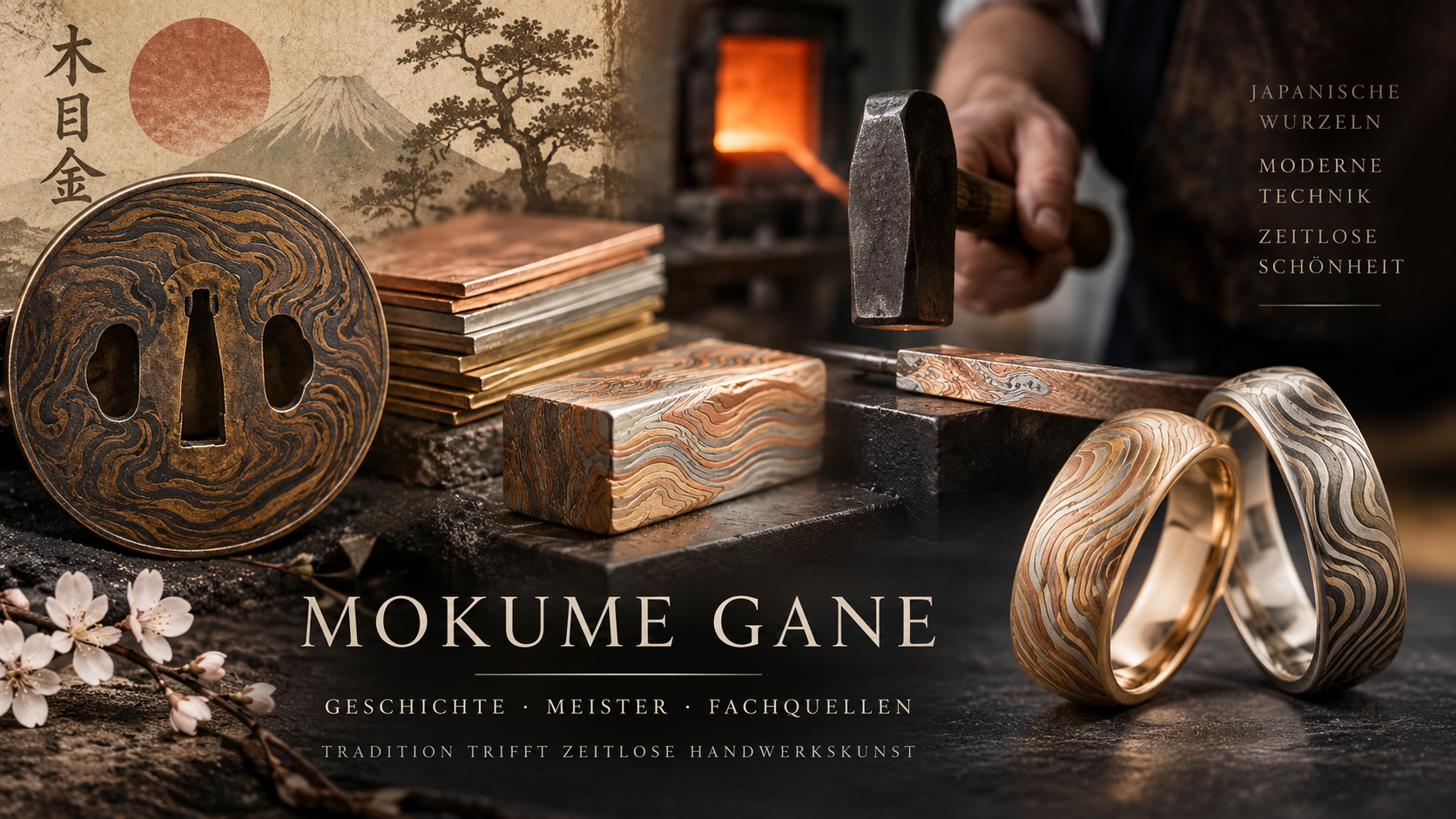
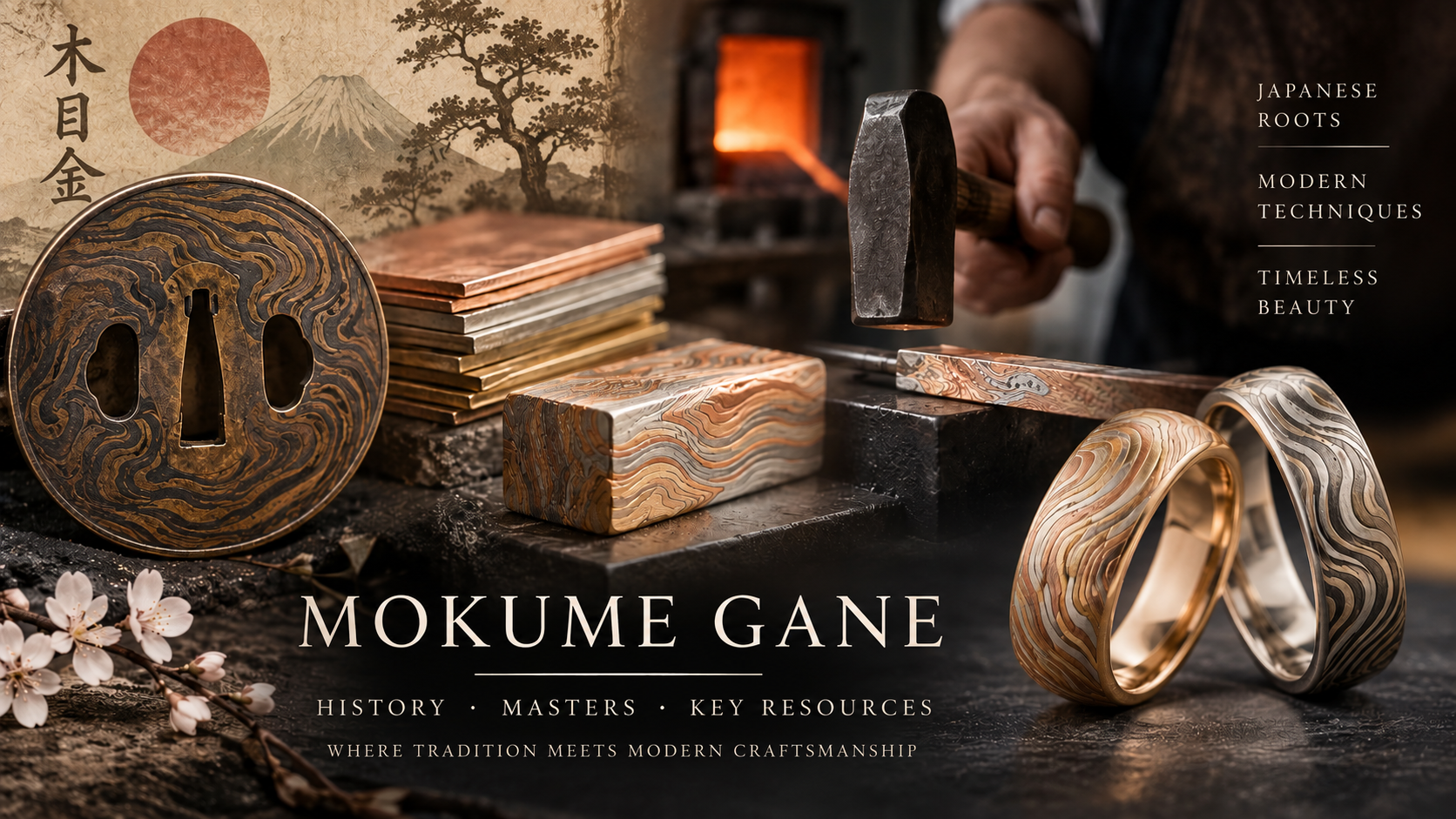
Today, Mokume Gane is primarily associated with extraordinary rings and jewelry. However, the roots of this metalworking technique stretch back several centuries. Its development traces back from Japanese metalcraft of the Edo period, through a rediscovery and intensive research in the 20th century, to today’s goldsmiths, who produce Mokume Gane using modern furnaces and precisely controlled processes.
There is no single person to whom today’s technique is solely attributable. Several generations of metal artisans, researchers, and goldsmiths have contributed to preserving historical knowledge, refining production methods, and making Mokume Gane known internationally.
On this page, we present some of the names and specialized sources that are particularly relevant to understanding this development.
Denbei Shōami – The Japanese Origins
The Japanese metalworker Denbei Shōami, who worked in what is now Akita Prefecture during the 17th and early 18th centuries, is considered an early key figure and founder of Mokume Gane.
Initially, his work was not related to jewelry or wedding rings. In Japan, the artistic design of sword components was highly valued. Metalworkers used various metals and alloys to achieve extraordinary patterns and color effects through layering, working, and patination.
Denbei Shōami is credited with works in which, among other materials, gold, silver, copper, and the traditional Japanese alloy shakudō were combined. The resulting structures resembled the grain of wood.
This appearance eventually gave rise to the term “Mokume Gane,” which literally means “wood grain in metal.”
From Traditional Craftsmanship to an Almost Forgotten Technique
For a long time, Mokume Gane remained closely tied to the highly specialized Japanese metalworking craft. Knowledge was traditionally passed down within workshops and from master to apprentice.
As Japanese society underwent changes in the 19th century, the significance of the traditional sword also shifted. Consequently, many of the highly developed techniques for crafting and decorating sword components lost their original purpose.
However, Mokume Gane did not disappear entirely. Japanese metal artists preserved and further developed the technique.
Hiroko Sato and Eugene Michael Pijanowski
Hiroko Sato Pijanowski and Eugene Michael Pijanowski have played a special role in the modern spread of Mokume Gane outside Japan.
In 1970, the two saw a Mokume Gane vessel by the metal artist Gyokumei Shindo at an exhibition of traditional Japanese crafts in Tokyo. What struck the Pijanowskis in particular was that such a heavily deformed vessel had been created from a permanently bonded, multilayered metal material.
They subsequently immersed themselves in the traditional techniques and were in contact with Japanese metal artists such as Gyokumei Shindo, Masahisa Yagihara, and Norio Tamagawa, among others.
After returning to the U.S., Hiroko and Eugene Pijanowski made significant contributions to spreading knowledge about diffusion-welded mokume gane. They published scholarly articles, held workshops, and participated in research on suitable metal combinations and manufacturing processes.
As a result, mokume gane became increasingly accessible to Western goldsmiths and metal artists as well.
The Modern Development of Mokume Gane
In the decades that followed, the technique underwent intensive further development. Various workshops developed their own methods for assembling, joining, and further processing the metal blocks.
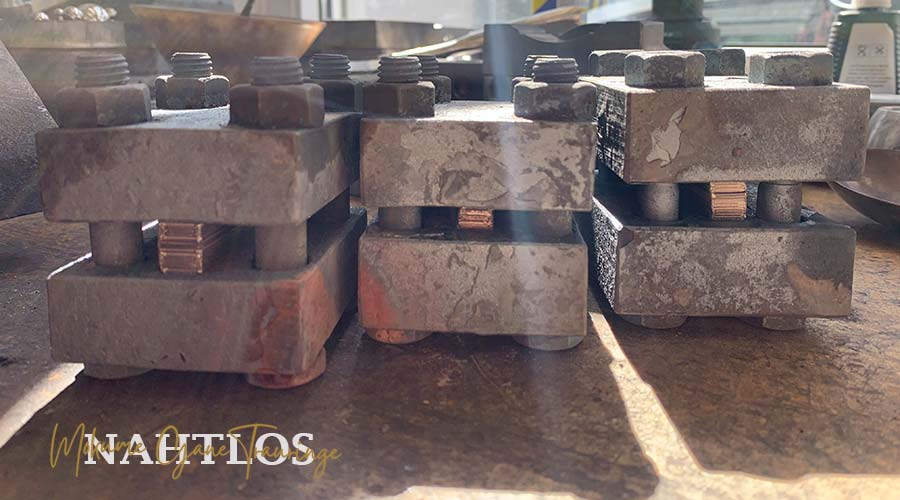
An important development was the use of bolted pressure plates, which allowed the individual metal layers to be held together in a controlled manner during the bonding process. At the same time, modern furnaces and electronic temperature controls improved the reproducibility of the processes.
The materials used also changed. In addition to traditional Japanese metal combinations, precious metals and gold alloys of various colors were increasingly employed.
As a result, Mokume Gane evolved from a historical Japanese metalworking technique into a material that is used today by specialized goldsmiths and metal artists around the world.
James Binnion – Mokume Gane in an Electrically Controlled Furnace
Among the internationally renowned specialists is the American metal artist James Binnion.
His work and publications focus, among other things, on the production of Mokume Gane in electrically heated and precisely controlled furnaces. Precise temperature control allows for extended holding times and thus controlled diffusion processes between the individual metal layers.
His experiences were also incorporated into the reference book *Mokume Gane: A Comprehensive Study* by Steven Midgett.
Robert Coogan – Mokume Gane from the Forge
Robert Coogan, on the other hand, represents a different modern production method. He worked with gas-fired forge furnaces and further developed the production of larger Mokume Gane blocks.
Coogan learned the basics of the technique in the late 1970s from Eugene and Hiroko Pijanowski. His work clearly demonstrates that different technical approaches can lead to a permanently bonded Mokume Gane material.
This is also important for understanding Mokume Gane: there is no single, universally applicable manufacturing process. Metal combinations, temperature control, pressure, and available workshop equipment all influence the specific method used.
Steven Midgett – Mokume Gane Comprehensively Documented
One of the most interesting contemporary authors on the subject is the American goldsmith Steven Midgett. Under the name Steven Jacob, his workshop has been intensively engaged in creating Mokume-Gane jewelry since 1989.
Midgett published *Mokume Gane: A Comprehensive Study*, an extensive reference book on the history, metallurgy, and practical production of Mokume Gane.
It is particularly interesting that the work is now available online in its entirety and free of charge. It contains chapters on the history of the technique, suitable metals, metallurgical fundamentals, preparation of the layered block, various joining methods, furnaces and tools, as well as the development of the actual Mokume Gane patterns.
In addition, the book features contributions and insights from other internationally renowned Mokume Gane specialists, including James Binnion, Robert Coogan, Hiroko Sato, and Eugene Michael Pijanowski.
For goldsmiths, metal artists, and anyone who wishes to delve deeper into the technical aspects of Mokume Gane, this collection is an exceptionally comprehensive English-language reference source.
The complete work is freely available on Steven Jacob’s website:
Steven Midgett: Mokume Gane – A Comprehensive Study
Historical Knowledge and Modern Workshop Practice
The history of Mokume Gane beautifully illustrates how traditional craftsmanship can continue to evolve. The fundamental idea—permanently fusing metals of different colors to create a visible grain pattern—dates back centuries.
The technical possibilities, however, have changed significantly. Modern temperature controls, precisely prepared metal alloys, and controlled workflows now enable a level of process reliability that was not available to historical metalworkers in this form.
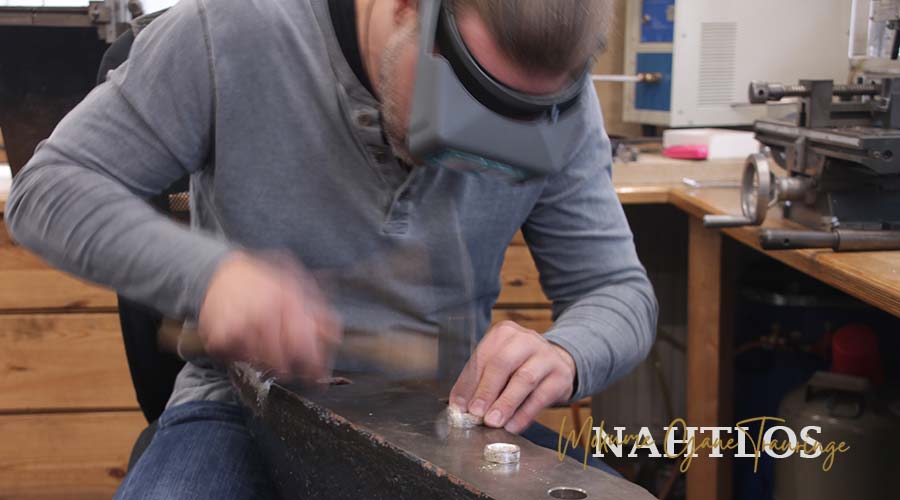
Nevertheless, Mokume Gane remains a true goldsmithing craft. After all, the finished metal block is only the beginning. The actual appearance is created through forging, rolling, shaping, carving, and the experience of the artisan working the material.
How We Produce Mokume Gane Today
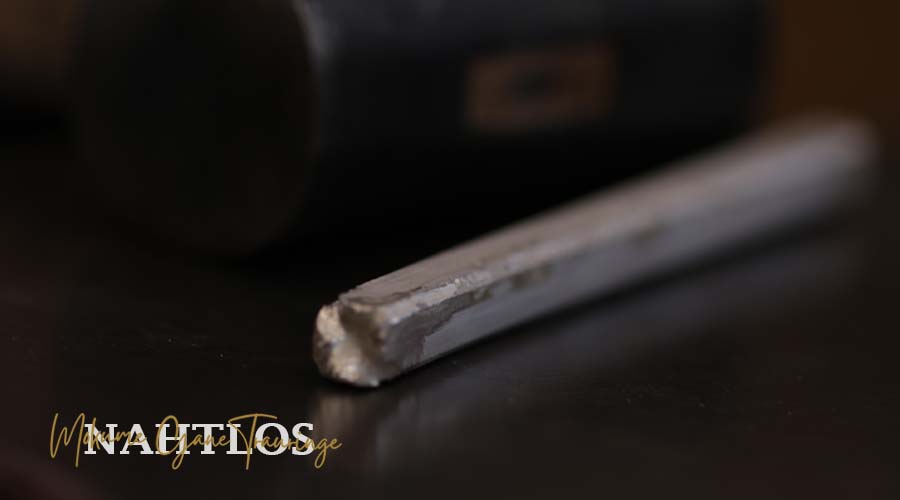
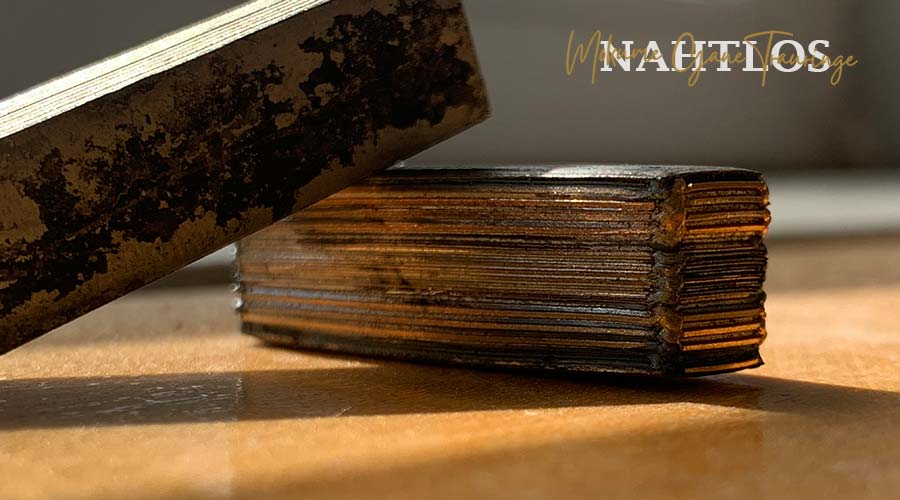
In our goldsmith’s workshop, too, we produce our own Mokume Gane material. Different sheets of precious metal are prepared, assembled into a layered block, and permanently bonded together through diffusion welding.
The resulting metal composite is then further forged, rolled, and patterned in a controlled manner. Only through this process do the lines, waves, and structures emerge that will later be visible on the finished piece of jewelry.
We explain in detail how this process works—and why we don’t simply “fold” Mokume Gane—in our article “Mokume Gane—The Art of the Masters.”
From the Mokume Gane Block to a Seamless Ring
For us, our exploration of Mokume Gane doesn’t end with the creation of the patterned material. What matters most is what is ultimately created from it.
Our Mokume Gane wedding rings are crafted seamlessly. This ensures there is no seam where the continuous grain pattern is interrupted. The pattern can flow uninterrupted all the way around the ring.
We particularly appreciate the symbolism associated with this in wedding rings: the closed ring with no beginning and no end represents a lasting bond—and in a seamless ring, this concept is also visibly reflected in the craftsmanship.
Learn more about our manufacturing process under SEAMLESS—our special technique for Mokume-Gane rings.
Mokume Gane Today
What began as a specialized Japanese metalworking technique has since evolved into an international form of sophisticated metal design. Nevertheless, Mokume Gane remains a decorative style that cannot be reproduced industrially at will.
Material selection, the creation of the layered block, temperature control, pattern development, and shaping are all directly intertwined. At the same time, each metal block being worked develops its own unique structure.
For us, this is precisely what makes this technique so fascinating: centuries-old knowledge meets modern metallurgy and the goldsmith’s unique artistic touch.
You’ll find a selection of our various patterns and precious metal combinations in our Mokume Gane rings and wedding bands.
Further Resources on Mokume Gane
Those who wish to delve deeper into the history and technique will find extensive material, particularly in the works of the goldsmiths and metal artists mentioned above. A particularly comprehensive, freely accessible source is:
Steven Midgett: Mokume Gane: A Comprehensive Study
Read the complete English-language reference book online
In addition to Midgett’s own contributions, the book also includes expertise and contributions from James Binnion, Robert Coogan, Hiroko Sato, and Eugene Michael Pijanowski, thereby combining historical research with various practical manufacturing techniques.