



What Makes Unique Wedding Rings Truly Special
Unique wedding rings don’t have to be flashy, extravagant, or overly trendy. Often, what makes them special lies in a detail that only becomes apparent upon closer inspection: a distinctive grain, an unusual material, a personal story, or the way the rings were crafted.
While classic wedding bands are often chosen based on shape, color, and precious metal, the decision to choose an extraordinary pair of rings often begins with a different question: What should these rings symbolize for us? For some couples, it’s the artisanal craftsmanship; for others, it’s a traditional material or a finish that cannot be replicated exactly.
We therefore do not view the models shown here as fixed products. They serve as inspiration and demonstrate the creative and artisanal possibilities that exist. In a personal consultation, we’ll determine which of these options best suit your vision, your hands, and your everyday life.
Distinctive Patterns Through Mokume Gane
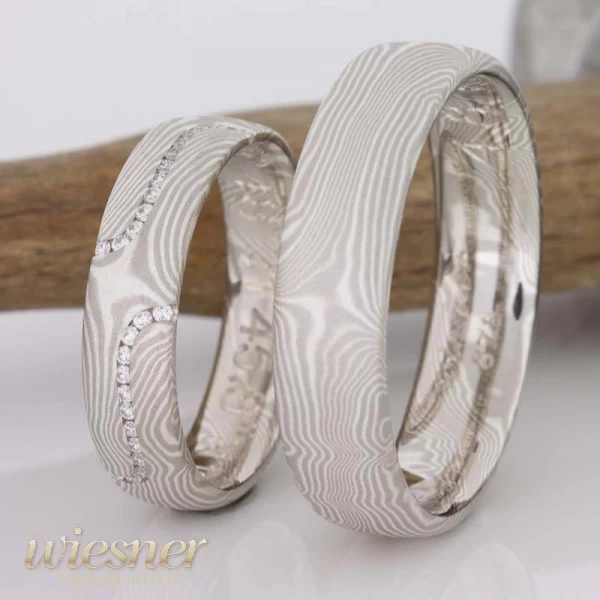
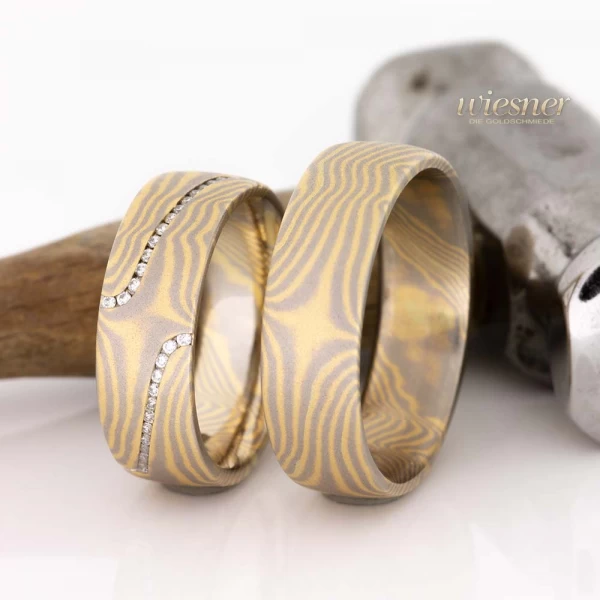
In Mokume Gane, different precious metals are permanently fused together and then forged and shaped. This process reveals layers and lines reminiscent of the grain of wood, flowing currents, or natural landscapes.
What makes this technique special is not just the method itself. The key is that the grain pattern emerges during the handcrafted process. As a result, every pair of rings has its own unique pattern. The combination of materials, ring width, profile, and surface finish also influence whether the pattern appears calm, delicate, high-contrast, or vibrant.
You can find a detailed overview of the technique, the various precious metal combinations, and our designs under the Mokume Gane Rings .
Damascus Steel Rings with Striking Patterns
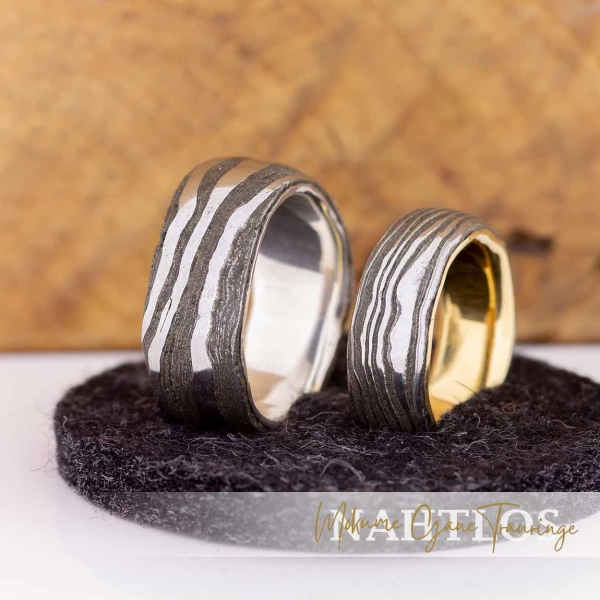
Damascus steel has a distinctive, often striking character. The structure and processing of the steel reveal lines, waves, or eye-like patterns. Depending on the design, the effect can be technical, rustic, minimalist, or particularly high-contrast.
Combinations with gold, silver, or other materials add further accents. This allows damask steel rings to be designed in a style that is either very minimalist or deliberately elegant. They are particularly popular with couples who prefer a robust-looking material and a clearly visible structure.
You can find examples and more information in our Damascus Steel Rings category .
Forging Your Own Wedding Rings—A Shared Memory
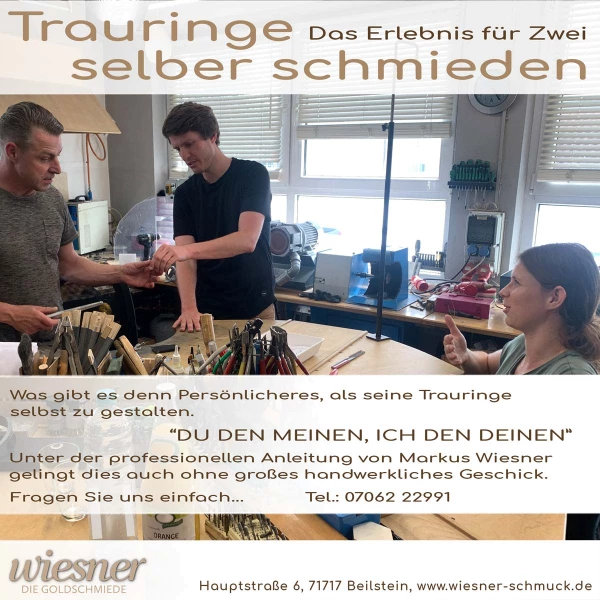
A ring can be extraordinary not only because of its appearance, but also because of how it was created. By crafting your wedding rings together, you become part of this process yourselves.
Under expert guidance, you’ll work with the materials prepared for your pair of rings and experience how your personalized wedding rings take shape through each step of the process. No prior crafting experience is required. The design, materials, and process will be discussed together beforehand.
For more information about the experience and the process, see Forging Your Own Wedding Rings.
Wedding Rings Made from Family Gold or Recycled Gold
Inherited or long-worn jewelry often holds a significance that goes far beyond its mere material value. When this gold is used to create new wedding rings, a part of the family’s history can be woven into your shared life together.
Whether the existing material can be processed directly and what additions are advisable or necessary depends on its alloy, composition, and condition. That’s why we first carefully examine the family gold you bring in and then discuss the design and craftsmanship options.
You can learn more about the inspection, processing, and design on the page Wedding Rings Made from Family Gold or Recycled Gold .
Which unique wedding rings are right for you?
The choice depends less on which pair of rings seems the most unusual. What’s more important is what kind of uniqueness suits you.
- Do you love flowing, natural textures? Then Mokume Gane rings might be right for you.
- Do you prefer a bold, high-contrast look? Then it’s worth taking a look at Damascus steel rings.
- Would you like to experience the creation of your rings together? Then crafting your own wedding rings is a special option.
- Would you like to preserve memories and use existing gold? Then wedding rings made from family gold might be the right choice.
It’s also possible to combine different ideas. For example, an existing family gemstone can be incorporated into a newly designed ring. Similarly, finishes, precious metals, ring profiles, widths, and engravings can all be coordinated.
Personally designed rather than copied exactly
The models on our website showcase examples of designs we’ve already created. They help you compare styles, proportions, materials, and finishes. Your future pair of rings will be finalized in collaboration with you and tailored to your preferences.
In doing so, we consider more than just the desired appearance. A wedding ring is worn every day. That’s why comfort, the ring’s profile, material properties, care, and the possibility of future refurbishment also play an important role.
Artisanal Goldsmithing with Personalized Consultation
Exceptional wedding rings aren’t created by an unusual idea alone. They require expert design and meticulous craftsmanship to ensure that aesthetics and practicality for everyday wear go hand in hand.
At our goldsmith’s workshop, we’ll discuss with you which technique, material, and shape are best suited to your vision. It’s not about cramming as many unique features as possible into a single ring. The goal is a harmonious pair of rings that retains its individual character for many years to come and is a joy to wear.
Frequently Asked Questions About Unique Wedding Bands
Do unique wedding rings have to be particularly eye-catching?
No. A wedding ring can also be unique because of a subtle grain, a personal choice of material, or its creation process. The uniqueness doesn’t have to be visible at first glance.
Can the ring designs shown here be ordered directly?
The designs are primarily intended to serve as inspiration and showcase various design possibilities. The specific details, materials, and dimensions will be determined during a personal consultation.
Can each design be customized?
The possible customizations depend on the specific technique and design. Often, the ring’s width, profile, finish, material combination, diamond setting, and engraving can be customized.
Are unique wedding rings suitable for everyday wear?
When designing, we ensure that the rings not only look unique but are also suitable for daily wear. The specific durability and care requirements depend on the material and design.
Can existing gold be combined with other materials?
This may be possible depending on the composition and condition of the existing material. Therefore, family heirloom gold or scrap gold is first examined before a recommendation is made.
Discover the path to your own unique pair of rings
Let our designs and the four different options inspire you. If you already have an idea or would like to find out which technique is right for you, please contact us via our contact form or by phone.
Together, we’ll use your ideas to create a pair of rings that not only look extraordinary but also hold personal meaning for you.
Frequently Asked Questions About Unique Wedding Rings
What Makes Wedding Rings Unique?
Unique wedding rings don’t necessarily have to be particularly eye-catching. For us, what makes a ring unique is when it doesn’t simply follow a standard design, but rather reflects the personalities of the people who wear it.
This can be achieved through an unusual material, a special forging technique, a custom finish, or an extraordinary combination of different precious metals. A ring’s personal history can also make it unique—for example, when family gold from existing jewelry is incorporated into the new wedding rings.
The way the rings are created can also be special: Some couples have us custom-craft their wedding rings, while others forge their own wedding bands right here with us.
“Extraordinary” therefore doesn’t necessarily mean “extravagant.” A ring can be very understated in appearance and still have a story that no other pair of rings shares.
Do extraordinary wedding rings have to be flashy?
No. Unusual wedding rings can look spectacular, but they don’t have to.
Some couples want clearly visible textures, strong color contrasts, or unusual materials. Others prefer simple rings whose uniqueness only becomes apparent upon closer inspection or through their story.
One example of this is wedding rings made from family heirloom gold. A gold ring that appears simple on the outside may be crafted from pieces of jewelry once worn by parents or grandparents. Its uniqueness then lies not in an eye-catching design, but in its personal significance.
For us, therefore, it isn’t what matters how unusual a ring looks at first glance. What matters is that the design, material, and story suit the person wearing it.
How are wedding rings created that not everyone has?
With custom-made wedding rings, the process doesn’t simply involve ordering an existing model in the right ring size.
Rather, the starting point is the couple’s vision. Together, they can coordinate the material, color, band width, profile, finish, pattern, engravings, and, if desired, diamonds.
With artisanal techniques such as Mokume Gane or damascening, another factor comes into play: the structure emerges as the material is worked. As a result, each pair of rings develops its own unique character.
The result is wedding rings that are not simply variations of a mass-produced model, but are crafted specifically for their future wearers.
What materials are suitable for unique wedding rings?
Unique wedding rings can be crafted from classic precious metals as well as from unusual combinations of materials.
Gold in various shades, platinum, palladium, or silver already offer numerous possibilities. The design becomes particularly interesting when different metals are combined or traditional forging techniques are used.
In Mokume Gane, different layers of precious metals are fused together and crafted into unique grain patterns. Damascus steel also derives its distinctive character from its layered structure.
Existing family heirloom gold can also—provided the material is suitable—be incorporated into new wedding rings.
Which material is appropriate therefore depends not only on the desired look. Everyday life, wearing habits, skin compatibility, the desired ring shape, and future customization options also play a role.
Why is Mokume Gane particularly well-suited for unique wedding rings?
Mokume Gane is particularly well-suited for couples who want wedding rings with a unique and one-of-a-kind pattern.
This traditional Japanese forging technique permanently bonds different precious metals together. The subsequent finishing process creates flowing lines and grain patterns reminiscent of natural wood.
The pattern is not applied to the ring afterward but arises from the material itself. That is why each pair of rings develops its own unique grain.
In our goldsmith’s workshop, we also craft Mokume Gane rings using our seamless technique, so that the pattern continues around the ring without any visible seams or interruptions.
You can learn more about the manufacturing process, materials, durability, and design in our detailed section on Mokume Gane rings and wedding bands.
What makes Damascus steel rings special as wedding rings?
Damascus steel has a distinctive structure created by layers of steel fused together. Further processing reveals this structure, giving each ring its characteristic pattern.
As a result, Damascus wedding rings can appear very different depending on the pattern—ranging from calm and linear to lively and expressive.
The combination of Damascus steel with gold or other design elements is also particularly interesting. This allows the cooler tones of the steel to be paired with the warm colors of precious metals.
Damascus wedding rings are therefore particularly well-suited for couples seeking an alternative to the classic gold ring and who value a clearly visible, handcrafted texture.
Can unique wedding rings be made from family heirloom gold?
Yes. Existing family gold can give unique wedding rings a significance that is virtually impossible to replicate with newly purchased material.
Jewelry from parents, grandparents, or other family members can—depending on the alloy, quality, and planned design—be repurposed for new wedding rings.
This doesn’t necessarily mean the old jewelry has to simply disappear. Depending on the design, the family gold can be intentionally integrated into the new rings so that it remains visible.
One particularly interesting option, for example, is combining it with Mokume Gane: Suitable family gold can become part of a multicolored Mokume Gane pattern as a single visible gold line.
In this way, the new wedding ring not only symbolically but also literally incorporates material from your own family history. You can learn more about these options under Wedding Rings and Jewelry Made from Family Gold.
What happens to our old gold if it cannot be reprocessed?
Not every piece of existing jewelry is technically suitable for direct reuse in a new wedding ring.
However, that doesn’t mean the material is worthless. If the old or family gold you bring in cannot be meaningfully used for the desired design, we can credit you for the material’s value and offset it against the cost of the new wedding rings.
Before beginning production, we therefore first examine the available material and discuss whether direct processing or a credit is the more sensible solution.
Can we bring our own ideas for our wedding rings?
Absolutely. We expressly encourage you to share your own ideas for a custom-made piece.
These can be photos, drawings, molds, specific materials, colors, or simply an idea that hasn’t yet been translated into a concrete ring design.
Our job as goldsmiths is then to work with you to figure out how this vision can be realized in a technically sound way.
Not every idea can be realized exactly as it appears on paper. Material properties, durability, and suitability for everyday use must also be taken into account. However, it is often precisely this exchange of ideas that leads to solutions you wouldn’t have come up with using a ready-made ring configurator.
What distinguishes custom-made wedding rings from rings created using a configurator?
A ring configurator offers many possibilities but remains within a predetermined system. For example, you select the ring width, material, finish, gemstone setting, or engraving from available options.
With a custom goldsmith creation, on the other hand, the process begins with the couple’s ideas.
Material, shape, finish, patterns, and details can be developed and coordinated together. Existing family heirlooms, unusual material combinations, or special artisanal techniques can also be incorporated into the design.
A configurator, therefore, customizes an existing system. A bespoke, handcrafted piece, on the other hand, can begin with an idea for which no ready-made model yet exists.
Do the bride’s and groom’s wedding rings have to look the same?
No. Wedding rings do not have to be identical to be a matching pair.
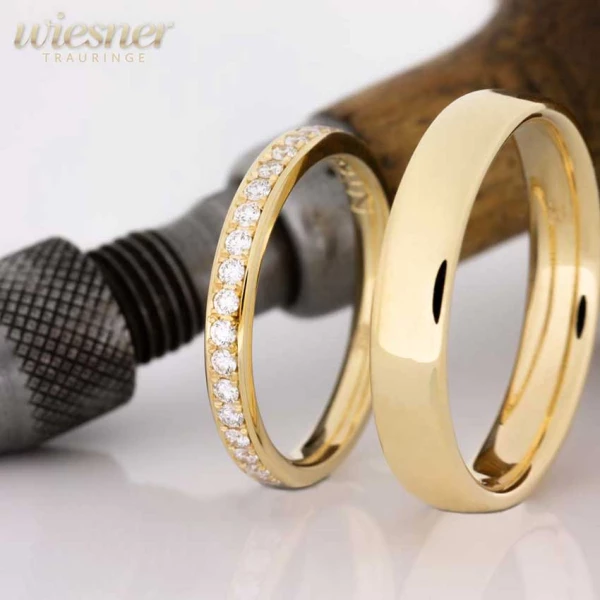
Different ring widths, profiles, or finishes can make sense because hands, tastes, and wearing habits vary. For example, diamond setting can be incorporated into only one of the two rings.
Nevertheless, both rings can be connected through a shared material, a similar shape, the same grain pattern, or a recurring design element.
This is why, especially with custom-made wedding rings, it’s possible to develop a shared design language without either partner having to wear a ring that doesn’t really suit them.
What finishes and textures make wedding rings special?
The surface has a greater impact on the appearance of a wedding ring than one might initially assume.
Polished surfaces have a different effect than matte, forged, or intentionally textured surfaces. Contrasts between different surfaces can also be used to highlight specific areas of a ring.
With Mokume Gane or damask, the texture also arises from the multi-layered material itself. As a result, patterns and surfaces are not merely decorative but an integral part of the ring’s artisanal creation.
The choice of finish depends not only on the desired look but also on the material and the daily life of the future wearer.
How can diamonds be incorporated into a wedding ring in an extraordinary way?
Diamonds do not necessarily have to be set individually and centered in a wedding ring in the traditional way.
The number, size, and position of the stones can become part of the overall design. Especially with textured rings, it can be particularly appealing when the diamond setting echoes existing lines and shapes.
In our Mokume Gane rings, for example, we like to set several small diamonds in a channel setting so that they follow a line within the grain pattern.
As a result, the diamond setting doesn’t look like an afterthought but becomes part of the pattern and the ring’s overall design.
Can we forge our own unique wedding rings?
Yes. Couples can forge their own wedding rings in our goldsmith’s workshop.
Under expert guidance, they create their own wedding rings step by step from the raw material. No prior knowledge of goldsmithing is required.
What makes this special isn’t just the finished pair of rings—the process of creating them also becomes part of your shared history.
For couples who value individuality not only in the design but also want to actively help shape and craft their wedding rings themselves, making your own rings is therefore a particularly personal option. Learn more under “Make Your Own Wedding Rings.”
Are unique wedding rings suitable for everyday wear?
They should be. After all, an extraordinary wedding ring isn’t a piece of jewelry meant to be worn only on special occasions.
That’s why we don’t just consider the appearance when designing them. The ring’s profile, width, material, finishes, gemstone settings, and construction must also be suited to the future wearer’s daily life.
Someone who does manual labor every day may have different requirements for a ring than someone whose hands aren’t subjected to as much physical strain.
For us, good, personalized design doesn’t mean cramming as many unusual elements as possible into a ring. The ring should be unique yet still comfortable to wear for many years to come.
Do extraordinary wedding rings eventually go out of style?
That depends less on how unique a ring is than on why it was designed that way.
A ring that follows only a short-lived fashion trend may be perceived differently after a few years. A ring whose design stems from the wearer’s personal vision, a special material, or a personal story works differently.
Mokume Gane, family heirloom gold, or a custom design aren’t special simply because they’re currently in style.
That’s why, when creating custom wedding rings, we don’t try to produce the most spectacular effects possible. The goal is a ring whose uniqueness still suits its wearers even after many years.
How much do custom-made, unique wedding rings cost?
There is no meaningful standard price for unique wedding rings because the materials and the complexity of production can vary greatly.
Key factors include the precious metals used, the ring’s width and thickness, the desired manufacturing technique, finishes, diamonds, or other gemstones, as well as the effort involved in custom production.
Existing family gold can also influence the cost estimate—either because it is used directly in the design or because its material value can be credited toward the cost of the new rings.
After an initial consultation and once the materials and design have been finalized, we can therefore provide a much more accurate estimate of the cost for the desired pair of rings.