
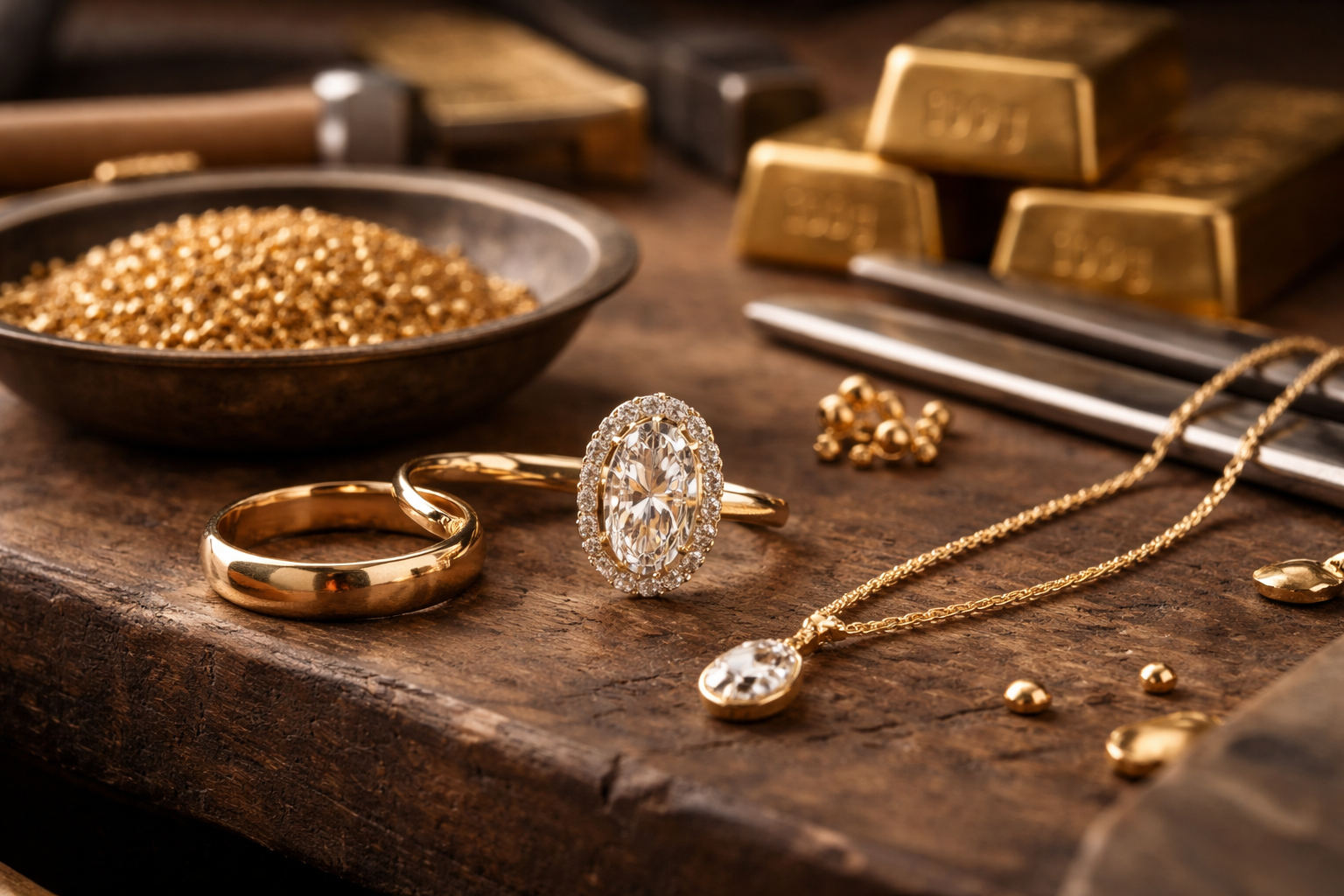
First published on January 28, 2026 · Comprehensively revised and fact-checked on September 19, 2026 · Featured image: AI-generated illustration
What a High Gold Price Really Means for Jewelry
The price of gold has reached exceptionally high levels in recent years and has at times set new records. For investors, this is news from the financial markets. For us as goldsmiths, however, the price of gold is directly linked to the material we use every day.
This is because, in a piece of jewelry, gold is not just a color and a design element, but also has real material value. When the price of gold rises, so do the material costs for gold jewelry and wedding rings.
However, the equation isn’t quite as simple as “the price of gold rises—jewelry becomes just as much more expensive.” The price of a handcrafted piece of jewelry consists of much more than just the market value of the gold it contains.
The price of gold is not the price of a piece of jewelry
On international markets, the price of fine gold is traded. It is usually quoted per troy ounce—one troy ounce is equivalent to approximately 31.1 grams.
Jewelry, on the other hand, is rarely made from pure fine gold. In our goldsmith’s workshop, we primarily use gold alloys, such as 585 or 750 gold.
- 585 gold contains 58.5 percent fine gold.
- 750 gold contains 75 percent fine gold.
- 999 or 999.9 gold is nearly pure fine gold.
The remaining portion of a jewelry alloy consists of other metals. Depending on the composition, this results in, for example, yellow gold, rose gold, or light-colored gold alloys. At the same time, hardness, workability, and other technical properties change.
If you’d like to know more about the differences between fine gold and the various gold alloys, check out our detailed guide on gold and fine gold in jewelry making.
How much does the price of gold affect the price of jewelry?
That depends primarily on how much gold is in a piece of jewelry.
For a solid, heavy gold ring, the material cost naturally accounts for a larger portion of the total price than for a very delicate piece of jewelry. For elaborate custom-made pieces, however, many other factors come into play:
- design and customization,
- labor time in the goldsmith’s workshop,
- alloy and material preparation,
- forging, rolling, soldering, and other production steps,
- surface finishing and polishing,
- Diamonds and other gemstones,
- Setting and engraving.
That’s why, when purchasing a handmade piece of jewelry, you’re never simply paying for a certain number of grams of gold.
Gold has a measurable material value. The value of the finished piece of jewelry is further enhanced by its design, craftsmanship, and—especially in the case of custom-made jewelry—its personal significance.
Why does the price of gold fluctuate in the first place?
The price of gold is determined on international markets and is influenced by numerous factors. These include, among other things, supply and demand, interest rate and currency trends, purchases and sales by major market participants, as well as economic and geopolitical uncertainties.
That is why the price of gold can change significantly within a relatively short period of time.
However, predicting whether the price of gold will be higher or lower tomorrow, in a year, or in ten years is not part of our work. We are goldsmiths, not investment advisors.
For our workshop, what matters most is what the precious metal actually costs at the time we purchase the material.
What does a high gold price mean for a goldsmith’s work?
Gold is one of our most important materials. Consequently, we notice price changes immediately when purchasing materials.
However, this does not mean that when the price of gold is high, we suddenly start producing thinner or lower-quality jewelry. The material thickness, construction, and alloy must still be appropriate for the specific piece of jewelry and the demands it will face.
This is especially important for wedding rings. They are worn every day and are meant to last for many years. A ring must therefore not be designed solely to contain as few grams of gold as possible.
It makes more sense to create a design in which the material, dimensions, comfort, and craftsmanship all work together.
585 or 750 gold—does the price of gold make a difference?
Yes. At 75 percent, 750 gold has a higher fine gold content than 585 gold, which has 58.5 percent. For the same weight, a piece of jewelry made of 750 gold therefore contains more fine gold.
However, the material value isn’t the only difference between gold alloys. Color, hardness, and finish can also vary. That’s why the choice of an alloy shouldn’t be based solely on the current price of gold.
Especially for jewelry intended to be worn for many years or even a lifetime, it is crucial to choose an alloy that is technically and aesthetically suited to the specific piece.
We demonstrate just how different gold can look depending on the alloy, for example, in our guide to yellow gold and its properties.
A high gold price makes old gold particularly attractive
The higher the price of gold, the more significant the material value of jewelry that may have been lying unworn in a drawer for years.
Old rings, necklaces, bracelets, coins, or damaged gold jewelry can contain significant amounts of precious metal. There are generally several options available.
Old gold can be returned to the precious metal cycle, and its material value can be credited. We explain in more detail how gold is transformed back into a defined jewelry material in our article on recycled gold in goldsmithing.
But there’s also a second option: existing jewelry can be transformed into new pieces or wedding rings.
Family heirlooms are worth more than just their gold value
Existing gold becomes particularly interesting when it is tied to personal memories.
Grandparents’ old wedding rings, a ring that belonged to one’s mother, or jewelry from both sides of the family often possess, in addition to their material value, an emotional value that no current gold price can express.
Such family gold doesn’t necessarily have to be sold or simply traded in as scrap gold. Depending on the existing alloy and the desired new piece of jewelry, we can test, refine, supplement, or re-alloy the material and use it to craft new jewelry or wedding rings.
We detail these options on our page “Wedding Rings Made from Family Gold or Scrap Gold.”
Especially when gold prices are high, an interesting distinction becomes apparent: With ordinary scrap gold, the material value may be the primary consideration. With family heirloom gold, however, there is a story attached that cannot be calculated in euros per gram.
Can you save money on new jewelry by using your own old gold?
Existing gold naturally has a material value and can therefore play an economic role in the creation of new jewelry.
However, there’s no one-size-fits-all answer to how significant this savings potential actually is. Key factors include the weight, fineness, and composition of the existing material, as well as how it can be used in the new piece of jewelry.
For example, an old 333 gold ring is not simply the same amount of 750 gold. Different alloys contain different proportions of fine gold. In addition, solders, coatings, or other components may be present that must be taken into account during further processing.
That’s why we first examine the existing material before determining the most appropriate use for it.
Should you sell your gold jewelry or have it remade?
This isn’t just a question of the price of gold.
For jewelry with no personal significance, selling it or returning it to the precious metal cycle may make sense. For pieces with family history, however, you should consider whether you really want to part with them permanently.
Once a ring from your grandparents is sold, it’s gone. If, on the other hand, its material is reworked into a new piece of jewelry, part of its history can be preserved.
That is precisely why, in our goldsmith’s workshop, we do not view old gold solely as a raw material. Sometimes the material value is what matters—sometimes it’s the memories.
Does gold jewelry still make sense when gold prices are high?
Anyone who judges jewelry solely by the market value of the precious metal it contains is considering only part of its value.
A wedding ring isn’t bought with the expectation of selling it for a profit a few years later. It’s worn. The same applies to a custom-made ring, a keepsake, or a piece of jewelry for a special occasion.
Today’s high gold price makes the material content more visible and valuable. Nevertheless, the decision to purchase high-quality jewelry should depend first and foremost on whether the design, material, craftsmanship, and personal significance are right.
What happens if the price of gold falls again?
Gold prices fluctuate. No one can reliably predict how the price will develop in the long term.
If the price of gold falls, this can affect the material costs of new pieces of jewelry. However, the amount of craftsmanship required for a custom-made piece does not change as a result.
A ring still requires a design, labor time, tools, experience, surface finishing, and, if necessary, setting or engraving work.
That is why the price of a handcrafted piece of jewelry does not fluctuate in direct proportion to the price of gold.
Our Conclusion from the Goldsmith’s Workshop
A high gold price changes the framework conditions for gold jewelry—but not the essence of a fine piece of jewelry.
Gold is a valuable material, and when prices are high, its share of the total price carries greater weight. Nevertheless, a custom-made piece of jewelry consists of far more than its pure metal value.
For us, therefore, three things are crucial: an alloy suited to the piece, a construction that makes sense from a craftsmanship perspective, and a design that will bring joy for years to come.
And if you already own gold, you should take a closer look—especially when gold prices are high. Old jewelry can have considerable material value—and family heirlooms sometimes hold even greater personal value.


