Yellow gold: the classic gold color for jewelry and wedding rings
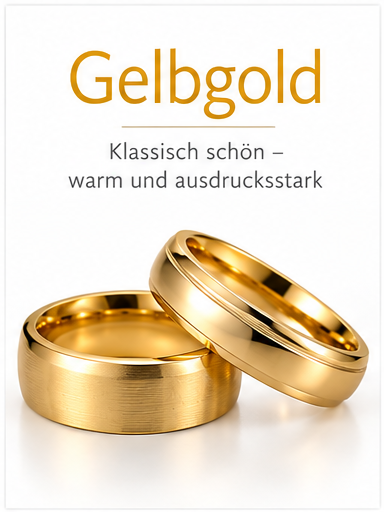
· Illustrations used: AI-generated
Yellow gold is the gold alloy whose color most closely resembles the natural hue of fine gold. However, jewelry is generally not made from pure gold, but rather from alloys whose composition is tailored to the desired color, workability, and intended use.
Typical yellow gold alloys consist of gold and other metals such as silver and copper. The ratio of these metals influences both the workability and the exact shade—ranging from a lighter yellow to a warm, rich golden hue.
What is yellow gold made of?
Yellow gold is not a single, strictly defined alloy. The key factor is the fineness of the gold. In 585 yellow gold, 585 out of 1,000 parts by weight consist of gold; in 750 yellow gold, it is 750 out of 1,000 parts.
Depending on the formula, the remaining components include silver and copper, among other elements. A higher silver content can make the gold appear lighter in tone, while copper adds a warmer to slightly reddish hue to the alloy.
If you’d like to first learn what fine gold is and why gold is alloyed for jewelry, you’ll find the relevant basics there. Silver also plays an important role as an alloying element in classic yellow gold alloys.
585 or 750 yellow gold—what’s the difference?
The most obvious difference lies in the gold content: 585 yellow gold contains 58.5 percent gold, while 750 yellow gold contains 75 percent.
Due to its higher gold content, 750 yellow gold generally has a particularly distinct and rich golden character. In 585 yellow gold, a larger portion of the alloy consists of other metals. Depending on the formula, the color may therefore be slightly lighter or have a different shade.
However, the decision between 585 and 750 should not be based solely on the number. For a piece of jewelry or a ring worn daily, the design, material thickness, finish, desired color, and the specific composition of the alloy also play an important role.
A higher fineness does not therefore automatically mean that an alloy is fundamentally better suited for every piece of jewelry.
How does the typical color of yellow gold come about?
Pure gold naturally has an intense yellow hue. When alloyed, the other components alter this color impression.
Silver can make the gold appear lighter, while copper creates a warmer hue. A balanced composition produces the classic yellow gold tone.
This is precisely where yellow gold differs from other gold colors. In white gold, the gold’s natural yellow color is deliberately lightened significantly, while rose and red gold appear noticeably redder due to a higher copper content.
Yellow Gold from the Perspective of the Goldsmith’s Workshop
For us as goldsmiths, yellow gold is not just a color, but a material. During forging, rolling, soldering, and polishing, it becomes clear just how much the specific alloy influences the working process.
For jewelry worn daily, it all comes down to the interplay of alloy, design, and finish. A solid ring behaves differently in everyday life than a delicate piece of jewelry. Similarly, a high-gloss polished surface shows signs of wear differently than a matte or textured surface.
Even yellow gold develops scratches and signs of wear over time when worn. This is perfectly normal, especially for wedding bands. If necessary, many surfaces can be refinished in a goldsmith’s workshop.
Yellow Gold for Wedding Bands
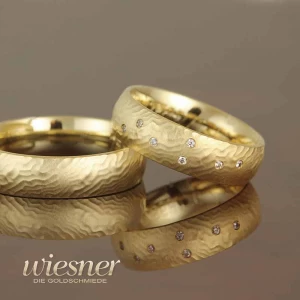
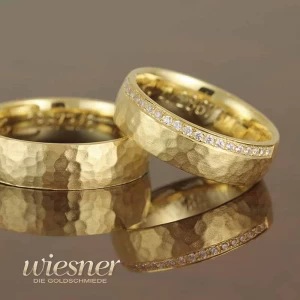
Yellow gold is one of the classic materials for wedding bands. Its warm color is unmistakably recognizable as gold and can be combined with both simple ring shapes and striking finishes, diamonds, and other precious metals. You’ll find a selection of different designs in our Gerstner yellow gold wedding bands.
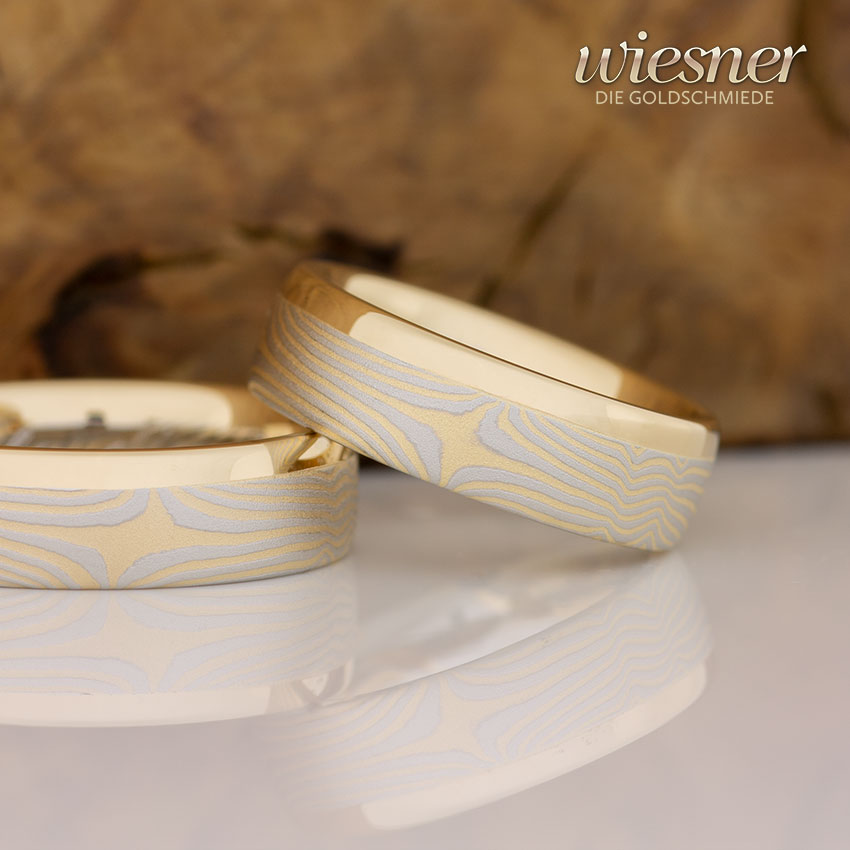
One example of this is the use of yellow gold in wedding bands alongside the lighter precious metal, platinum. The warm yellow gold tone can be used to great creative effect, especially in multicolored and patterned rings.
Yellow Gold and Diamonds
Diamonds can create a striking contrast to the warm hue of yellow gold. It is not just the stone itself that makes an impact, but always the interplay of the precious metal’s color, the setting, the finish, and the ring’s design.
Yellow gold therefore does not have to look exclusively classic. With unusual finishes, modern ring shapes, or strategically placed diamonds, very contemporary pieces of jewelry can be created.
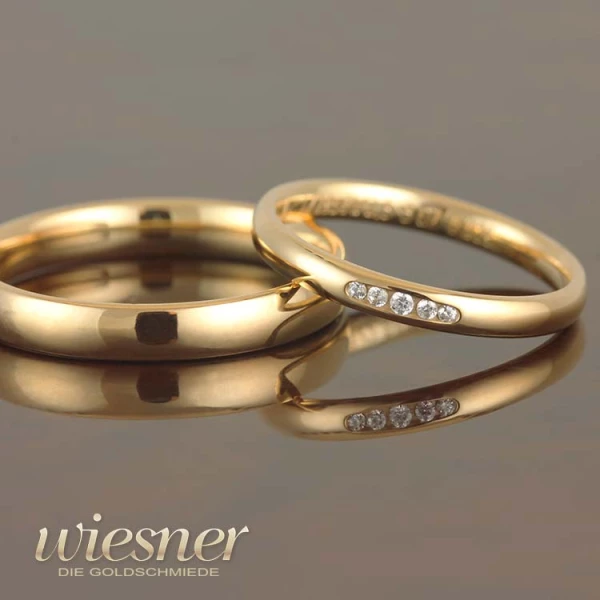
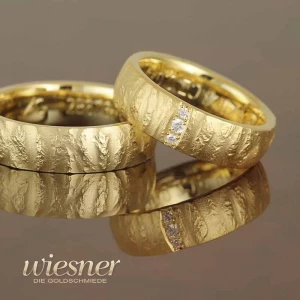
An example of the use of yellow gold in Gerstner wedding rings. Diamonds are also set in them.
Yellow Gold in Mokume Gane
Yellow gold is particularly interesting for Mokume Gane because its warm hue contrasts distinctly with silver, palladium, platinum, or other shades of gold. This makes the forged layers and patterns clearly visible.
Which metal combination makes sense depends not only on the desired look. The alloys involved must also harmonize with one another in terms of craftsmanship and be suitable for the respective manufacturing process.
This is why, especially with Mokume Gane, it becomes particularly clear that the color and technical properties of an alloy cannot be considered separately from one another.
Does yellow gold change color?
Yellow gold does not require an additional coating to achieve its typical yellow color. The hue arises directly from the alloy itself.
Nevertheless, the surface of a piece of jewelry does change over time due to wear. Fine scratches, dulling, and deposits can affect its appearance over time. However, this does not mean that the yellow gold itself loses its fundamental color.
In many cases, the original surface appearance can be restored through professional cleaning or refinishing.
How do you care for yellow gold jewelry?
For routine care, lukewarm water with a mild soap solution and a soft cloth or soft brush are often sufficient for suitable pieces of jewelry.
- Avoid mechanical stress: Rings should be removed during heavy work or activities with a high risk of impact or scratches.
- Do not use highly abrasive cleaners: These can alter polished or matte surfaces.
- Avoid chemicals: Harsh cleaning agents and similar substances should not come into direct contact with jewelry whenever possible.
- Store separately: Pieces of jewelry can scratch each other and should therefore not be stored loose together whenever possible.
- Take gemstones into account: Not every cleaning method suitable for gold is automatically suitable for every set stone.
For frequently worn wedding rings or jewelry with diamonds, it may also be advisable to have the settings and the overall condition of the piece checked occasionally at a jeweler’s workshop.
Is 750 yellow gold better than 585 yellow gold?
Not across the board. 750 yellow gold has a higher gold content and usually a particularly rich golden character. 585 yellow gold contains a correspondingly higher proportion of alloy components and, depending on its composition, may have different color and finishing properties.
Which alloy is a better fit depends on the piece of jewelry and your personal preferences. For wedding rings, factors such as ring width, material thickness, finish, gemstone setting, and the desired gold color play a role in addition to the fineness.
Yellow gold, white gold, or rose gold?
All three are gold alloys. The most important visible difference stems from the composition of each alloy.
Yellow gold retains the classic warm character of gold. White gold is significantly lightened by the addition of specific alloying metals. Red and rose gold derive their characteristic hues primarily from a higher copper content.
Which gold color is the right one is therefore less a question of “better” or “worse” than of personal taste, design, and the desired interplay with other materials.
Conclusion: Yellow gold is much more than just yellow gold
Yellow gold combines the characteristic color of gold with the properties of a carefully formulated jewelry alloy. The fineness, silver and copper content, and the specific formula collectively determine the hue and finish.
For wedding bands and jewelry, yellow gold thus offers many possibilities: from classically polished rings to modern textured surfaces, and even multicolored combinations and Mokume Gane.
From our perspective as goldsmiths, therefore, the number 585 or 750 alone is not the decisive factor. What matters is that the alloy, design, and intended use are well-matched.
Originally published on June 1, 2024; comprehensively revised on September 2, 2026.