
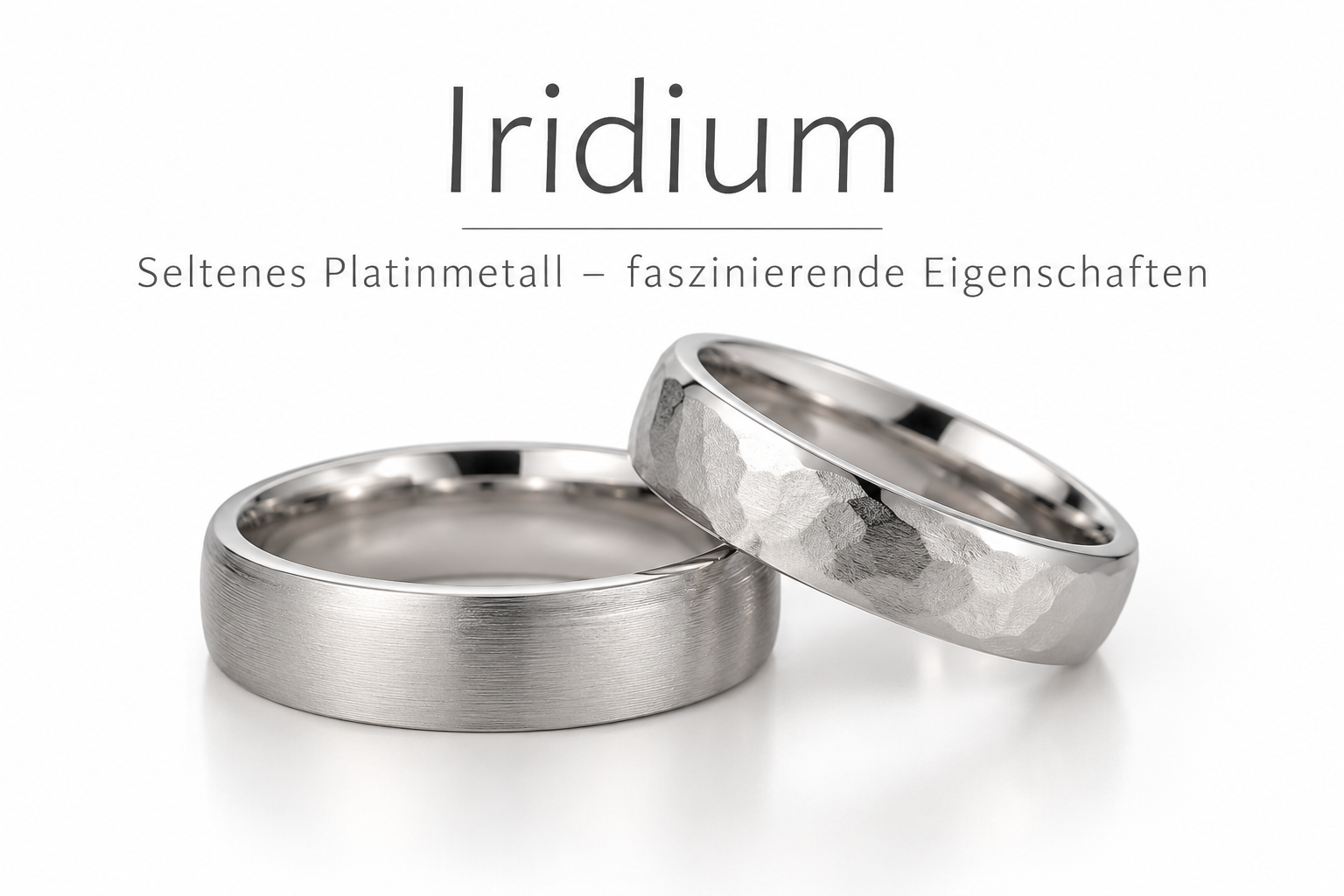
Iridium – A Rare Platinum Group Metal and Alloying Metal Used in Jewelry
First published on June 6, 2024 – comprehensively revised and technically updated on September 14,2026 · Illustrations used: AI-generated
Iridium is one of the rarest metals on Earth. It is exceptionally dense, has a very high melting point, and is highly resistant to chemical attack. Nevertheless, iridium is not typically used as a standalone jewelry metal in jewelry manufacturing.
It becomes particularly interesting as a component in platinum alloys. However, one should be cautious about making simplistic statements such as “iridium makes platinum especially hard”: The properties of a platinum alloy always depend on its overall composition and its state of processing.
What Is Iridium?
Iridium is a chemical element with the symbol Ir and atomic number 77. Together with platinum, palladium, rhodium, ruthenium, and osmium, it belongs to the group of platinum metals.
The pure metal has a silvery-white color. Its high density, high melting point, and exceptional chemical resistance are particularly notable.
In the world of jewelry, iridium is much rarer than platinum or palladium.
When was iridium discovered?
Iridium was discovered in 1803 by the English chemist Smithson Tennant. During his analysis of raw platinum, a dark, insoluble residue remained after treating it with aqua regia.
Tennant was able to isolate two previously unknown elements from it: iridium and osmium.
The name “iridium” derives from the Latin word “iris,” meaning “rainbow.” This was due to the different colors of various iridium compounds.
What are the properties of iridium?
Iridium possesses some extraordinary physical and chemical properties:
- With a density of approximately 22.56 g/cm³, it is one of the densest known metals.
- Its melting point is approximately 2,446 °C.
- It is exceptionally corrosion-resistant.
- Pure iridium is hard yet brittle.
- It has a silvery-white metallic color.
It is precisely the combination of a high melting point, chemical resistance, and brittleness that explains why iridium, despite its rarity, is not simply crafted into jewelry like gold or silver.
Is iridium a precious metal?
Yes. Iridium is classified as a precious metal and belongs to the group of six platinum metals.
This group includes:
- platinum,
- palladium,
- rhodium,
- iridium,
- ruthenium, and
- osmium.
These metals sometimes have very different technical properties. The fact that they belong to the same group of metals does not, therefore, mean that they are interchangeable in goldsmithing.
Why is jewelry rarely made from solid iridium?
The properties that make iridium technically interesting also make it difficult to work with using traditional goldsmithing techniques.
Its high melting point of around 2,446 °C is far above the melting temperatures of traditional gold and silver alloys. Furthermore, iridium in its pure form is brittle and difficult to shape.
For a goldsmith, therefore, solid iridium is not a material that can be forged, rolled, and processed into a piece of jewelry in the traditional way, as gold, silver, platinum, or palladium can be.
Rather, its significance in jewelry lies in its use as a component of certain alloys.
Iridium in Platinum Alloys
A well-known application in the jewelry industry is the alloying of platinum with iridium.
Historically and internationally, for example, platinum alloys containing 90 percent platinum and 10 percent iridium are well known. In addition, there are also alloys with 95 percent platinum and 5 percent iridium.
It is important to note that the iridium content alone does not determine how hard or durable the finished alloy is.
A Pt900/iridium alloy may have different mechanical properties than a Pt950/iridium alloy. Manufacturing processes, forming, and work hardening also influence the material’s behavior.
Therefore, a platinum-iridium alloy should not be generally described as “scratch-resistant” or “extremely hard.”
Does iridium make platinum scratch-resistant?
No. That would be too simplistic.
Even jewelry made from a platinum-iridium alloy will show signs of wear when worn. A ring is constantly exposed to friction, impacts, and contact with harder objects.
Furthermore, different platinum-iridium alloys have different degrees of hardness. A higher fineness or the addition of a particularly hard metal does not automatically mean that the resulting alloy is also as hard as possible.
That is precisely why, at Goldschmiede, we always consider the specific alloy and not just the names of its components.
Iridium or platinum—what’s the difference?
| Property | Iridium | Platinum |
| Chemical symbol | Ir | Pt |
| Density | approx. 22.56 g/cm³ | approx. 21.45 g/cm³ |
| Melting point | approx. 2,446 °C | approx. 1,768 °C |
| Processing | Very difficult in its pure form | Easily workable as a suitable jewelry alloy |
| Significance for jewelry | primarily an alloying metal | A material used on its own for jewelry and wedding rings |
What other platinum alloys are there?
Iridium is by no means the only possible alloying element in jewelry-grade platinum.
Depending on the intended use, metals such as palladium, ruthenium, cobalt, copper, or others are or have been used. This allows for the targeted adjustment of properties such as hardness, castability, formability, and machinability.
That is why the designation “950 platinum” initially only indicates that the alloy consists of 950 thousandths—or 95 percent—platinum. The metals that make up the remaining 50 thousandths can vary.
We explain more about fineness marks in our guide “What Do 585, 750, and 950 Mean?”
Does Wiesner use iridium in Mokume Gane?
Iridium is not a component of our Mokume Gane layer combinations.
For our Mokume Gane rings, we use different combinations of yellow gold, rose gold, palladium, silver, and platinum, depending on the model.
It’s not just the color of a metal that matters. The different alloys must also be technically suitable for welding the layers together, as well as for the subsequent forging and patterning.
Iridium is therefore of interest to our Mokume Gane work primarily as a metallurgical topic within the platinum group, rather than as a visible metal layer in its own right.
Where is iridium used outside of jewelry?
Due to its high resistance to temperature and corrosion, iridium is used for specialized technical applications.
These include, for example, high-stress contacts and components, as well as special alloys. Its historical significance is also noteworthy: The former international meter prototype consisted of an alloy of 90 percent platinum and 10 percent iridium.
For a jewelry guide, however, industrial uses are of secondary importance. What matters most here is iridium’s role as a potential component in special platinum alloys.
Iridium at a Glance
| Chemical Symbol | Ir |
| Atomic number | 77 |
| Group | Platinum group metals |
| Density | approx. 22.56 g/cm³ |
| Melting point | approx. 2,446 °C |
| Color | silvery-white |
| Distinctive Feature | Very high corrosion resistance |
| Use in jewelry | primarily as a component of certain platinum alloys |
| Solid iridium jewelry | Uncommon due to the difficulty of working with it |
| Wiesner Mokume Gane | Iridium is not used as a separate layer |
Frequently Asked Questions About Iridium
Is iridium a precious metal?
Yes. Iridium, along with platinum, palladium, rhodium, ruthenium, and osmium, belongs to the platinum group of metals.
Is iridium heavier than platinum?
Yes. With a density of approximately 22.56 g/cm³, iridium is slightly denser than platinum, which has a density of approximately 21.45 g/cm³. Both are among the densest metals.
Is iridium harder than platinum?
Pure iridium is hard and brittle. However, this does not directly indicate the hardness of a platinum-iridium alloy. Its properties depend on its composition and how it is processed.
Is there jewelry made of iridium?
Solid jewelry made of pure iridium is very rare. In jewelry manufacturing, iridium is primarily used as a component in certain platinum alloys.
What does “platinum-iridium” mean?
This refers to an alloy consisting primarily of platinum and containing iridium as an additional component. Well-known examples include Pt900, which contains about 10 percent iridium, and Pt950, which contains about 5 percent iridium.
Are platinum-iridium rings scratch-resistant?
No. Even these alloys will develop scratches and signs of wear when worn. How durable a ring actually is depends on the specific alloy, craftsmanship, design, and the stresses it is subjected to.
Does Wiesner use iridium for Mokume Gane?
No. Depending on the model, our Mokume Gane layered combinations consist of yellow gold, rose gold, palladium, silver, or platinum.
Our Conclusion from the Goldsmiths
Iridium is a fascinating precious metal, but it is not a typical material that a goldsmith would use to craft a ring. Its high density, enormous corrosion resistance, brittleness, and very high melting point make the pure metal extremely challenging to work with in traditional jewelry making.
Its true significance in jewelry lies in its role as a component of platinum alloys. In this context, iridium illustrates particularly well why one should never deduce the properties of a jewelry alloy solely from the properties of its individual components.
Anyone interested in platinum as a jewelry metal will find the information most relevant to practical use in our guide to platinum. You can find information on other metals and alloys in the Precious Metals section of our guide.