




What is Mokume Gane?
Are there imitations of mokume gane rings?
If you take a closer look at the Internet and some of the stores offering mokume gane rings, you will notice that there are very different versions and qualities of this technique. The Japanese term mokume gane initially means nothing more than "wood-structured metal" and says nothing about the exact manufacturing method and quality of the ring or wedding band described as such.
As we repeatedly encounter this uncertainty in our day-to-day work when advising our customers, we would now like to provide all interested parties with a clarifying overview of the known forms of this technique. For this purpose, we have given a name to the known characteristics in order to distinguish them clearly from each other.
After all, the price of a product is always linked to its quality and the service offered, even over the years.
- Gravo Mokume
- Mokume Cover
- Mokume Seam
- Mokume Seamless
We at "Wiesner - Die Goldschmiede" do not want to presume to declare anything right or wrong. Everything has its justification if it is offered for what it is. However, it is important to us to name the different qualities.
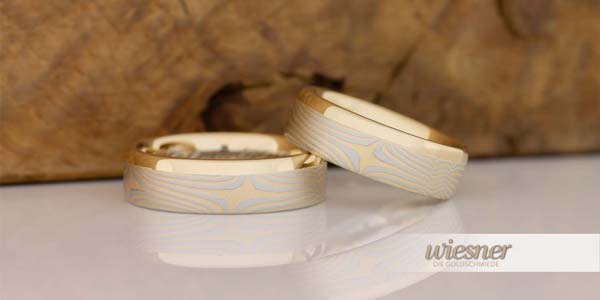
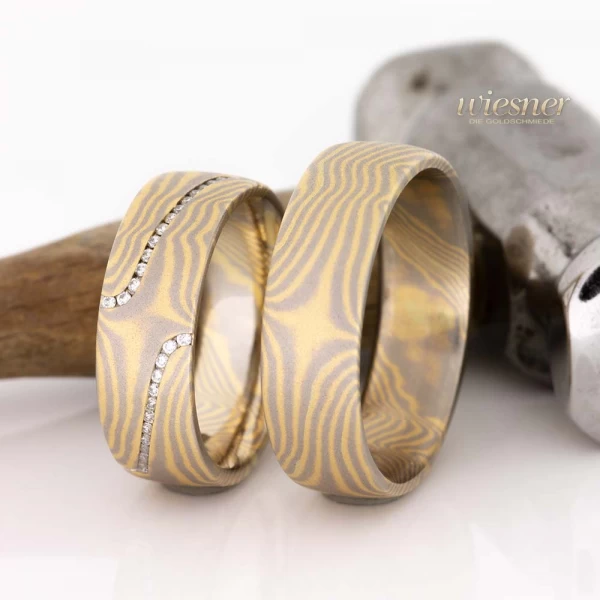
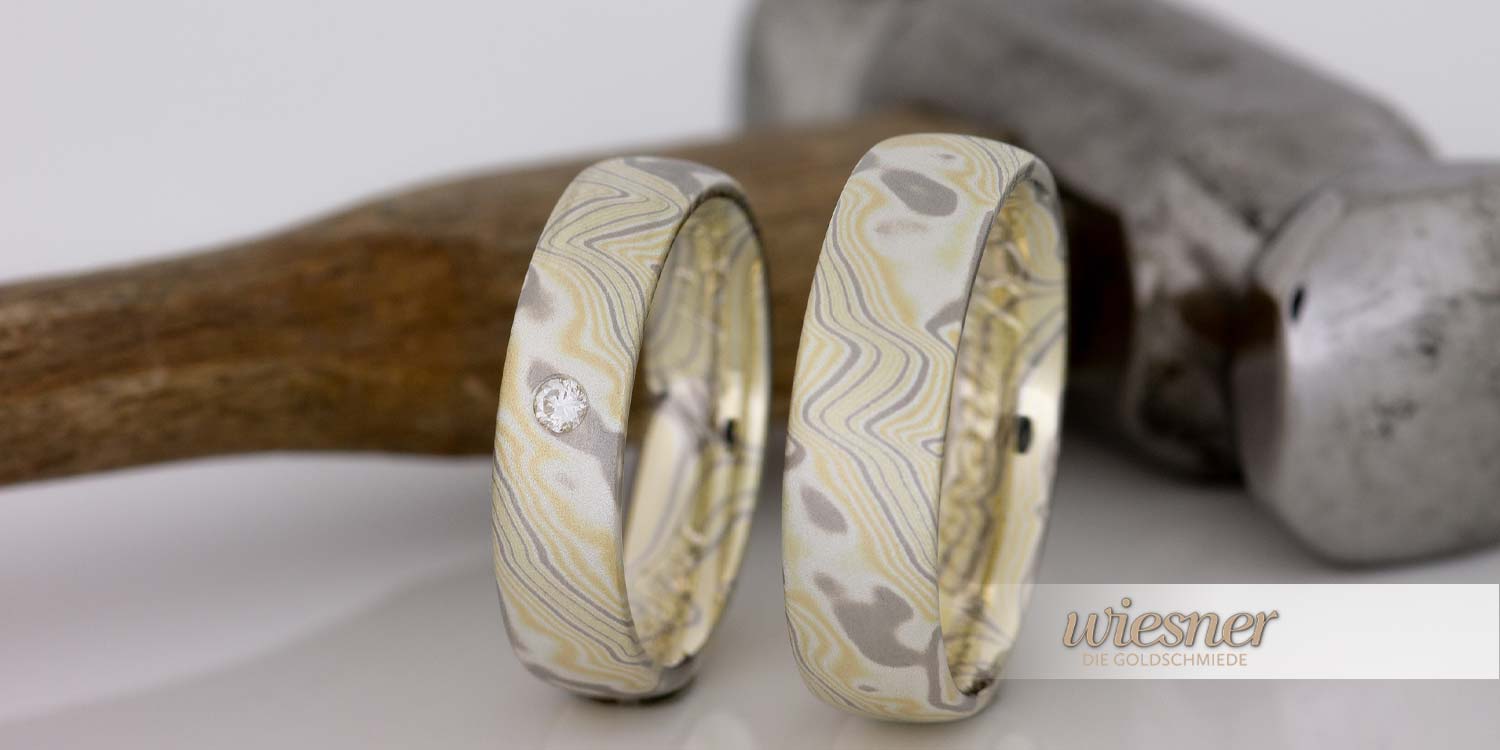
Mokume Gane wedding rings from our workshop in seamless technique:
Gravo Mokume (engraved pattern):
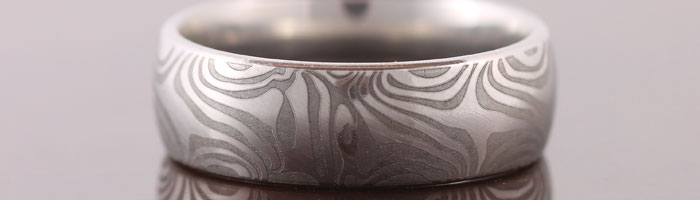
Gravo mokume are rings or wedding rings made of stainless steel, as well as precious metals such as yellow gold, white gold, red gold, etc., which are engraved with a pattern. the pattern of a mokume gane wedding ring is engraved on the surface of the ring. This can be easily recognized by the fact that there is no pattern on the inside of the rings or that the pattern itself is not two-tone. It is possible that an apparent two-tone pattern may have been created by blackening the engraving using a laser or suitable chemicals.
If the engraving is sufficiently deep, it may also be possible to cover the engraving with a second color. For example, by incorporating yellow gold into the engraved pattern of a white gold ring. The production of a wedding ring in GravoMokume is relatively simple and quick. For example, with an engraving laser.
Mokume Cover (Mokume plated):

MokumeCover is a thin, usually 0.5 - 0.8 mm thick Mokume Gane sheet, which is wrapped around an existing stainless steel or precious metal wedding ring and soldered to it. It should be noted that the mokume gane sheets used are usually actually welded and patterned precious metals. Here too, yellow gold, white gold, red gold, green gold, platinum or palladium, as well as silver, may have been used. The combination of copper and silver is also frequently found in mokume covers.
Like GravoMokume, MokumeCover can be recognized first by the fact that the typical pattern on the inside and edges of the wedding rings is not to be found. Another distinguishing feature is the pattern interruption, which is usually present and can be clearly recognized as a transverse line on the outside of the rings. In very rare cases, an endless pattern can also be found.
Compared to GravoMokume, MokumeCover wedding rings are somewhat more complex to produce. It is virtually impossible to change the ring width of MokumeCover wedding rings, especially to extend them.
Mokume Seam (soldered band ring) compared to Seamless:
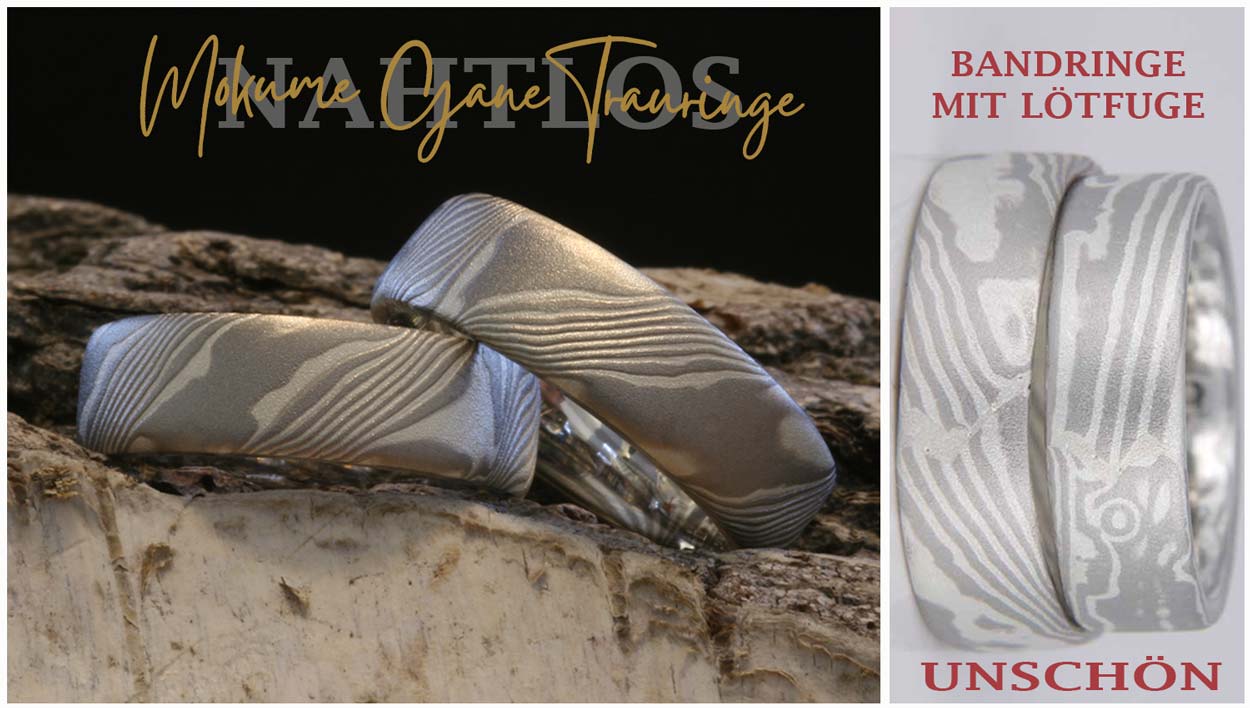
MokumeSeam wedding rings are also known as band rings because of the way they are made in the goldsmith's trade. A mokume gane strand is made from various precious metals, or possibly also non-precious metals, and rolled into a sufficiently long band.
The goldsmith then forges this band into a round ring until the two ends of the band touch. The wedding ring is then soldered there.
This is a tried and tested technique used by goldsmiths to make rings or wedding rings. In this respect, this technique is of course also used in the manufacture of many a mokume gane wedding ring.
Occasionally, we have also been able to find MokumeSeam wedding rings on the web, which have been very skillfully soldered together diagonally in a diagonal pattern. Even an expert has to look closely to recognize this time-saving trick. MokumeSeam wedding rings can cause serious problems when the ring width changes and can break open at the solder joint.
Mokume Seamless
Mokume Gane wedding rings in seamless technique (traditional technique, forged endlessly without a seam)
This is the traditional forging technique for mokume gane wedding rings, as produced by any goldsmith who accepts and masters the challenge of splicing mokume gane material.
Basically, this is the only design that does justice to the symbolism of a wedding ring, namely endlessness. These traditionally made mokume gane wedding rings can be recognized by the pattern that is visible on the inside and outside and runs around the ring without interruption. In addition to the advantage of having no unsightly pattern interruptions, the ring width of endlessly crafted mokume gane wedding rings can easily be changed.
"Wiesner - Die Goldschmiede" exclusively offers Mokume Gane in seamless technique (traditional technique, endless pattern).
Some insights into our Mokume Gane wedding ring workshop Meta: Videos about the Mokume Gane production of wedding rings / Mokume Gane wedding ring production videos from the goldsmith's workshop to illustrate the working methods of master goldsmith Markus Wiesner.
Videos from our goldsmith's workshop:
Production of seamless Mokume Gane wedding rings
1) Mokume Gane wedding rings | The ingot:
Master goldsmith: Markus Wiesner | Music: Michael Wiesner
2) Annealing, rolling, annealing, rolling | How Mokume Gane wedding rings are made
3) Mokume Gane wedding rings | The pattern is applied
4) And forging and rolling again.
5) Marking and drilling the mokume gane rings
What are mokume gane rings?
A special centuries-old Japanese art of forging
The mokume gane technique originated in Japan around 350 years ago. Mokume Gane wedding rings, which are made using this ancient Japanese forging technique, are very special and unique. Mokume Gane wedding rings are created by welding together thin layers of precious metal, which are then forged and patterned. In this way, new and unique patterns and color gradients are created again and again - depending on the precious metals and patterning techniques used. A pair of mokume gane rings is always made from a single piece of welded base material. This makes the two Mokume Gane wedding rings very similar.
Hand-forged in countless different designs
Just as individual as the patterns of the mokume gane rings are, your wedding ring can be made just as individually for you. The ladies' ring, for example, can be embellished with a single diamond or with many small stones.
Mokume Gane wedding rings made from precious metals
Whether gold, silver, platinum or palladium - we forge mokume gane rings for you in a wide variety of materials. We will be happy to make a completely individual pair for you.
Wearing comfort of Mokume Gane partner rings
Of course, in addition to their appearance, the wearing comfort of partner rings, including mokume gane wedding rings, also plays a major role. After all, the wedding ring accompanies you day after day. For this reason, the ring height, width and profile are adapted to your personal preference.
Any questions about mokume gane wedding rings? We are happy to help you at any time.
Whether in person in our store or over the phone - we will be happy to help you choose the perfect Mokume Gane wedding rings and advise you in detail. Let us inspire you and find the right wedding rings for your big day and your whole life in our studio. Is it also possible to have a single ring or engagement ring made? In addition to the Wiesner Mokume Gane ring collection, we also manufacture a jewelry collection and engagement rings using the Mokume Gane technique. We can also make completely custom jewelry rings.
Historical development of Mokume Gane
History of mokume gane: a fascinating craft
Origins of layered steel
The search for better materials for weapon blades ushered in the era of patterned metals. Europeans first discovered sabre weapons made of high-quality steel in Damascus and mistakenly referred to this material as Damascus steel. This steel impressed with its strength and power, as well as its wavy flame pattern. Although it appears that the development of this new steel took place independently in different regions of Europe and Asia, there are references to it in Norse sagas and archaeological excavations from Roman times.
In China, layered steel appeared in the 1st century BC, Japanese samurai and their weapons masters developed the technique further and welded the steel to be high-carbon. A well-known Japanese swordsmith named Shoami (1651-1728) from Akita made a name for himself as the first person to weld non-ferrous metals with steel and precious metals and form them into artistic decorations. He called it mokume gane.
Mokume Gane in Japan
The mokume gane technique became established in Japan due to advanced sword-making techniques, extensive knowledge of metallurgy and an excellent exchange of information in large schools. In addition, Japan had unique colored metal alloys such as red copper (shibuishi and kuromido), which were created due to the scarcity of precious metals such as gold and silver, but were still rare and expensive.
Why was mokume gane unknown for a long time?
For a long time, the technique of mokume gane was not known abroad, as Japan was a remote island until 1853 and the techniques of Japanese artists and craftsmen were kept secret. The fact that mokume gane is a very demanding technique that requires a lot of practice and skill also contributed to the fact that it remained a well-kept secret for a long time
Europe's industrial revolution prevents its spread
Secondly, the industrial revolution developed in Western countries, causing seemingly alchemical craftsmanship and sentiment to become increasingly unpopular.
Turning point of Mokume Gane
It was not until the 1960s that jewelry changed from a purely decorative and prestigious investment to an increasingly artistic approach. The discovery of mokume gane in the United States in the 1970s laid the foundation for further development. It was Hiroko Sato and Gene Pijanowski who began working with mokume gane in the 1970s. After some unsatisfactory results, the two traveled to Japan to learn the classical technique of mokume gane. On their return to Japan, they continued to develop mokume gane techniques, in particular the production of large vessels and jewelry.
- 1970: Brazing of metal layers by George Sayer, USA
- 1978: Mc Cullum from England travels to Japan to learn the art of Mokume Gane and returns to England to produce wonderful pottery.
- 1980: Stefan D. Kretschmer in the United States learned the mokume gane technique from Sato and Pijanoski and has been working on gold mokume gane ingots without the use of solder ever since.
Since mokume gane requires a considerable amount of time and materials, it did not become popular in the early days due to the labor hours and cost.
Frequently Asked Questions About Mokume Gane Rings
How durable are Mokume Gane rings?
Mokume Gane rings are very well suited for everyday wear. However, the durability of the rings depends largely on the proper fabrication of the layered material. In Mokume Gane, different precious metals are permanently bonded together through welding and then shaped into the characteristic grain pattern through forging, forming, and carving.
A properly crafted Mokume Gane ring, therefore, features a pattern that extends beyond just the surface; the different metal layers run throughout the ring’s material.
Like any wedding band, a Mokume Gane ring will show signs of wear over the years. Small scratches, changes in the matte finish, and a natural patina are all part of a piece of jewelry worn daily. However, the actual Mokume Gane pattern does not simply disappear as a result.
At Wiesner Goldsmiths, we craft Mokume Gane rings as one-of-a-kind pieces of jewelry, and we take into account—right from the material selection and design stages—that a wedding ring is meant to be worn for many decades.
Does the pattern of a Mokume Gane ring change over time?
Yes, the surface of a Mokume Gane ring changes with wear—just like the surface of a classic gold ring. Matte areas may become shinier over time, polished areas develop fine signs of wear, and indentations may develop their own patina.
What makes Mokume Gane special, however, is that the pattern arises from the interwoven metal layers. It is not simply printed on or applied as a thin decorative layer.
As a result, the characteristic grain is essentially preserved. After many years, it may look slightly different than it did on the first day due to signs of wear. For many couples, this very evolution is part of the special character of handcrafted Mokume Gane wedding rings.
With professional refinishing, the surface and contrast can be restored later.
However, upon request, we will refinish your Mokume Gane wedding rings once a year free of charge.
Is every Mokume Gane ring one-of-a-kind?
Yes. A genuine, handcrafted Mokume Gane pattern can be influenced and intentionally shaped, but it cannot be reproduced identically at will like an industrial design.
Unique structures emerge as early as the forging and shaping of the interlayered metals. As the metal is further worked, different areas of these layers become visible, forming the characteristic grain pattern.
That’s why two rings can be intentionally designed as a matching pair without looking completely identical.
We find this particularly appealing when it comes to wedding rings: Both rings can stem from the same design concept and yet still possess their own unique character.
What materials are suitable for Mokume Gane rings?
For Mokume Gane, various precious metals and alloys can be combined. Which combination makes sense depends not only on the desired color. The metals used must also be technically suitable for the manufacturing process and capable of being permanently bonded together.
Different shades of gold and other suitable precious metals create light, warm, or high-contrast color combinations. The subsequent surface treatment also influences how clearly the pattern is perceived.
For wedding rings, we also take into account everyday wear and tear, the desired ring width and thickness, skin compatibility, and the possibility of future modifications.
That is why, when creating a custom design, we do not select the material combination based solely on appearance, but rather to suit the specific ring and its wearers.
Can Mokume Gane rings be resized later?
Resizing is generally possible for many Mokume Gane rings. However, it is more challenging than with a classic ring made from a single gold alloy.
Which adjustments are possible and advisable depend on the ring’s construction, the Mokume Gane material, the pattern, any gemstones present, and the extent of the desired size adjustment.
For this reason, a Mokume Gane ring should not be resized without the appropriate expertise. Improper handling can damage the pattern and the material composition.
For Mokume Gane rings crafted by us, we have a thorough understanding of their construction and the materials used. If the ring size needs to be adjusted later, we first examine the ring and then determine which method is best suited for that particular piece of jewelry.
How do you care for a Mokume Gane ring?
Mokume Gane rings do not require complicated care in everyday use. Dirt can usually be removed with water, mild soap, and a soft cloth.
Handling the ring with care is more important than frequent polishing. When performing tasks that involve high mechanical stress—such as working with tools, heavy objects, or abrasive materials—you should remove your wedding ring whenever possible. This applies not only to Mokume Gane but to high-quality wedding rings in general.
Over the years, however, signs of wear will still appear. This is completely normal for a piece of jewelry worn every day.
If the surface, matte finish, or contrast has changed significantly over time, a Mokume Gane ring can be professionally restored. In doing so, it is important to consider how the original pattern and surface were created.
How are authentic Mokume Gane rings made?
Mokume Gane is a historical metalworking technique that originated in Japan. The name translates roughly to “wood grain in metal”—a description that refers to the characteristic patterns reminiscent of natural wood.
To create the rings, different layers of metal or precious metal are bonded together to form a solid block. The final grain pattern is created from this raw material through forging, shaping, and precise machining.
The pattern is therefore not applied to a finished ring after the fact. It arises from the structure of the material itself.
This is precisely the key difference between genuine Mokume Gane and a surface that merely creates a similar appearance.
The manufacturing process requires experience because the different metals each possess their own properties when being joined and forged. Temperature, material combinations, and further processing must all be carefully coordinated.
How can you recognize high-quality Mokume Gane rings?
When it comes to high-quality Mokume Gane rings, you shouldn’t just look for the most eye-catching pattern. In particular, the seamless technique we use gives the rings a pattern that runs all the way around without any seams or interruptions.
Crucial factors include the quality of the material composite, suitable precious metal combinations, clean craftsmanship, and a design suitable for long-term wear as a wedding ring.
The pattern itself should not appear to be just a random surface decoration. Good Mokume Gane design consciously utilizes the structure of the material and harmoniously integrates grain, ring shape, proportions, and surface texture.
Another important consideration is future maintenance. Wedding rings are worn for decades. Therefore, even during the manufacturing process, it is important to consider how a ring can later be refurbished or—to the extent technically possible—resized.
At Wiesner Goldsmiths, we therefore view Mokume Gane not merely as a unique aesthetic, but as a sophisticated goldsmithing technique for custom jewelry.
What is the difference between Mokume Gane and damask?
At first glance, Mokume Gane and damask may appear similar because both techniques produce characteristic patterns resulting from different layers of material. However, they are not the same material.
Mokume Gane originates from Japanese metalwork and is typically crafted for jewelry using various precious metals or suitable alloys. This results not only in the grain pattern but also in a variety of metal colors.
Damascus, on the other hand, is primarily known for the working of different types of steel. Here, too, the structure and processing of multiple layers create a unique pattern.
For wedding rings, this results in different properties, design options, and care requirements. Which technique is more suitable therefore depends not only on which pattern you prefer, but also on the desired materials and your expectations for the ring.
Can two Mokume Gane wedding rings have the same pattern?
Two Mokume Gane wedding rings can be designed so that they are clearly recognizable as a pair. However, a completely identical grain pattern is neither necessary nor necessarily the goal in handcrafted Mokume Gane.
The pattern emerges from the different layers of metal and how they are shaped during the crafting process. As a result, each ring develops its own unique structure.
We can coordinate the material combinations, color effects, grain patterns, ring shapes, and finishes so that both wedding rings speak the same design language.
The result is two unique rings that belong together without being mere copies of one another.
Can Mokume Gane rings be custom-made?
Yes. Mokume Gane offers an exceptionally wide range of design possibilities, especially for custom-made pieces.
Material combinations, colors, pattern characteristics, ring width, ring profile, and surface finishes can all be combined. Furthermore, a couple’s two wedding rings do not have to be designed exactly the same.
Custom work is therefore not simply a matter of reproducing an existing model in a different ring size. The starting point is the couple’s vision and the question of which materials and designs best suit it.
In our goldsmith’s workshop, this results in Mokume Gane rings in which the materials, patterns, and shapes are deliberately coordinated.
How much do Mokume Gane rings cost?
The price of a Mokume Gane ring depends heavily on its design. For this reason, it is not possible to provide a meaningful standard price for custom-made Mokume Gane wedding bands.
Key factors include the precious metals used, the amount of material, the ring’s width and thickness, as well as the effort involved in production and pattern development. Additional costs may arise from gemstones, special finishes, engravings, or other custom design requests.
Mokume Gane is significantly more labor-intensive than crafting a simple ring from a single alloy. A significant portion of the value therefore lies not only in the precious metal used but also in the production of the layered material and its further processing.
Once the materials and design have been selected, we can provide a specific price quote for the desired Mokume Gane rings.
Can family heirloom gold be incorporated into Mokume Gane rings?
Yes, under certain conditions, we can integrate existing family gold directly into new Mokume Gane rings. The prerequisite is that the existing material is suitable for the planned processing in terms of alloy, quality, and quantity.
It is particularly appealing not to simply melt down the family gold, but to preserve it as a visible component of the new ring. For example, a single line of existing yellow gold can be incorporated into a Mokume Gane pattern made of palladium and silver.
This gives the characteristic grain an additional personal significance: one of the lines in the new wedding band is actually made of gold that once belonged to the family.
We assess on a case-by-case basis whether and in what form existing family gold can be incorporated into Mokume Gane, based on the jewelry you bring in and your desired design.
What happens to our old gold if it isn’t suitable for Mokume Gane?
Not all gold brought in is suitable for direct use in Mokume-Gane. However, that doesn’t mean that existing jewelry or scrap gold is worthless for the new wedding rings.
If we cannot meaningfully integrate the material into the new Mokume Gane rings, we can credit our couples for the scrap gold and offset it against the cost of the new rings.
We’ll determine which option makes more sense—actually incorporating the family gold into the new rings or crediting its value—after examining the available material.
Can existing wedding rings be incorporated into new Mokume Gane rings?
Yes. For couples who are already married and would like to keep their original wedding rings, we at Wiesner Goldsmiths have developed what we call the “wedding ring setting.”
In this process, the existing wedding ring is not melted down. Instead, it is set into a new Mokume Gane ring.
The original ring is thus preserved inside the new ring. It is particularly important to us that personal details, such as the existing engraving, remain part of the original ring.
This way, you don’t have to choose between the old wedding ring—with its shared history—and a new Mokume Gane ring. The original wedding ring becomes an integral part of the new piece of jewelry and, in a sense, receives a new “outfit” made of Mokume Gane.
Especially for a wedding anniversary or a renewal of wedding rings, this approach allows the history of the previous rings to be preserved while visibly continuing it.
How can diamonds be integrated particularly harmoniously into Mokume Gane rings?
In our view, when it comes to Mokume Gane, the setting for diamonds should not be designed independently of the pattern. It looks particularly harmonious when the stones blend into the flowing grain of the Mokume Gane.
One technique we particularly enjoy using for this is a channel setting with several small diamonds. The stones can be arranged along a line within the Mokume Gane pattern. As a result, the setting does not appear to be an afterthought but becomes an integral part of the design.
This creates a particularly charming contrast with smaller diamonds: the clear brilliance of the stones follows the organic structure of the various metal layers.
At Wiesner Goldsmiths, we began using and refining this design approach for Mokume Gane early on. For us, what matters most is not the quantity or size of the diamonds, but how naturally they blend into the ring’s unique pattern.