
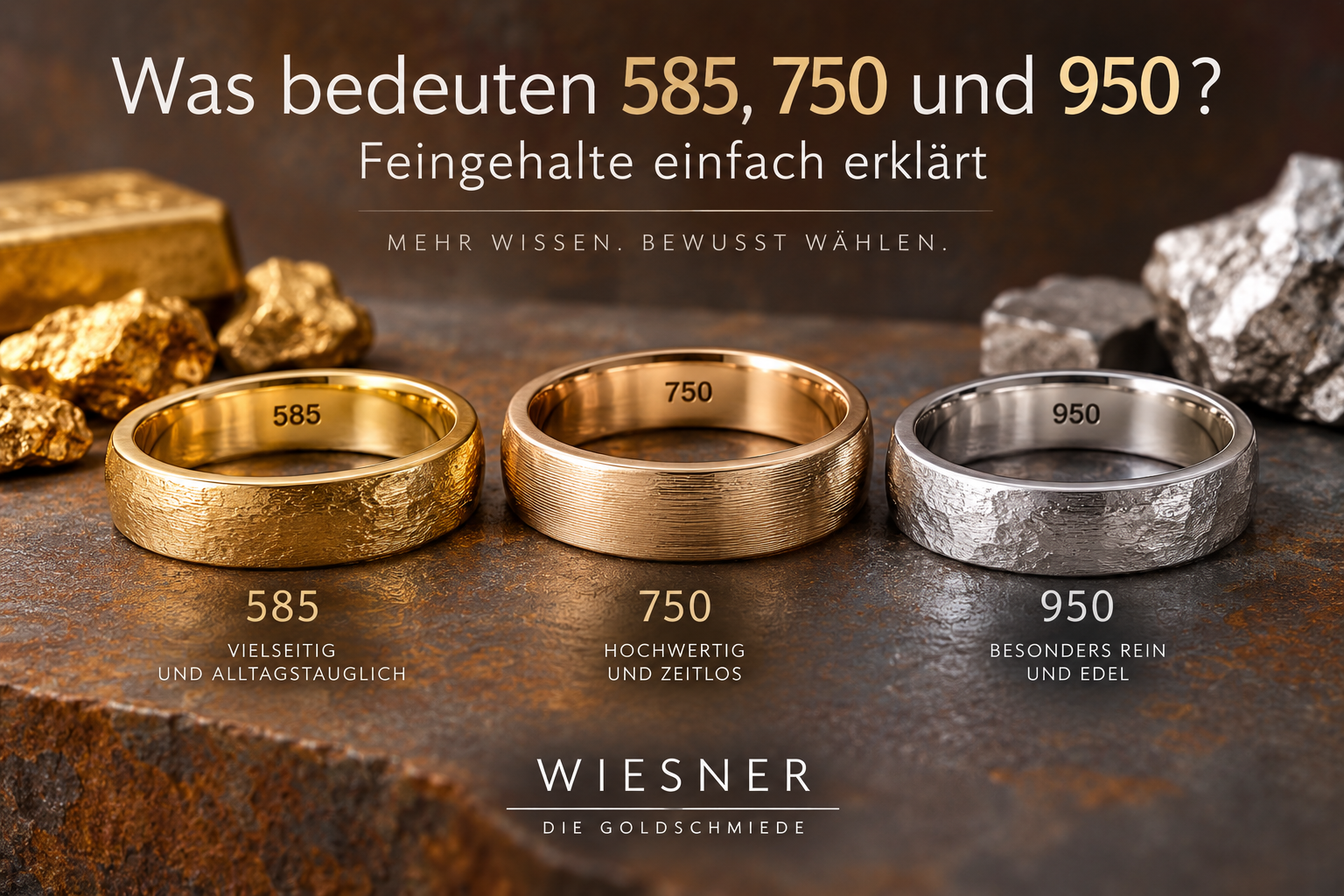
What do 585, 750, and 950 mean when it comes to jewelry?
First published on December 1, 2025 · comprehensively revised and technically updated on September 17,2026 · Illustrations used: AI-generated
Numbers such as 333, 585, 750, 925, or 950 can be found on many pieces of jewelry. They indicate the so-called fineness —that is, the proportion of the precious metal in the alloy’s name.
For example, a hallmark with the number 750 does not mean that a ring consists of 75 percent “metal,” but rather, specifically: Out of 1,000 parts by weight of the alloy, 750 parts are the specified precious metal. For 750 gold, this corresponds to 75 percent fine gold.
For the goldsmith’s workshop, however, the fineness is only one part of the material description. The remaining alloy components play a key role in determining the color, hardness, and workability of a jewelry metal.
What is fineness?
Fineness describes the mass fraction of a precious metal in an alloy. In jewelry, it is usually expressed in parts per thousand.
| Designation | Percentage of Precious Metal | Typical Use |
| 333 Gold | 33.3% gold | Gold jewelry |
| 585 gold | 58.5% gold | Jewelry and Wedding Rings |
| 750 gold | 75.0% gold | High-quality jewelry and wedding rings |
| 925 silver | 92.5% silver | Sterling silver jewelry |
| 950 platinum | 95.0% platinum | High-quality jewelry and wedding rings |
So, at first glance, the number simply indicates how much of the respective precious metal is contained in the alloy. It does not fully describe which metals make up the remaining portion of the alloy.
What does 585 gold mean?
In 585 gold, 585 out of every 1,000 parts by weight consist of fine gold. This corresponds to a gold content of 58.5 percent. The remaining 41.5 percent consists of other alloying metals.
The metals used in the alloy influence, among other things, its color. That is why there can be, for example, 585 yellow gold, 585 white gold, or 585 rose gold. The gold content is the same in each case, but the composition of the remaining 415 thousandths differs.
You can learn more about the composition and color effects in our guide to yellow gold and in our article on white gold.
What does 750 gold mean?
750 gold contains 75 percent fine gold. The remaining 25 percent consists of alloying metals, which influence the color and technical properties.
750 gold thus has a significantly higher gold content than 585 gold. Nevertheless, the number alone does not indicate how hard or durable a specific piece of jewelry is. To determine this, the entire alloy must be considered.
Pure gold itself is extremely malleable. For this reason, gold is specifically combined with other metals when used in jewelry. We explain this relationship in more detail in our guide to gold and pure gold.
What does 925 mean for silver?
The designation 925 indicates that the silver contains 92.5 percent silver. One of the best-known alloys of this type is sterling silver.
The remaining 7.5 percent consists of other alloy components. This gives the material properties that may be more suitable for jewelry making than those of fine silver.
Silver also has a distinctive characteristic that should not be confused with its fineness: its surface can tarnish. We explain in detail why this happens and how to care for silver in our guide to silver as a jewelry metal.
What does 950 mean for platinum?
In 950 platinum, 95 percent of the alloy consists of platinum. This high fineness is characteristic of platinum jewelry.
Platinum has a naturally light color, high density, and excellent chemical resistance. Especially with rings, this high density is also noticeable in their weight.
You can find more about its properties, craftsmanship, and uses in our guide to platinum.
Why are alloys used in jewelry at all?
A jewelry metal is not alloyed solely to reduce its precious metal content. The composition of an alloy allows important properties to be specifically tailored.
- Color: For example, gold can be used to create yellow gold, white gold, or rose gold.
- Hardness and formability: Alloy components alter the material’s mechanical behavior.
- Workability: Rolling, forging, soldering, setting, and polishing place different demands on the material.
- Wear characteristics: Different properties are important for a ring worn daily than, for example, for a pendant.
From a goldsmith’s perspective, therefore, it’s not just the number in the hallmark that matters. What’s important is which alloy is suitable for the specific piece of jewelry and the stresses it will face.
Is 750 gold better than 585 gold?
Not necessarily. 750 gold contains more fine gold and thus has a higher gold content. However, this does not mean that every 750 alloy is technically better suited for every application than every 585 alloy.
Hardness, elasticity, color, and finish depend on the overall composition and the condition of the material. Two gold alloys with the same fineness can therefore behave quite differently.
When selecting a piece of jewelry, the fineness should therefore be considered alongside the alloy, construction, surface finish, and intended use.
Why is the alloy particularly important in Mokume Gane?
In Mokume Gane, different precious metals or alloys are permanently bonded together. The choice of materials not only determines the resulting color effect but is also crucial for the craftsmanship involved.
The individual metals must be technically compatible with one another during the joining and subsequent forging processes. That is why we do not select material combinations based solely on their color.
In our Mokume Gane rings, the characteristic lines and grain patterns emerge from the interplay of different precious metal colors. This is precisely where it becomes very clear that fineness is only one aspect of what defines a jewelry alloy.
What does a hallmark on a piece of jewelry indicate?
A fineness number such as 585, 750, 925, or 950 is, first and foremost, a specification of the material. It indicates the fineness of the precious metal in question.
However, it says nothing about how intricately a piece of jewelry was crafted, how well a setting is worked, or the quality of craftsmanship in a ring. Likewise, the fineness mark alone does not reveal the complete composition of an alloy.
With older pieces of jewelry, it’s also important to note that hallmarks, manufacturer’s marks, and other stamps may look different. A professional appraisal may therefore be necessary for a reliable determination of the material.
Fineness and Family Heirlooms
The topic becomes particularly interesting when it comes to existing jewelry or family heirlooms. For example, an old ring with a 585 hallmark contains, mathematically speaking, 58.5 percent gold—but this does not reveal which metals make up the remaining portion.
This is one of the reasons why existing gold must be professionally evaluated when creating new pieces. Old jewelry is not simply “gold,” but rather an existing alloy with its own composition and history.
If you’d like to have new wedding rings made from existing jewelry, you’ll find your options in our category “Wedding Rings Made from Family Gold and Recycled Gold.”
Gold Purity at a Glance
| Hallmarks | Meaning |
| 333 | 33.3% of the specified precious metal |
| 585 | 58.5% of the specified precious metal |
| 750 | 75.0% of the specified precious metal |
| 925 | 92.5% of the specified precious metal |
| 950 | 95.0% of the specified precious metal |
Frequently Asked Questions About Fine Content in Jewelry
What does 585 mean on a ring?
On a gold ring, 585 means that the gold alloy consists of 58.5 percent fine gold. The remaining 41.5 percent consists of other alloying metals.
Which is more valuable: 585 or 750 gold?
For the same weight, 750 gold contains more fine gold than 585 gold. However, the value of a finished piece of jewelry depends not only on the precious metal it contains, but also on its design, craftsmanship, gemstones, and other factors.
Is 750 gold softer than 585 gold?
This cannot be answered based solely on the fineness. The mechanical properties are determined by the overall alloy composition and its craftsmanship.
What does 925 mean on a piece of jewelry?
For silver, 925 indicates a silver content of 92.5 percent. Sterling silver is the best-known jewelry alloy with this fineness.
Why is platinum often marked with the number 950?
950 platinum contains 95 percent platinum. Platinum jewelry is often made with a very high platinum content.
Does a high fineness indicate the quality of the jewelry?
Yes, regarding the precious metal content—but no, regarding the overall quality. The design, alloy, workmanship, setting, finish, and craftsmanship cannot be determined from the fineness number alone.
Our conclusion from the goldsmiths
585, 750, 925, or 950 are not quality ratings, but rather precise indications of a precious metal’s fineness.
Therefore, simply choosing the highest number possible is not enough to ensure a good piece of jewelry. What matters most is that the material, alloy, and construction are suited to the piece and its intended use.
That is precisely why, in our workshop, we consider more than just the fineness. Color, workability, how it wears, and how it combines with other materials are at least as important—especially for custom-made rings and Mokume Gane.

