
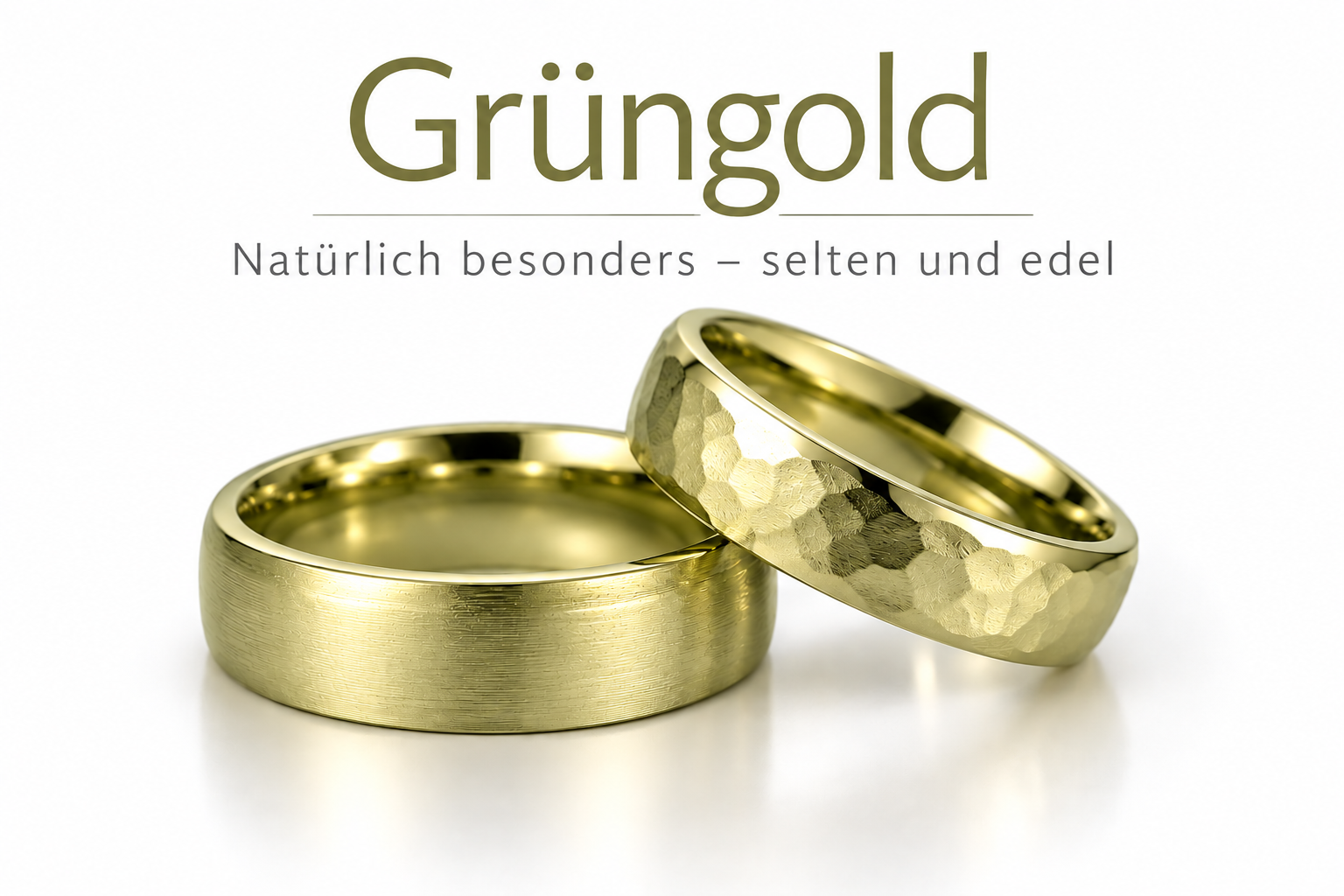
Green Gold – a rare shade of gold between yellow and green
First published on June 10, 2024—comprehensively revised and technically updated on September 8,2026· Illustrations used: AI-generated
At first glance, “green gold” sounds like an intensely green gold alloy. In practice, however, the color is much less spectacular: genuine green gold usually appears yellowish-green, pale gold, or slightly olive-colored. A rich green, such as one might expect from a gemstone, does not occur in classic gold alloys.
The distinctive color effect is primarily created by a high proportion of silver in the gold alloy. Depending on the composition, other metals may be added, altering the color and technical properties.
In modern jewelry making, however, green gold plays only a minor role. It is more of an interesting niche phenomenon among the various gold alloys and precious metals than a typical material for wedding rings or everyday jewelry.
What is green gold?
Green gold is a gold alloy with a slightly greenish-yellow hue.
Like yellow gold, rose gold, or white gold, green gold is not a distinct type of gold in itself. It is derived from fine gold, whose color is influenced by other alloying metals.
In the case of green gold, silver plays a particularly important role. When gold is alloyed with a relatively high percentage of silver, the intense golden yellow loses some of its warmth. The color shifts toward a lighter, cooler shade of yellow with a greenish sheen.
Contrary to what the name might suggest, however, it does not result in a vivid green.
Why does gold appear greenish when mixed with silver?
The color of a gold alloy results from the interaction of the metals it contains.
Fine gold has an intense, warm yellow hue. Silver, on the other hand, is very light in color. As the silver content in a gold alloy increases, the yellow becomes progressively lighter and cooler.
In certain compositions, this results in a color that our eyes perceive as yellowish-green or greenish-gold.
Copper, on the other hand, has the opposite effect: it introduces warmer hues into a gold alloy, which become increasingly reddish as its proportion increases. Therefore, the color of gold alloys can be influenced across a wide range by the ratio of gold, silver, and copper.
Is green gold really green?
Only to a very limited extent.
Anyone expecting a clearly visible emerald or grass green based on the name will be disappointed by classic green gold. The color is more of a light gold with a greenish or olive undertone.
How clearly this undertone is perceived also depends on the lighting, the surface, and the colors of the metals immediately adjacent to it.
Especially when placed next to rose gold or rich yellow gold, a greenish-yellow gold tone can stand out more clearly than in a piece of jewelry made exclusively of green gold.
What is the composition of green gold?
There is no single, standard formula for green gold.
A classic greenish gold alloy, for example, can consist of 750 parts gold and 250 parts silver. Variations with small amounts of copper are also possible. In 585 alloys, a correspondingly larger proportion of other metals must be used due to the lower gold content.
The exact color therefore depends on both the gold fineness and the type and amount of the other alloy components.
We explain in more detail what designations such as 585 or 750 mean in our guide “What Do 585, 750, and 950 Mean?”.
Why was cadmium used in the past for greenish gold alloys?
Cadmium is sometimes found in historical recipes for colored gold alloys. It was used to enhance the greenish hue of certain gold-silver alloys.
However, such historical recipes do not serve as a model for today’s jewelry-making practices. Cadmium poses health risks, and modern jewelry alloys must comply with current legal limits for such substances.
When evaluating a piece of contemporary jewelry, it is therefore crucial to determine which specific modern alloy was actually used —not which formulas once existed for producing certain colors.
Is green gold soft?
A simple gold-silver alloy with a high silver content can be comparatively soft. However, this does not mean that every material labeled as “green gold” possesses the same mechanical properties.
As with all gold alloys, hardness, malleability, and workability are determined by the overall composition and the condition of the material.
Small amounts of other alloying elements can significantly alter the material’s properties.
From a goldsmith’s perspective, one should therefore not infer the technical properties of green gold based solely on its color.
Why is green gold used so rarely for jewelry?
The main reason is surprisingly simple: the color is less striking than the name suggests.
Yellow gold has a distinct, warm golden color; rose gold has a clearly recognizable reddish hue; and white gold has a light, nearly colorless appearance. In terms of color, green gold is much closer to yellow gold.
The difference is therefore often only apparent when the metals are compared side by side.
In addition, gold alloys with a very high silver content are not the ideal choice for every forging or design application.
In jewelry design, green gold is therefore used more specifically as a color nuance than as a universal material.
Green Gold and Mokume Gane
At first glance, green gold seems to be an excellent fit for the Mokume Gane technique. After all, Mokume Gane thrives on the interplay of different metal colors.
In practice, however, an additional greenish gold tone is not strictly necessary. What matters far more is that the precious metals used create a clearly recognizable contrast and are technically suitable for joint processing.
In our goldsmith’s workshop, we therefore specifically use combinations of yellow gold, rose gold, palladium, silver, or platinum for our Mokume Gane rings. The colors arise directly from the different layers of precious metals, which we weld together and then forge and shape.
A greenish appearance without any green gold
Our Seraya model —Mokume Gane rings made of platinum and yellow gold—demonstrates just how much the perception of a metal’s color depends on its interaction with other metals and on light.
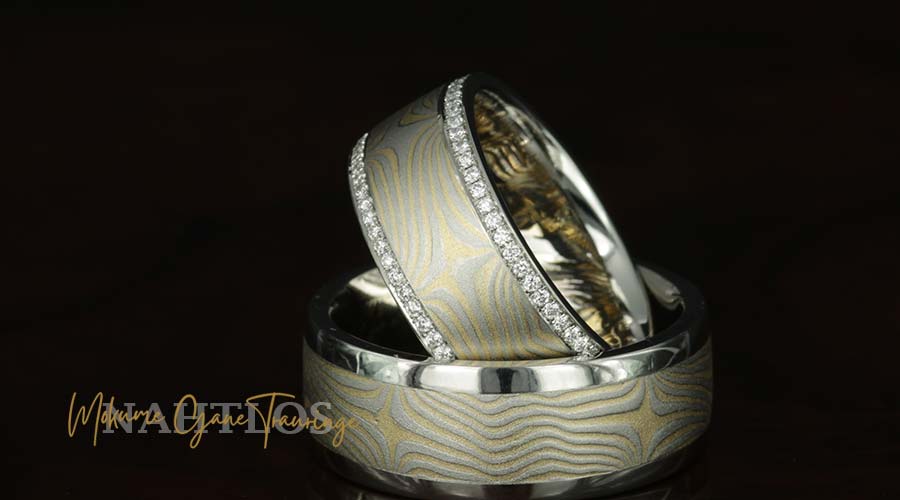
Seraya is made of 950 platinum and 750 yellow gold —in other words, it is explicitly not green gold. Nevertheless, when placed next to the cool, light platinum, the yellow gold can, depending on the lighting, appear slightly greener or cooler in places.
This is a good example of why the perceived color of a piece of jewelry does not depend solely on an alloy designation. Light, surface finish, neighboring metals, and reflections significantly influence the overall impression.
Green Gold, Yellow Gold, and Rose Gold Compared
| Gold Color | Typical Color Effect | Main Color-Giving Elements |
| Yellow gold | Warm yellow | balanced interaction of the alloy metals, often silver and copper |
| Red gold | Warm to distinctly reddish | primarily copper |
| Green gold | light yellow to yellowish-green | high silver content |
You can learn more about these two much more common shades of gold in our guides to yellow gold and rose gold.
Green Gold at a Glance
| Material Type | Gold alloy |
| Color | light yellow to yellowish-green or slightly olive-colored |
| Primary colorant | Silver |
| Possible finenesses | e.g., 585 or 750 gold |
| A vivid green color? | No, classic green gold alloys appear only slightly greenish |
| Usage | Rare; usually used to create a unique shade or in multicolored jewelry designs |
| Use in Wiesner Mokume Gane | Not required; we create color contrasts using other proven precious metal combinations |
Frequently Asked Questions About Green Gold
Is green gold real gold?
Yes. Green gold is a gold alloy. The actual gold content is determined by the respective fineness, such as 585 or 750.
Is green gold really green?
Not in the sense of a vivid green. Classic green gold usually appears light gold with a slight yellowish-green or olive undertone.
Which metal makes gold look greenish?
Mainly silver. A high silver content lightens the gold and can shift its color toward a slightly greenish-yellow hue.
Does green gold contain copper?
That depends on the specific alloy. A simple 750 green gold alloy, for example, may consist only of gold and silver. Other formulations contain small amounts of copper or other alloying elements to influence color and technical properties.
Is green gold toxic?
Green gold is not inherently toxic. Historically, however, there were alloys containing cadmium, which poses health risks. For modern jewelry, therefore, the actual alloy composition and compliance with applicable legal requirements must be considered.
Why is green gold so rare?
The color difference compared to yellow gold is relatively small. Other gold colors, such as rose gold and white gold, create much stronger visual contrasts and have therefore become much more widely established in jewelry.
Is green gold suitable for wedding rings?
In principle, suitable green gold alloys can be used to make jewelry. For wedding rings worn continuously, however, the specific technical properties of the alloy are always the deciding factor. The unique color alone does not automatically make an alloy the ideal material for wedding rings.
Our Conclusion from the Goldsmith’s Workshop
Green gold is interesting from a metallurgical standpoint, but its name often gives rise to misconceptions. It is not bright green gold, but rather a gold alloy with a rather subtle yellowish-green hue.
The color effect is primarily created by silver. Depending on the alloy composition, other metals can alter the color and technical properties.
We do not require green gold for our own Mokume-Gane pieces. We achieve more distinct yet very harmonious color contrasts using tried-and-true combinations of yellow gold, rose gold, silver, palladium, and platinum.
For more information on gold colors, alloys, and jewelry metals, please visit our guide section on precious metals.


