
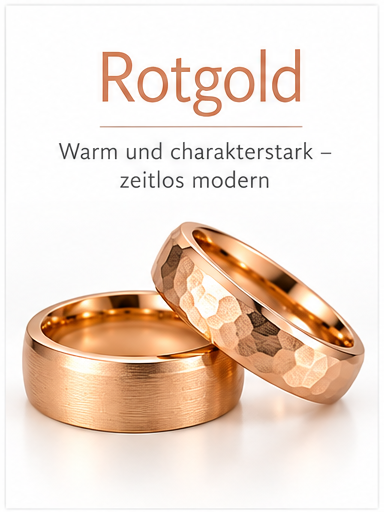
Rose Gold – Composition, Color, and Use in Jewelry
First published on June 9, 2024 – comprehensively revised and technically updated on September 15, 2026.· Illustrations used: AI-generated
Rose gold is one of the most striking classic gold alloys. Depending on its composition, its warm hue ranges from a subtle rosé-colored gold to a distinctly reddish tone.
The color is not the result of a coating. Red gold is a gold alloy colored throughout, with copper being primarily responsible for the reddish hue.
For us as goldsmiths, red gold is particularly interesting when different metal colors are combined. In our Mokume Gane rings, we therefore specifically use red gold in various designs to create a warm contrast to palladium, silver, or yellow gold.
What is rose gold?
Rose gold is not a distinct type of gold, but rather a gold alloy. Fine gold is combined with other metals to alter the material’s color and technical properties.
The most important alloying element for the red color is copper. Depending on the formula, the alloy may also contain silver, for example.
The principle is simple: Pure fine gold has an intense yellow hue. Copper adds a reddish tint to the alloy. Silver, in turn, can lighten the color.
That is why there is not just a single shade of red gold, nor is there just a single red gold formulation.
What is red gold made of?
The exact composition depends on the desired fineness, color tone, and the required working properties.
Typical components include:
- Gold as the precious metal that determines its value,
- copper as the primary colorant for the reddish hue,
- and, depending on the formula, silver or other alloying elements.
A blanket statement such as “red gold always consists of 75% gold, 22.25% copper, and 2.75% silver” would therefore be incorrect. That would merely be one possible composition.
585 or 750 rose gold—what does that mean?
The numbers 585 and 750 indicate the fine gold content of the alloy.
| Alloy | Fine Gold Content | Percentage of Other Metals |
| 585 rose gold | 58.5% | 41.5% |
| 750 red gold | 75.0% | 25.0% |
The number alone does not reveal which metals make up the remaining proportions.
In the case of rose gold in particular, this ratio significantly influences the color. Since 585 rose gold has more room for alloying metals than 750 rose gold, it allows for correspondingly intense copper tones.
However, the fineness alone does not indicate whether a piece of jewelry is “better” or more durable. To determine that, one must always consider the specific alloy.
Why is rose gold red?
Copper is primarily responsible for this.
The higher its proportion within a gold alloy, the more pronounced the warm reddish hue becomes. Silver, on the other hand, appears lighter and can tone down the red effect.
This allows for different color variations. Two rose gold rings with the same gold fineness do not necessarily have to be exactly the same color.
This is an important distinction from a surface coating: if rose gold is polished or refinished, a different metal color does not suddenly appear underneath. The hue comes from the alloy itself.
Red gold or rose gold—what’s the difference?
There is no strictly defined chemical distinction between red gold and rose gold in the jewelry trade.
Both terms refer to reddish gold alloys. In common parlance, a lighter, more delicate, and pinkish gold hue is usually referred to as rose gold, while a more intense reddish hue is typically called red gold.
What the color actually looks like depends on the fineness and the alloy’s composition.
That’s why it makes more sense to examine a specific piece of jewelry or a material sample rather than relying solely on the terms “red gold” or “rose gold.”
Is red gold harder than yellow gold?
There is no one-size-fits-all answer to this question.
Copper can significantly alter the mechanical properties of gold. Nevertheless, this does not mean that every red gold alloy is automatically harder than every yellow gold alloy.
Fineness, exact composition, manufacturing process, and material condition all influence hardness and malleability.
From a goldsmith’s perspective, therefore, the specific alloy is always the decisive factor—not just its color.
Rose Gold in Jewelry Making
Rose gold can be used for nearly all classic types of jewelry: rings, wedding bands, engagement rings, pendants, earrings, or bangles.
From a design perspective, its particular strength lies in its warm natural color. A piece of jewelry can be made entirely of red gold, or red gold can be specifically combined with metals of other colors.
This effect is particularly evident in multicolored pieces of jewelry. When paired with light-colored metals such as palladium, platinum, or silver, red gold stands out much more prominently than when paired with yellow gold.
Red Gold in Mokume Gane
In Mokume Gane, red gold is particularly interesting to us because the color doesn’t just define a large surface area but can run as a single line through the grain pattern.
In our own workshop, we fuse different layers of precious metals into a solid composite material. Through subsequent forging, rolling, and patterning, the individual layers become visible on the surface.
As a result, rose gold can create very different effects when set against gray palladium, light silver, and yellow gold.
Aiele – Red Gold and Palladium
A particularly clear example is our Aiele Mokume Gane rings.
In the current design, we combine 585 red gold with 500 palladium. As a result, only two metal colors interact: the warm red gold and the cooler gray of the palladium.
Precisely because no other colors are added, it is very easy to see here just how strongly red gold can influence the character of a Mokume Gane ring.
Abarco – Red Gold in Four-Color Mokume Gane
Red gold takes on yet another look in our Abarco Mokume Gane rings.
Here we use 750 yellow gold, 585 rose gold, 500 palladium, and 925 silver. Rose gold is thus just one of four metal colors.
Its reddish lines add warm accents among the gold, gray, and silver tones. It is precisely these kinds of combinations that demonstrate why an alloy’s inherent color is so important in Mokume Gane: every single layer contributes to the pattern’s overall effect.
Rose Gold and Skin Tone
Red gold is occasionally recommended for certain skin types. However, we consider such blanket rules to be of little help during the consultation process.
How a metal looks on your finger depends on more than just your skin tone. Ring width, finish, shape, combinations with other metals, and, of course, personal taste all play at least as significant a role.
With red gold in particular, it’s therefore worth examining how the color looks on your own finger.
Does rose gold change color?
Rose gold is not a colored coating and therefore cannot simply “wear off.”
As with any piece of jewelry that’s worn, however, the surface does change. Polished surfaces develop fine scratches, matte surfaces can become shinier due to friction, and textured surfaces develop their own patina over time.
In copper-rich alloys, surface reactions may also occur. However, this does not mean that red gold will turn into a metal of a different color.
Can rose gold stain the skin?
With copper-containing alloys, temporary discoloration of the skin may occur under certain conditions. Moisture, sweat, cosmetics, and individual skin chemistry can all play a role in this.
Such discoloration does not automatically mean that a piece of jewelry is of inferior quality.
The severity of such reactions depends on the specific alloy and the wearer.
How do you care for rose gold?
Rose gold does not require any special care.
For routine cleaning, lukewarm water, a mild dish soap, and a soft brush or cloth are usually sufficient. Afterward, the piece of jewelry should be rinsed with clean water and dried thoroughly.
Strong abrasive cleaners or harsh household cleaners are not suitable; they can damage the surface.
For jewelry with diamonds, gemstones, or intricate finishes, cleaning should always be tailored to the entire piece.
Can rose gold be refinished?
Yes. Depending on the design, signs of wear on rose gold jewelry can be reduced through professional polishing, matting, or reworking the original surface texture.
However, a Mokume-Gane ring requires a different approach than a solid-color rose gold ring. The visible grain pattern should be preserved and must not be unnecessarily altered by excessive refinishing.
Professional restoration is therefore particularly advisable for handmade or multicolored rings.
Rose Gold at a Glance
| Material Type | Gold Alloy |
| Color-giving component | primarily copper |
| Other possible components | e.g., silver, depending on the alloy composition |
| Common finenesses | 585 and 750 |
| Color | Warm rose-colored to distinctly reddish |
| Coating? | No, the color comes from the alloy itself |
| Typical uses | Rings, wedding bands, engagement rings, and jewelry |
| At Wiesner Mokume Gane | e.g., in the Aiele, Abarco, Sipo, and other models |
Frequently Asked Questions About Rose Gold
Is rose gold real gold?
Yes. Red gold is a gold alloy. In 585 red gold, 58.5 percent of the alloy consists of fine gold; in 750 red gold, it is 75 percent.
Why does copper make gold red?
Fine gold has a yellow hue, while copper has a distinctly redder one. When the two metals are alloyed, the color of the material shifts toward red or rose.
What is the difference between red gold and rose gold?
There is no definitive chemical distinction. In common parlance, a lighter, more delicate reddish gold tone is usually called rose gold, while a more vibrant shade is called red gold.
Is 750 red gold better than 585 red gold?
750 red gold has a higher gold content. However, this does not automatically mean that it is technically better suited for every jewelry application. Color, hardness, and workability depend on the overall alloy.
Is red gold only red on the surface?
No. Unlike a coating, the color comes from the alloy itself and extends throughout the entire material.
Is rose gold suitable for wedding rings?
Yes. Suitable rose gold alloys work very well for wedding rings. As with all wedding ring materials, the specific alloy, design, and professional craftsmanship are important.
Does Wiesner use rose gold for Mokume Gane?
Yes. Rose gold is a component of various Mokume Gane designs created by our goldsmiths. For example, we combine it with palladium or with yellow gold, palladium, and silver.
Our Conclusion from the Goldsmiths
Rose gold is far more than just “red gold.” Only the specific combination of fine gold with copper—and, if necessary, other alloying elements—produces the desired color and technical properties of the material.
That is precisely why, when it comes to rose gold, it’s worth taking a closer look at the specific alloy. 585 and 750 describe the gold content, but not the exact color or behavior of the material.
In our workshop, we particularly value rose gold as a contrasting metal in Mokume Gane rings. Even narrow lines of rose gold can create a completely different effect in a grain pattern when combined with palladium, silver, and yellow gold.
For more information on gold alloys and jewelry metals, please visit our “Precious Metals” guide section.

