
Shibuichi – a Japanese copper-silver alloy and Mokume Gane
First published on February 6, 2023 – comprehensively revised and technically updated on September 12,2026 · Illustrations used: AI-generated
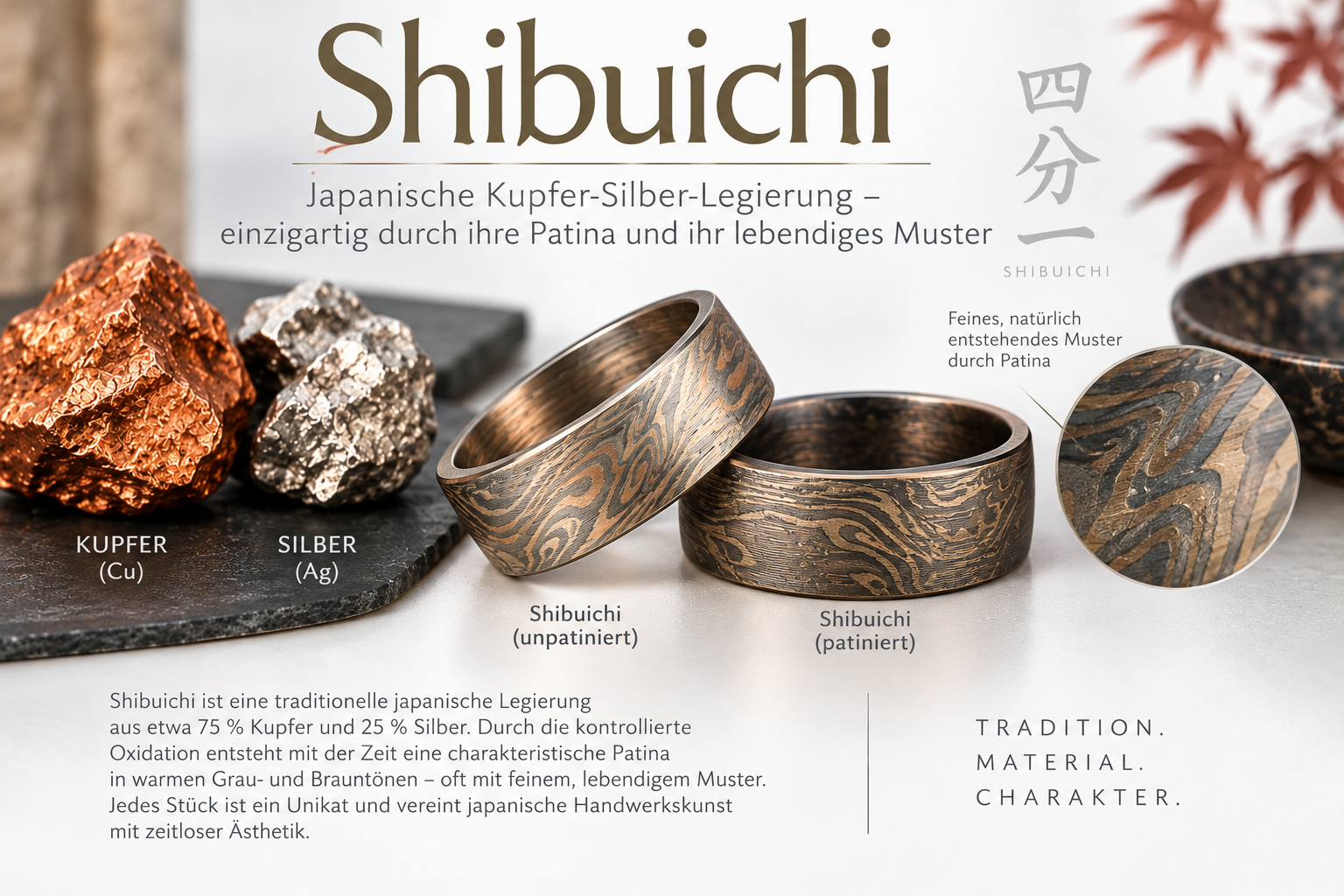
Shibuichi is one of the traditional Japanese metal alloys. It consists primarily of copper and silver and is particularly interesting for its color effects: Through a deliberate patination process, the alloy—which initially appears rather unremarkable—can develop surfaces ranging from gray to brownish-gray.
Shibuichi is therefore often encountered in the context of historical Japanese metal art—and occasionally in connection with Mokume Gane.
It is important to make the distinction: Shibuichi is an alloy. Mokume Gane is a metalworking technique—or rather, the patterned layered material produced by it.
What is Shibuichi?
Shibuichi is a copper-rich alloy containing silver. A classic composition consists of approximately 75 percent copper and 25 percent silver.
However, the composition is not limited to this specific ratio. Different proportions of silver and copper alter both the base color and the alloy’s behavior during subsequent patination.
Shibuichi is therefore neither a silver alloy in the sense of our standard 925 sterling silver nor a precious metal. It is an alloy whose main component is copper.
What does the name Shibuichi mean?
The Japanese name Shibuichi roughly translates to “one-quarter.”
This refers to the traditional silver content: one part silver to about three parts copper corresponds to approximately 25 percent silver and 75 percent copper.
The name thus originally describes the composition of the alloy directly.
What color is Shibuichi?
The distinctive appearance of Shibuichi is primarily due to its surface.
Through controlled patination, the alloy can develop various shades of silver-gray, gray, and brownish-gray. The actual appearance of the result depends, among other things, on the exact composition of the alloy, the surface preparation, and the patination process used.
It is precisely these controllable color variations that made Shibuichi appealing for traditional Japanese metalwork.
Shibuichi is not simply tarnished silver
The gray color should not be confused with the normal tarnishing of silver.
With Shibuichi, the composition of the copper-silver alloy is deliberately combined with a surface treatment to achieve a specific color effect.
In 925 sterling silver, on the other hand, dark tarnishing is an undesirable—or rather, natural—reaction of the silver’s surface with substances in the environment.
Visually, both processes can produce darker metal surfaces. Metallurgically and aesthetically, however, they are distinct phenomena.
Shibuichi in Traditional Japanese Metalwork
Historical Shibuichi works are particularly well known from Japanese sword fittings.
In so-called tsuba—the guard plates of Japanese swords—and other sword fittings, shibuichi was used in combination with gold, silver, copper, and other traditional alloys.
The goal was not simply to craft an object from a single material. It was precisely the interplay of different metal colors that allowed for highly nuanced ornaments, inlays, and pictorial representations.
Preserved Japanese works in museums, for example, show shibuichi used alongside gold, silver, copper, and shakudo.
Shibuichi and Shakudo—what’s the difference?
Shibuichi and shakudo are often mentioned together because both materials were used in traditional Japanese metalwork.
| Material | Basic Composition | Typical appearance after patination |
| Shibuichi | Copper and silver | silvery-gray to brownish-gray |
| Shakudo | predominantly copper with a small amount of gold | very dark to nearly black |
As a result, both alloys produce very different color effects. It was precisely these contrasts that were of particular interest for multicolored Japanese metalwork.
We explain more about the second material in our guide, “Shakudo—Japanese Copper-Gold Alloy.”
What does Shibuichi have to do with Mokume Gane?
Shibuichi can be used as one of the alloys within a Mokume-Gane piece.
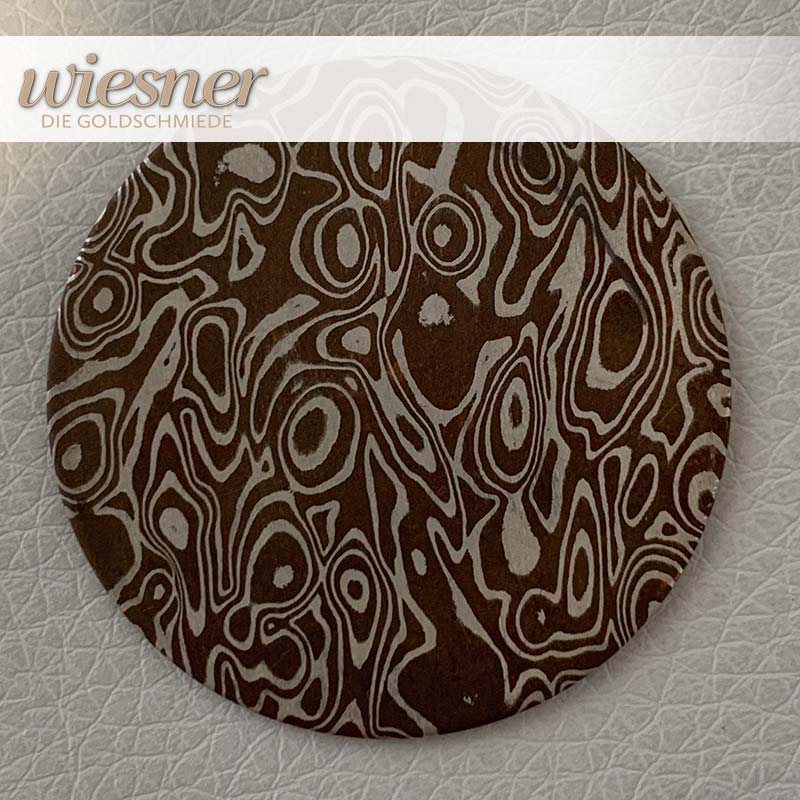
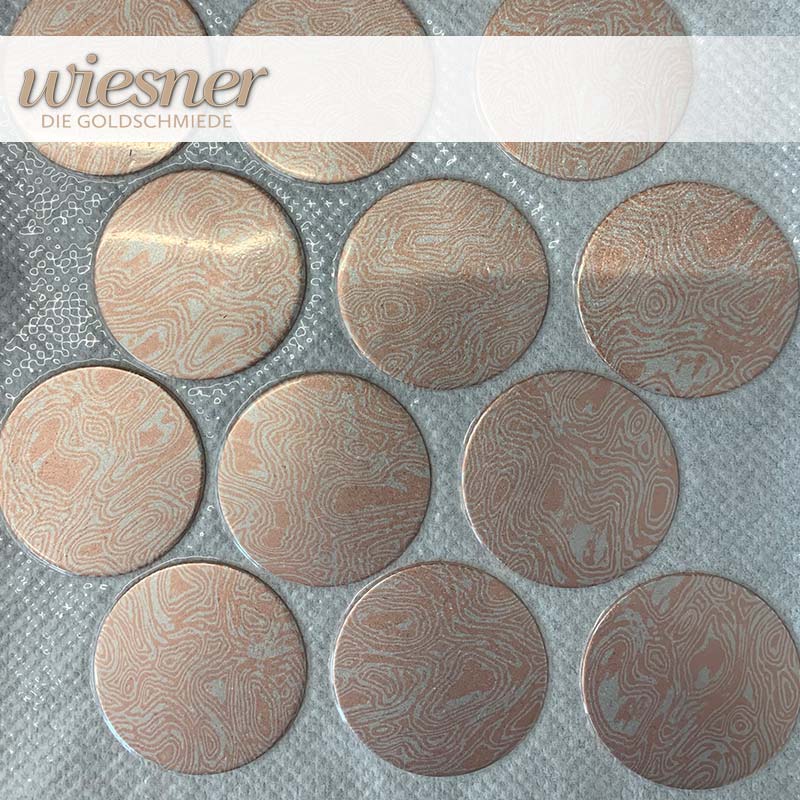
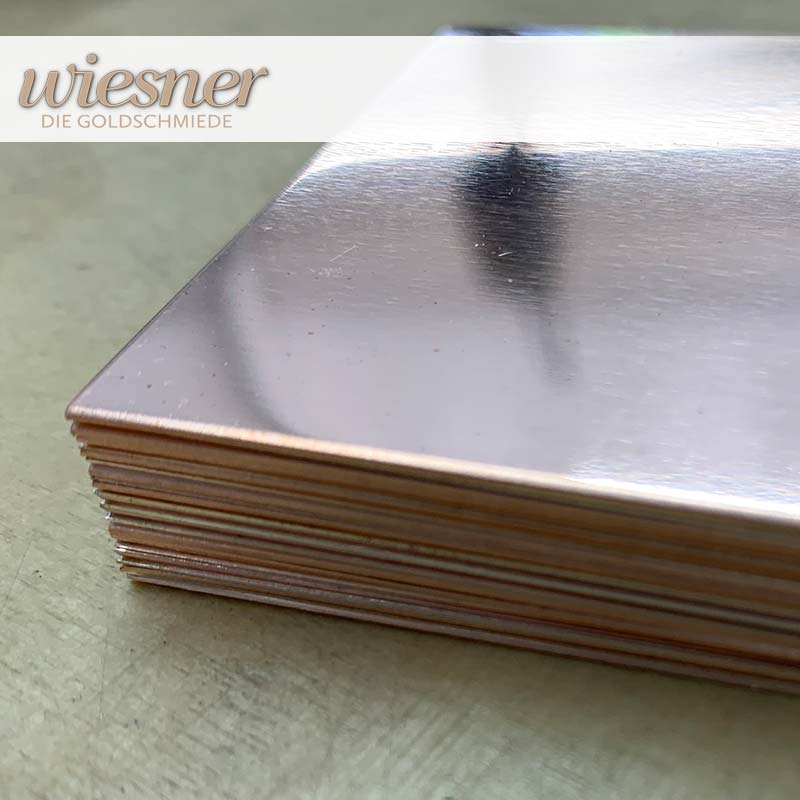
In Mokume Gane, different layers of metal are permanently bonded together and then further processed so that the individual layers become visible as a distinctive grain pattern.
An alloy like Shibuichi is interesting from a design perspective because its color can differ from that of silver, copper, gold, or other metals.
However, Shibuichi is not a necessary component of Mokume Gane. Which metals are combined depends on the design, the manufacturing process, and the intended use.
Does Wiesner use Shibuichi for Mokume Gane?
We do not use Shibuichi for our current Mokume Gane wedding bands.
Instead, depending on the model, we work with various combinations of yellow gold, rose gold, palladium, silver, and platinum. This allows us to create distinct metal contrasts without the need for subsequent patination to reveal the actual pattern.
We produce the raw material for Mokume Gane in our own goldsmith’s workshop. The different layers of precious metal are welded together and then forged and patterned.
For us, Shibuichi is therefore particularly interesting from a materials science and historical perspective: It beautifully illustrates the significance of different metal colors in Japanese metalwork.
Why do we use different alloys for wedding bands?
For a piece of jewelry worn every day, it’s not just the unique color of a metal that matters.
For our Mokume-Gane wedding rings, the alloys used must be compatible both visually and technically. This applies to the welding of the layers, the subsequent forging, the finishing of the pattern, and finally, how the finished ring holds up in everyday use.
In the case of Shibuichi, there is also the high copper content. The characteristic color effect is also largely due to the surface patina. Especially with a ring, this surface is exposed to constant mechanical stress.
In contrast, our proven precious metal combinations produce their various colors directly from the alloys used.
Shibuichi and Mokume Gane—not the same thing
| Shibuichi | Mokume Gane |
| Copper-silver alloy | Metalworking technique and patterned layered material |
| a single material | consists of multiple interconnected layers of metal |
| The color effect can be enhanced through patination | The pattern is created by building up and working the different metal layers |
| can be a component of a Mokume-Gane piece | Does not necessarily require Shibuichi |
Shibuichi at a Glance
| Material Type | Copper-silver alloy |
| Classic composition | approximately 75% copper and 25% silver |
| Meaning of the Name | literally “a quarter” |
| Typical color appearance | silvery-gray to brownish-gray after patination |
| Historical use | Japanese metalwork, particularly sword fittings |
| Connection to Mokume Gane | Can be used as an alloy within a layered composite |
| Used by Wiesner? | Not in our current Mokume Gane wedding rings |
Frequently Asked Questions About Shibuichi
Is Shibuichi silver?
No. Although Shibuichi contains silver, its main component is copper. In the classic composition, the silver content is about one-quarter.
Is Shibuichi a precious metal?
No. Shibuichi is a copper-silver alloy. Silver is a precious metal, but copper is not.
Why is Shibuichi called “one-quarter”?
The name refers to the traditional composition of approximately one-quarter silver and three-quarters copper.
What color is Shibuichi?
Of particular interest are the gray to brownish-gray hues that can be achieved through controlled patination. The exact effect depends on the alloy composition and surface treatment.
Is Shibuichi the same as Shakudo?
No. Shibuichi is based on copper and silver. Shakudo, on the other hand, is a copper-rich alloy with a small amount of gold and can appear significantly darker due to patination.
Is Shibuichi the same as Mokume Gane?
No. Shibuichi is a material. Mokume Gane refers to a technique or a patterned layered material made from several metals bonded together.
Can Shibuichi be used for Mokume Gane?
Yes. Shibuichi can be used as one of the metal layers in a Mokume Gane piece. However, it is not an essential component of the technique.
Does Wiesner use Shibuichi in its Mokume Gane rings?
No. Depending on the model, we craft our current Mokume-Gane wedding rings from combinations of yellow gold, rose gold, palladium, silver, and platinum.
Our Conclusion from the Goldsmith’s Workshop
Shibuichi is a good example of how traditional Japanese metalwork has made sophisticated use of material colors. A comparatively simple alloy of copper and silver can develop a wide range of gray hues through its composition and targeted surface treatment.
Shibuichi is therefore interesting for understanding Mokume Gane, even though we do not use it ourselves in our current wedding rings.
In our Mokume Gane rings, we create color contrasts using different precious metal alloys. The principle behind it, however, is similar: it is the interplay of different metal colors that makes the structure of the layered material particularly visible.
You can find more information about alloys and jewelry metals in our guide section on precious metals.


