
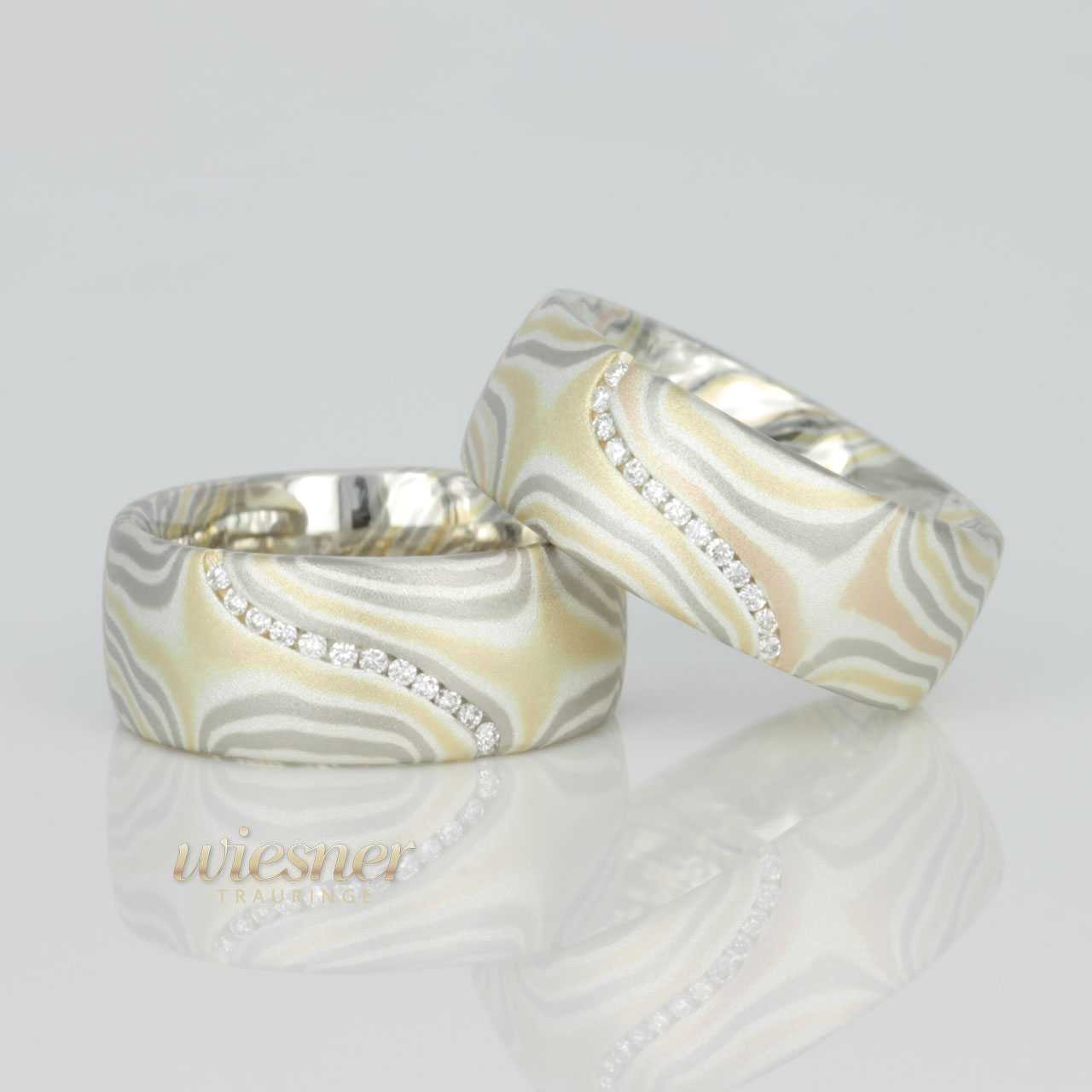
First of all—What exactly is Mokume Gane?
Mokume Gane is a traditional Japanese metalworking technique in which multiple layers of different metals are fused together and then worked to create a pattern with wood-like textures. The technique is often used to create jewelry, wedding rings, knives, and other works of art. A more detailed description, including its history, can be found in our article on the history of Mokume Gane.
The exchange of rings symbolizes the union of the couple and the beginning of a new chapter.
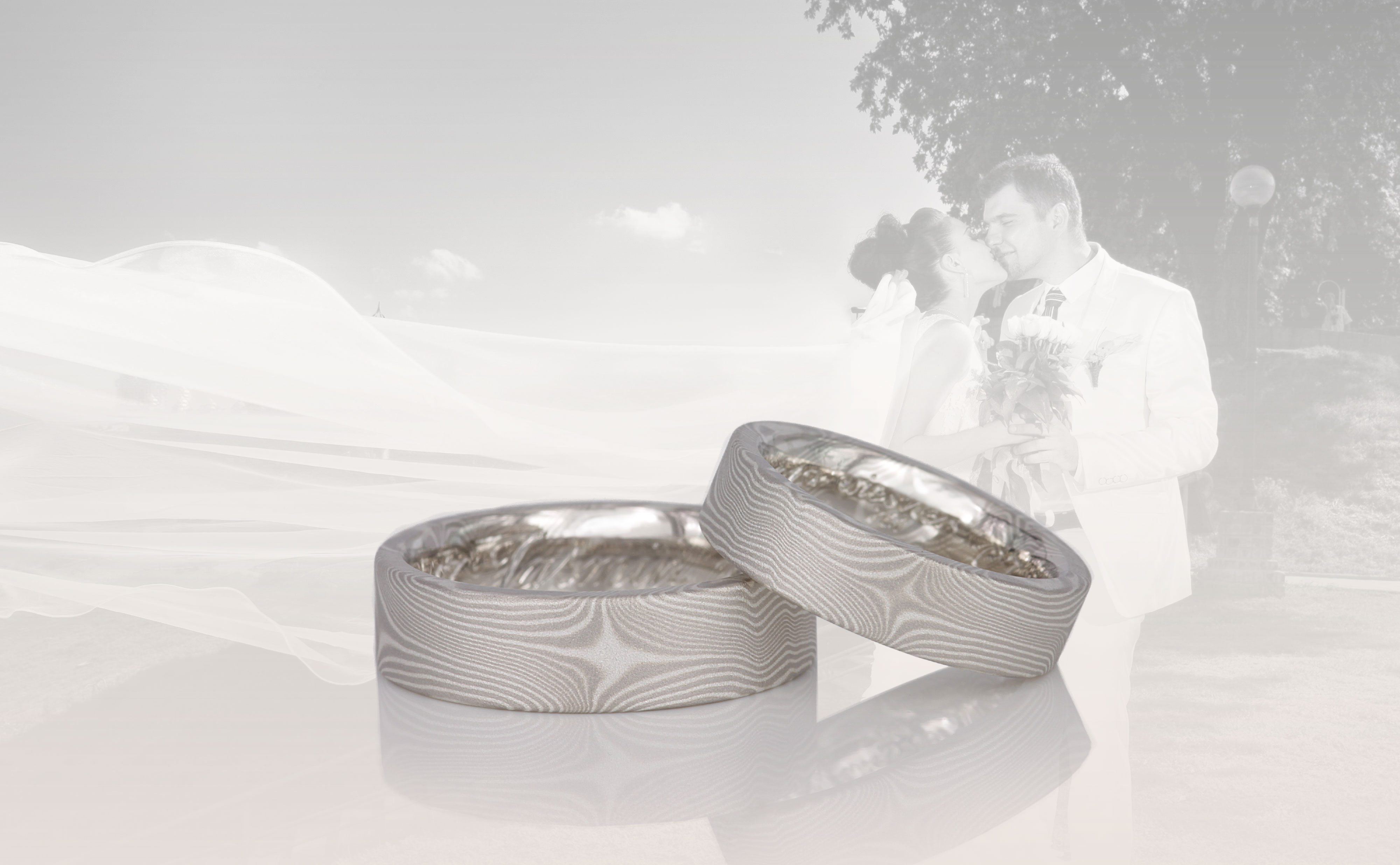
To provide the event with a fitting setting and, at the same time, ensure the highest possible value, precious metals are used in the creation of partner rings. A special form of this is Mokume Gane, in which partner rings are crafted according to this Japanese art form. Various metals are fused together and worked, a process that creates unique grain patterns within the metal block. For partner rings, care is taken to ensure they are crafted from the same layered block to guarantee the greatest possible similarity.
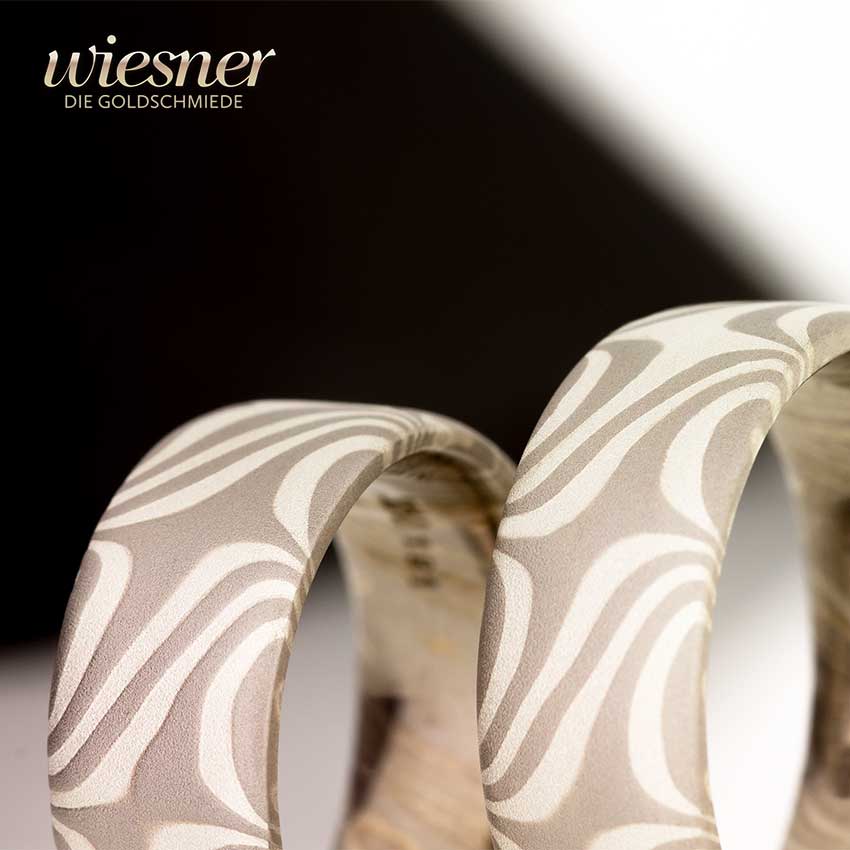
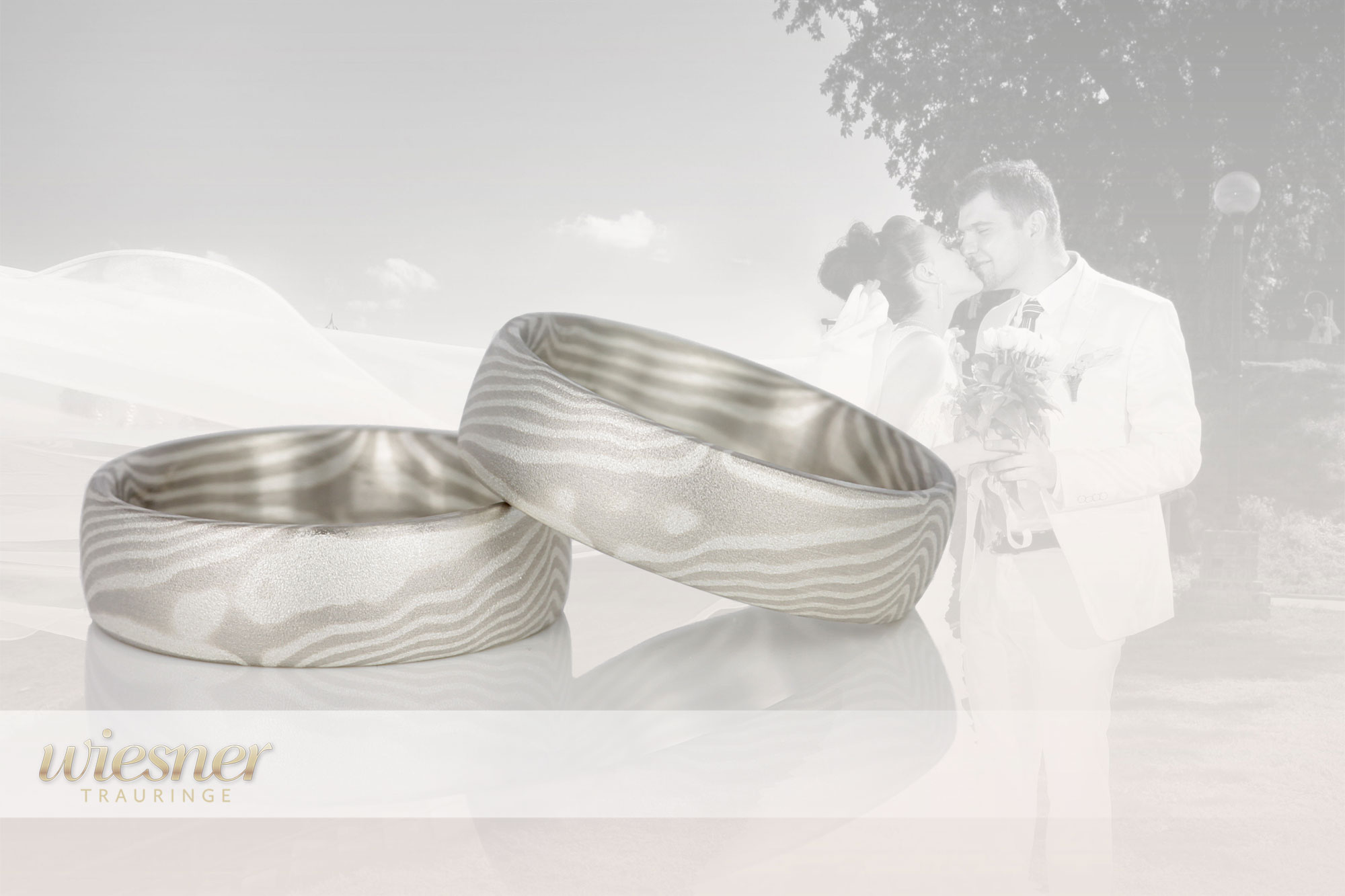
Camaru rings in Mokume Gane, featuring a very striking pattern. Palladium and silver alternate in the design.
Today we had the pleasure of completing a wonderful Mokume Gane pendant for one of our customers.
Master goldsmith Markus Wiesner developed the design in collaboration with the customer.
Using the same materials and patterns as those previously used to craft Mokume Gane wedding bands, a ring made of yellow gold, palladium, and silver was first welded and forged.
However, instead of shaping the ring as a traditional ring, it was formed into a flat disc. Since the engraving design also required the space inside the Mokume Gane ring, the center was closed off with a round plate made of 750 yellow gold. To complete the pendant, a palladium loop was added so that the pre-selected chain could be threaded through it.
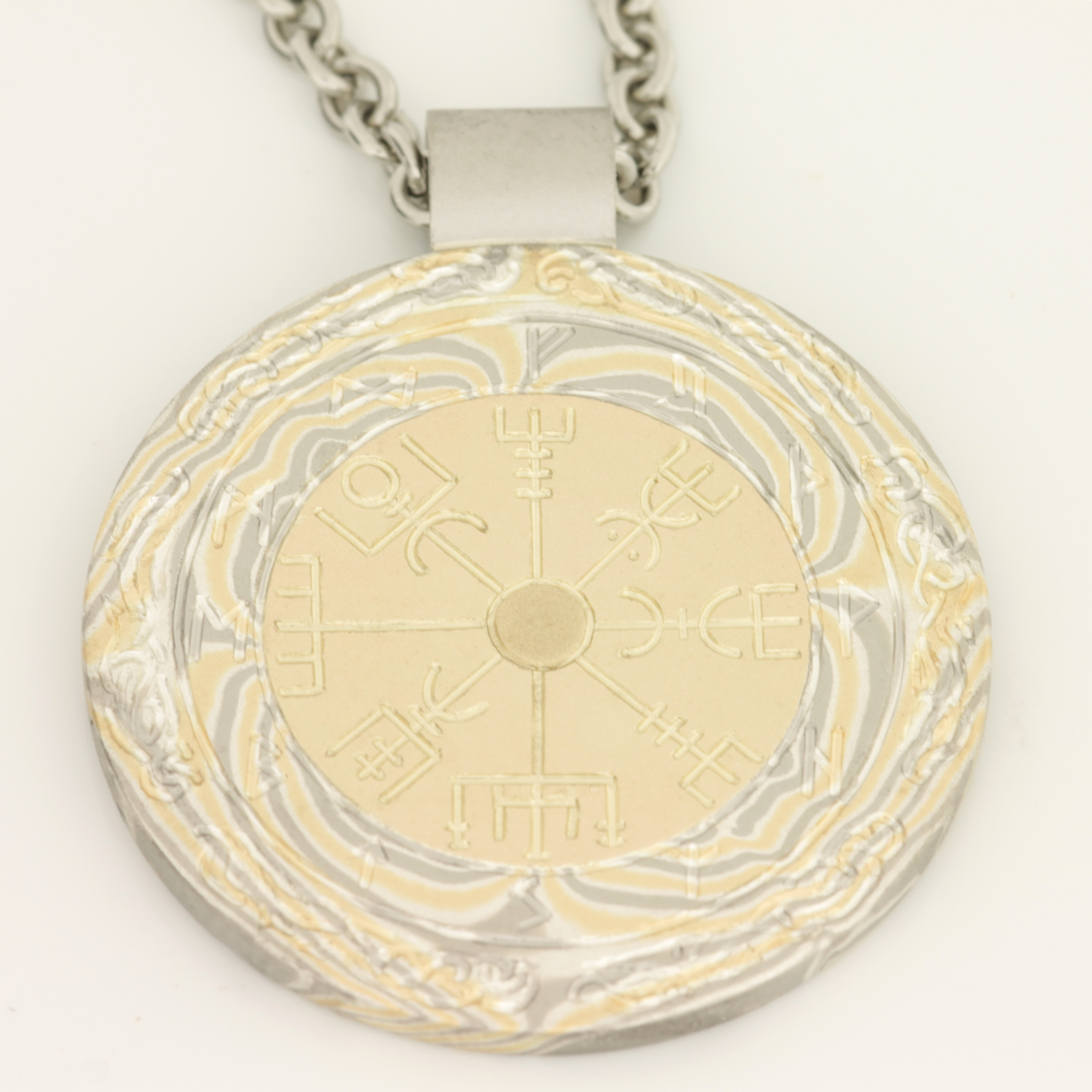
Our master engraver then brought the engraving design to life through hand engraving. Although the vibrant pattern of the Mokume Gane structures naturally draws the eye, the luster of the hand engraving—created by carving out the metal—allows the ornamentation to stand out very clearly.
Turning Old into New | Wedding Bands Made from Recycled Gold
Today was that time again. The collection container for precious metal scraps and shavings was filled with a good 1.3 kilograms of various precious metals. These collected shavings, which are produced during the creation of Mokume Gane wedding rings, contain proportions of the materials we process: yellow gold, rose gold, palladium, platinum, and silver. To recover the precious metals through chemical separation, we commission a refinery, which carries out these chemical processes for us in strict compliance with environmental regulations. Before it leaves our facility, we melt the precious metal scrap into a solid ingot, which we then analyze to determine its composition.
To do this, the machined Mokume Gane material is heated in a crucible using induction to approximately 2,000 degrees Celsius. By adding copper to promote alloying and carefully stirring the melt, a very homogeneous ingot is produced when poured into the mold. “Homogeneous” here refers to the even distribution of the precious metals within the finished ingot. This ensures that when the fineness is measured using X-ray fluorescence analysis, reliable values are obtained that represent the entire ingot.
This melting process—and especially the pouring of the 2,000-degree metal—is often nerve-wracking, as even the smallest mistake can lead to accidents with devastating consequences. However, this effort is appropriate and beneficial for fostering mutual trust between our workshop and the recycling company.
Stories from the Workshop—Mokume Gane Wedding Ring—Lost Diamond
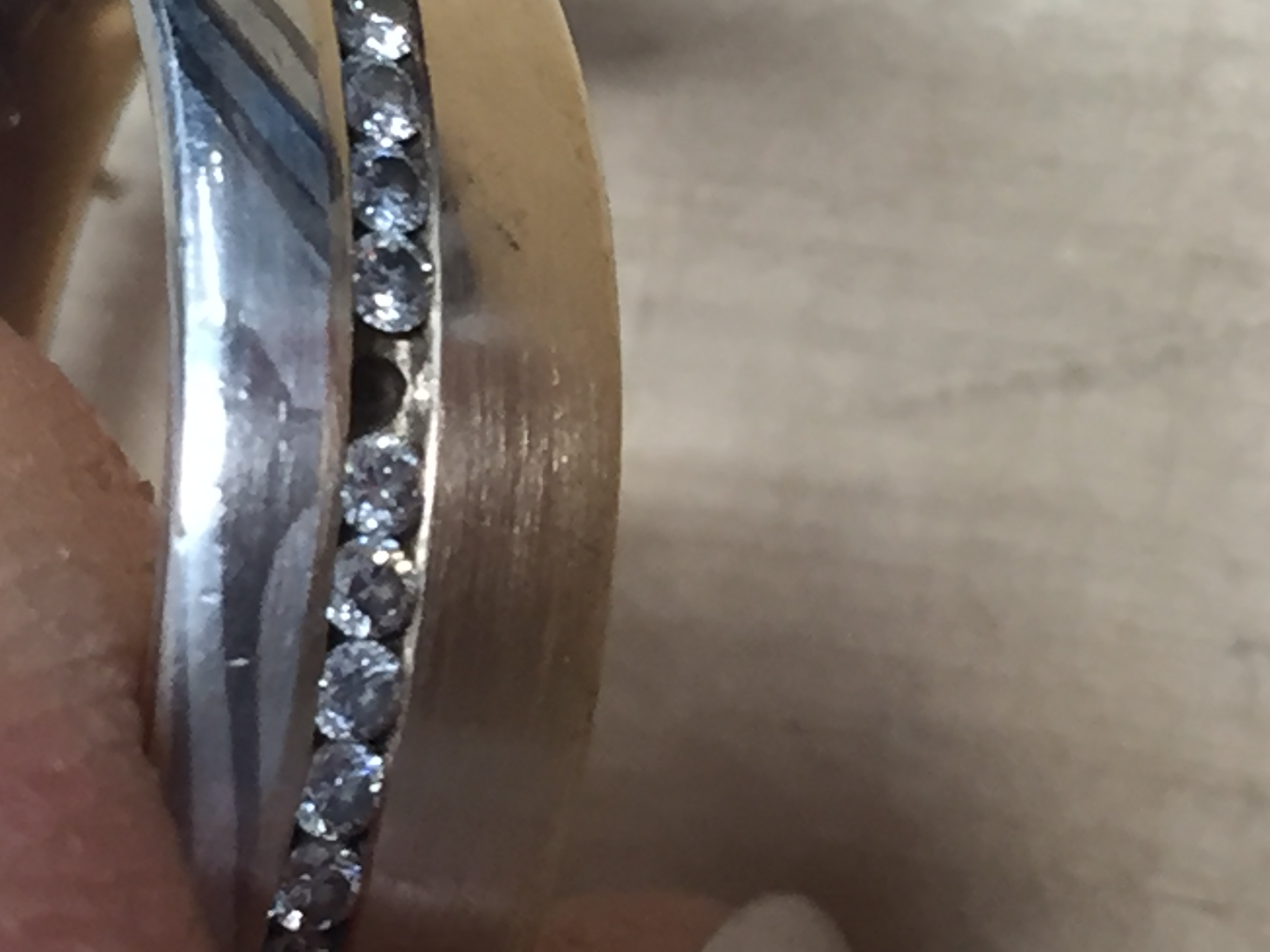
Every now and then, we have customers visit us who’ve had some bad luck with their Mokume Gane wedding rings—whether they were made in our workshop or, as in this case, by another manufacturer. In the case of this women’s ring, which is set with diamonds all around, a stone has gone missing. Of course, this can happen in rare cases and for a variety of reasons. Either the diamond took a blow during everyday wear and broke—which is very likely with this ring, since the setting shows no signs of damage— Or the setting for this particular stone may have been slightly too loose, causing the stone to fall out when subjected to a jolt. We are awaiting the expert analysis of our jeweler shortly.
Complaint | Warranty or Just Bad Luck?
The customer who brought her ring to us for repair had, of course, first contacted the manufacturer of her Mokume Gane wedding rings—a large, high-revenue company with a strong local reputation. However, she was not received very warmly there. We find the proposed solutions for repairing the lost diamond—which were presented to the lady there—quite interesting. First, to replace a single diamond, apparently all the stones would have to be removed and reset, which was estimated to cost around 400 euros. When she asked whether this might be covered under warranty, the cost was set to rise even further. Whether or not it was a warranty case was to be decided by an appraiser, whose fee of around 300 euros would also have to be paid by the customer.
The Solution
The replacement of the 0.01-carat diamond, graded TW VSI, is expected to cost a maximum of 100 euros. This includes setting a new diamond as well as a complete refurbishment of the ring in our workshop. Under no circumstances will it be necessary to remove and re-set all 52 stones.
This week, we had the pleasure of completing a very special set of wedding rings for a bride and groom.
The basic design of the rings is based on the “Iroko” model and is crafted from palladium and silver. What makes these wedding bands unique is that the basic shape is not round but square. However, the sides of the square are curved, creating a hybrid shape that blends a square and a circle. The corners of these unique wedding rings are pleasantly rounded, resulting in a fluted pattern in the Mokume Gane at these points—a detail not typically seen elsewhere.
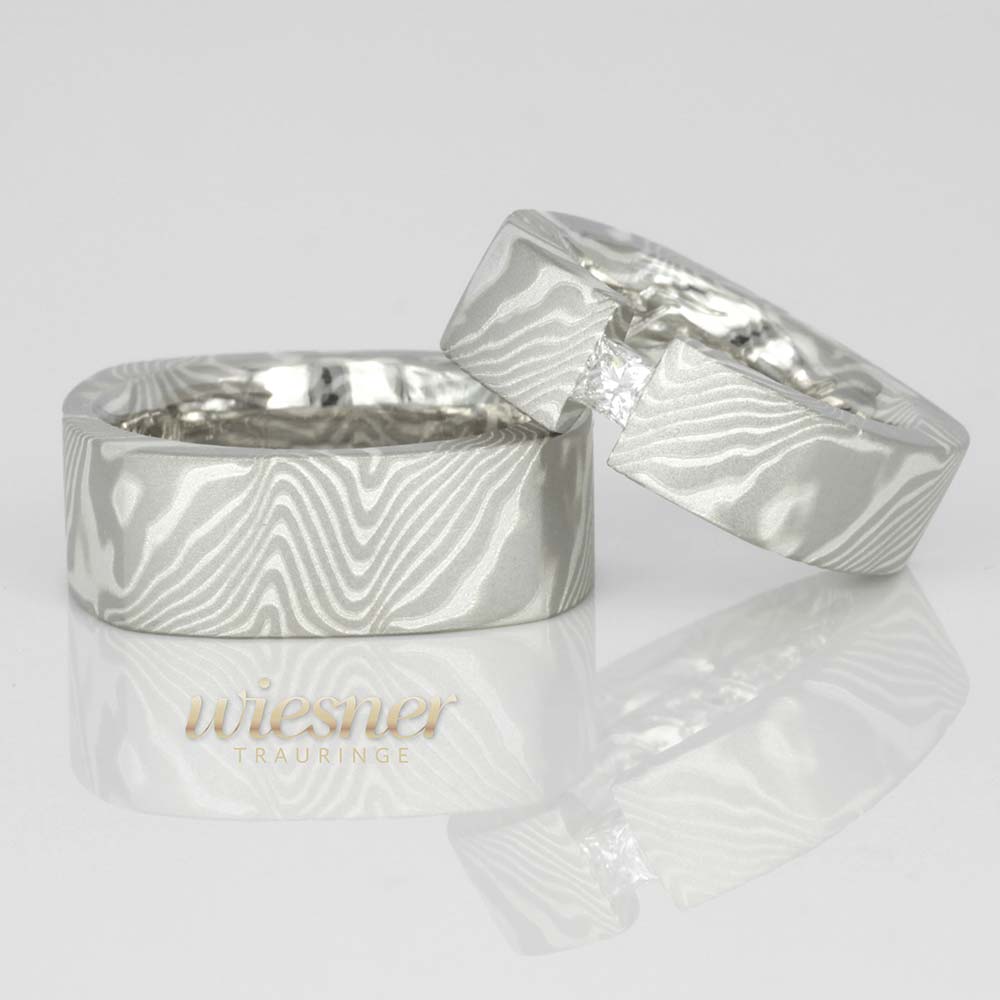
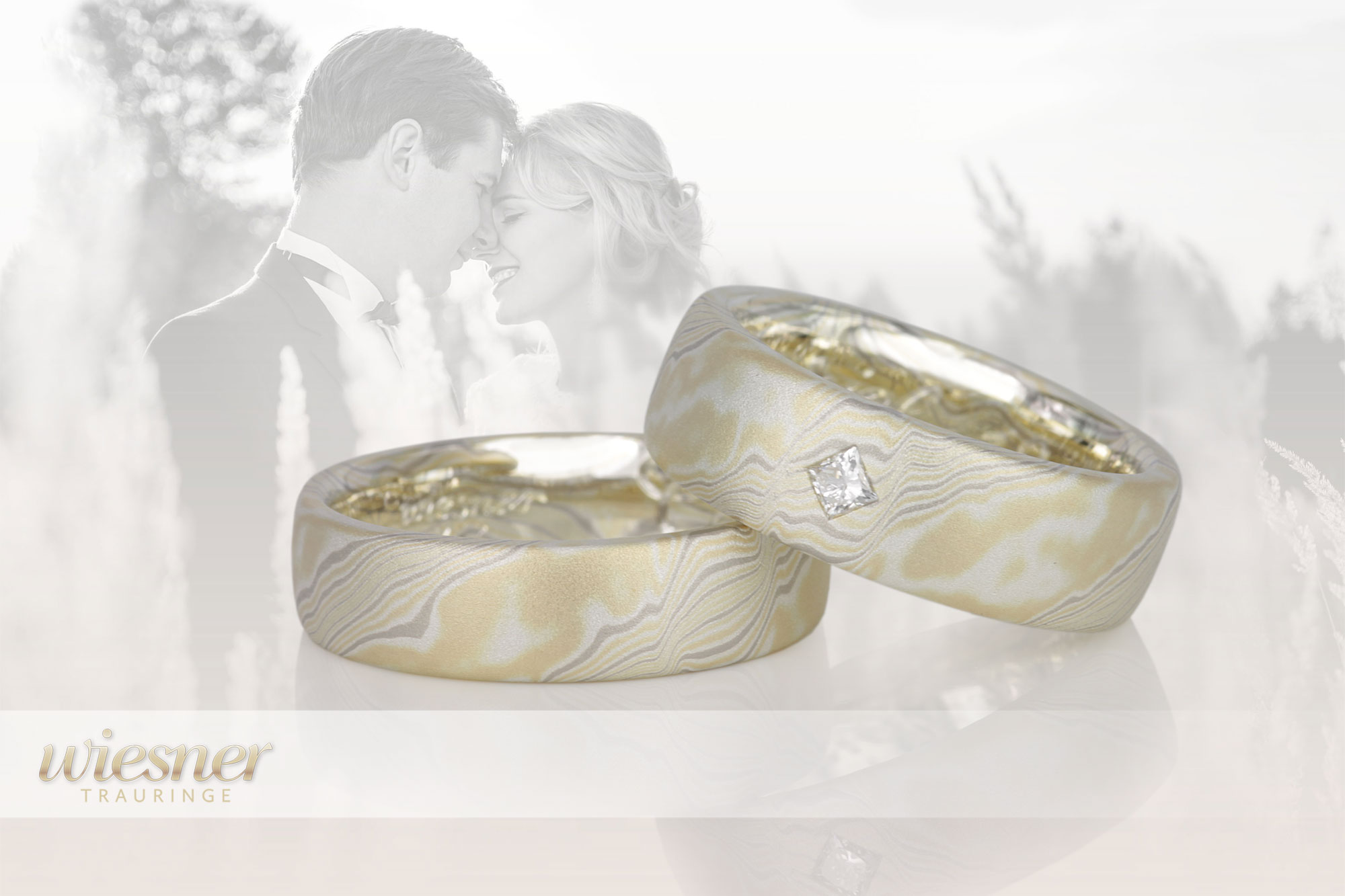
The women’s ring is additionally set with a 0.16-carat TWvvs princess-cut diamond.
Stunning appearance. The Jaboty Mokume Gane wedding ring set...
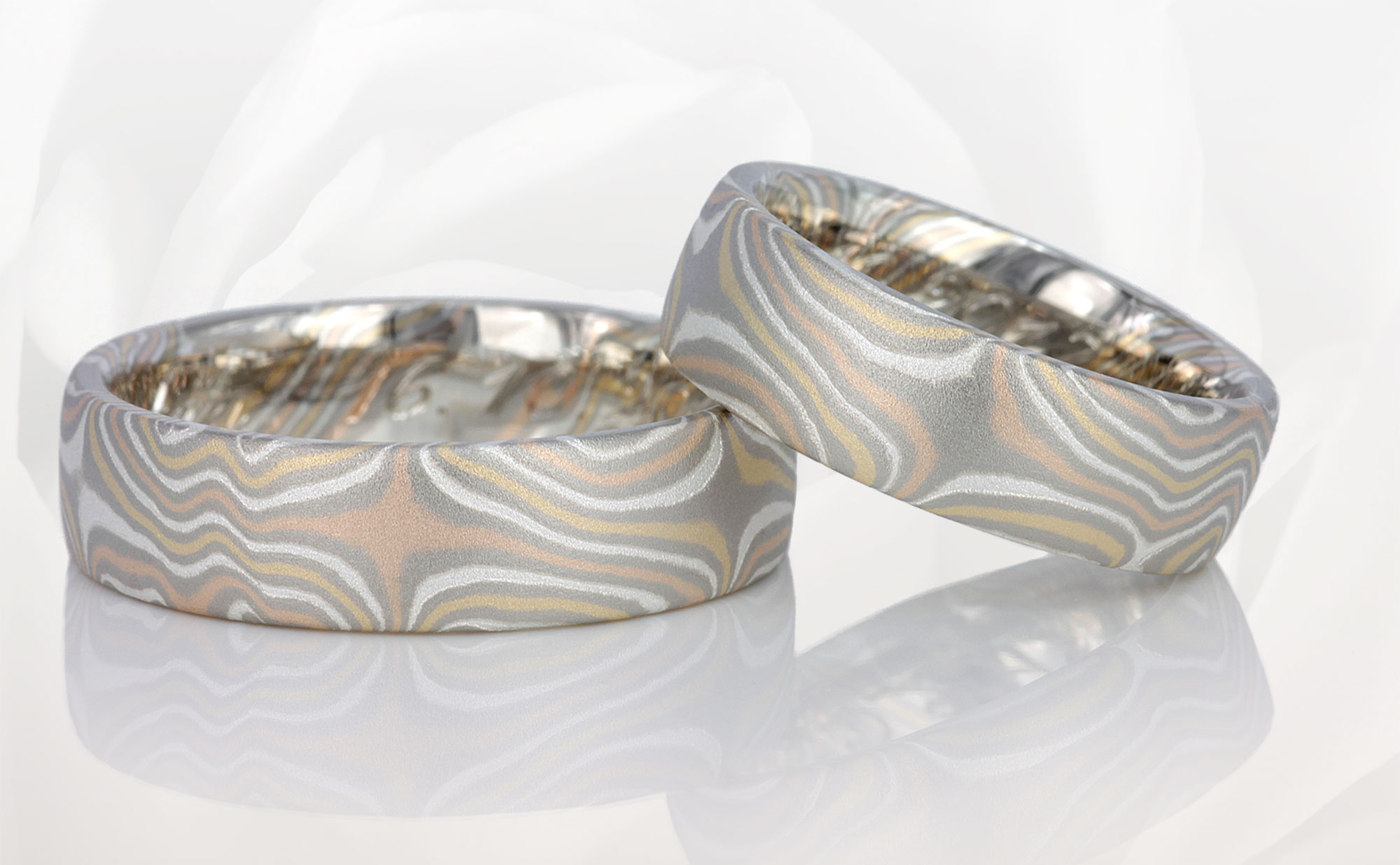
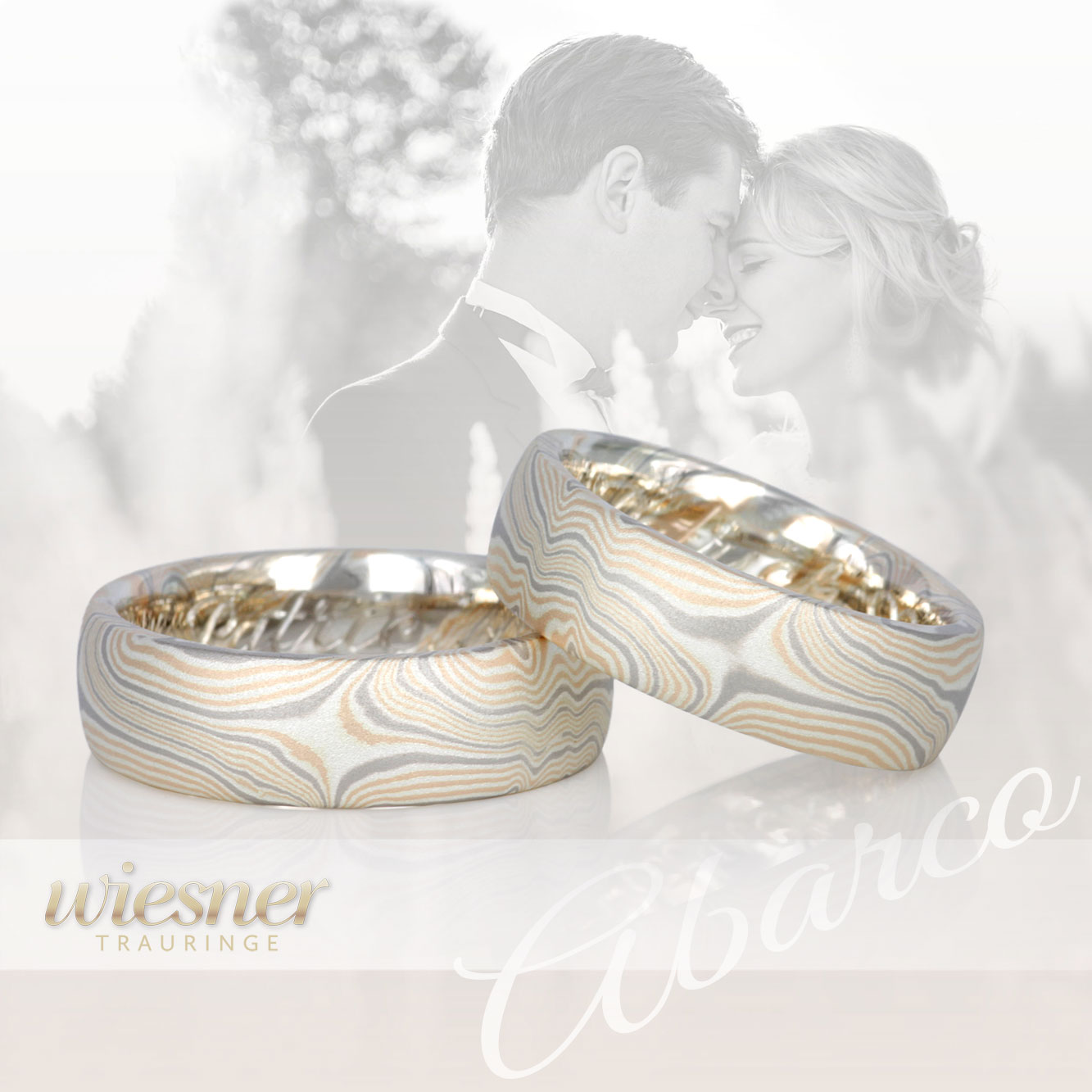
...in 8- and 10-mm widths offers plenty of surface area for the pattern created by this Japanese forging technique to shine. The colors of the Jaboty rings are also beautifully showcased here. Rose gold, yellow gold, palladium, and silver fuse together to create an entirely new overall impression. This pair of wedding rings also clearly demonstrates how the patterns on the two rings differ, even though both rings were crafted from a single piece of welded base metal.
Mokume Gane wedding rings can be customized by rearranging the colors.
In our Jaboty base pattern, the precious metals are arranged in a specific order and layer thickness. Changing this order, for example, alters the resulting pattern. This often gives the rings a completely different overall appearance. By adjusting the layer thicknesses, it’s also possible to highlight individual colors or let them recede into the background. These variations open up a whole cornucopia of possibilities and entirely new, one-of-a-kind creations.
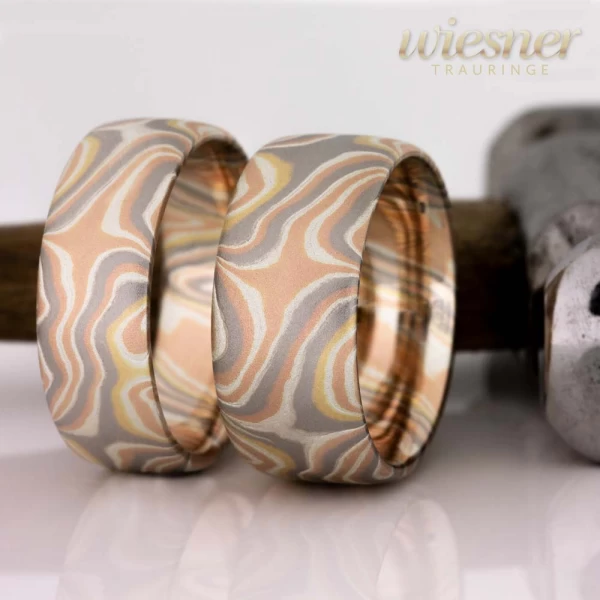
Mokume Gane Jaboty Rings: Sizes and Quantities
- 750 yellow gold | 585 rose gold | 500 palladium | 925 silver
- 8 and 10 mm wide | 2 mm profile height
- Ring profile, slightly domed on the inside and outside
- Wedding rings hand-forged by Markus Wiesner without seams or joints
Each pair of Mokume Gane rings is a “one-of-a-kind pair”
Thanks to the aforementioned possibilities for varying the basic pattern of the Mokume Gane Jaboty wedding rings, we can accommodate even the smallest special requests from the bride and groom. This ensures that completely new and unique wedding rings are created time and time again. In addition to the basic patterns we’ve created in our studio, we’d love for you to challenge us and bring your very own ideas for color and pattern designs. We’ll then be happy to discuss with you what your rings for life might look like.
One-of-a-kind wedding rings forged in Mokume Gane fulfill every wish
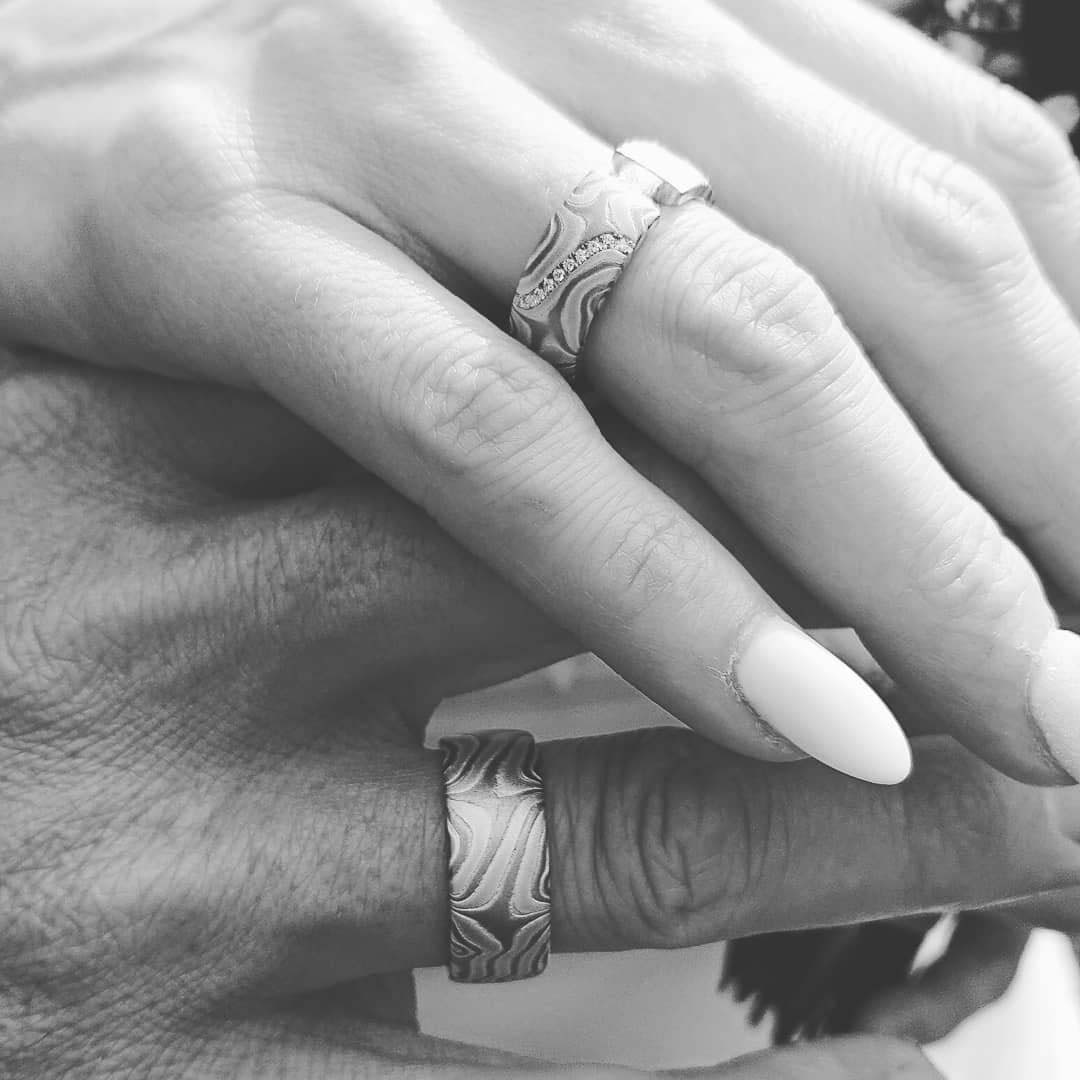
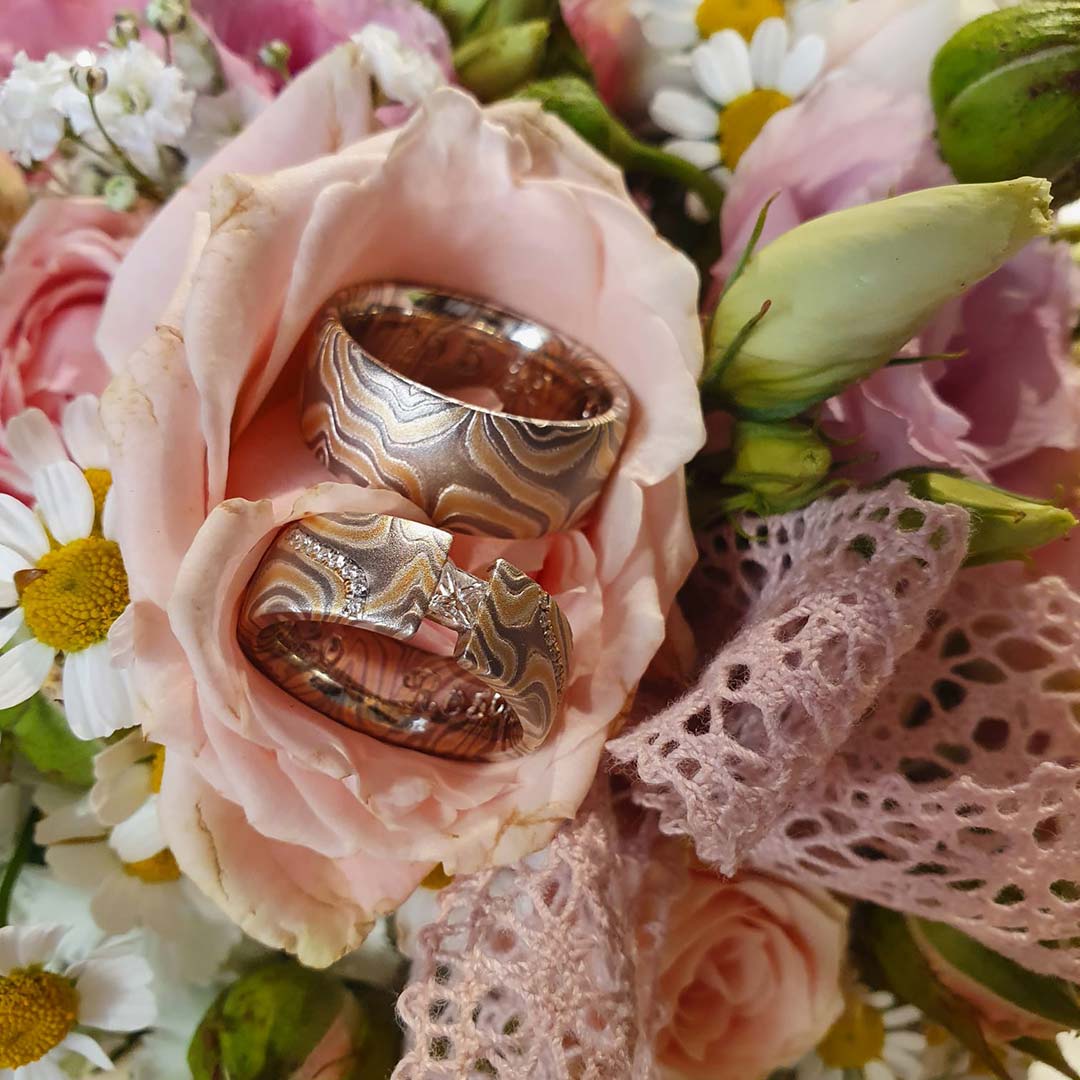
Thank you so much for your wonderful review on Google and the beautiful wedding photos featuring your Mokume Gane wedding rings. The photo with the rings on the bridal bouquet is, of course, great. The black-and-white one with the wedding rings on your hands is absolutely brilliant. Although Mokume Gane wedding rings really do thrive on their colors, the texture of your beautiful, one-of-a-kind pieces is shown here in a particularly stunning way.
Unique pieces forged with passion
Yes, it truly brings us great joy time and again to craft such brilliant, one-of-a-kind wedding rings. It brings us even more joy when the bride and groom are so enthusiastic about our work—and are particularly thrilled by such an important detail as their wedding rings. After all, these rings will accompany the couple for a lifetime.
Fascinating textures meet classic wedding ring design
This wedding ring model, so beautifully photographed here, successfully combines the vibrant and wild textures of Mokume Gane with classic stylistic elements typical of wedding rings. A princess-cut diamond fits perfectly into the Mokume Gane thanks to the setting style, which is a tension ring—or, more precisely, an “upgrade” tension ring. Why “upgrade”? At first glance, the diamond appears to be set freely. However, it conceals a bridge beneath it that connects both sides of the band, ensuring the stone sits securely. This is because, aside from platinum, no other precious metal provides sufficient tension to hold the stone securely. For this reason, we’ve incorporated this security feature into this Mokume Gane women’s ring made of yellow gold, rose gold, palladium, and silver.
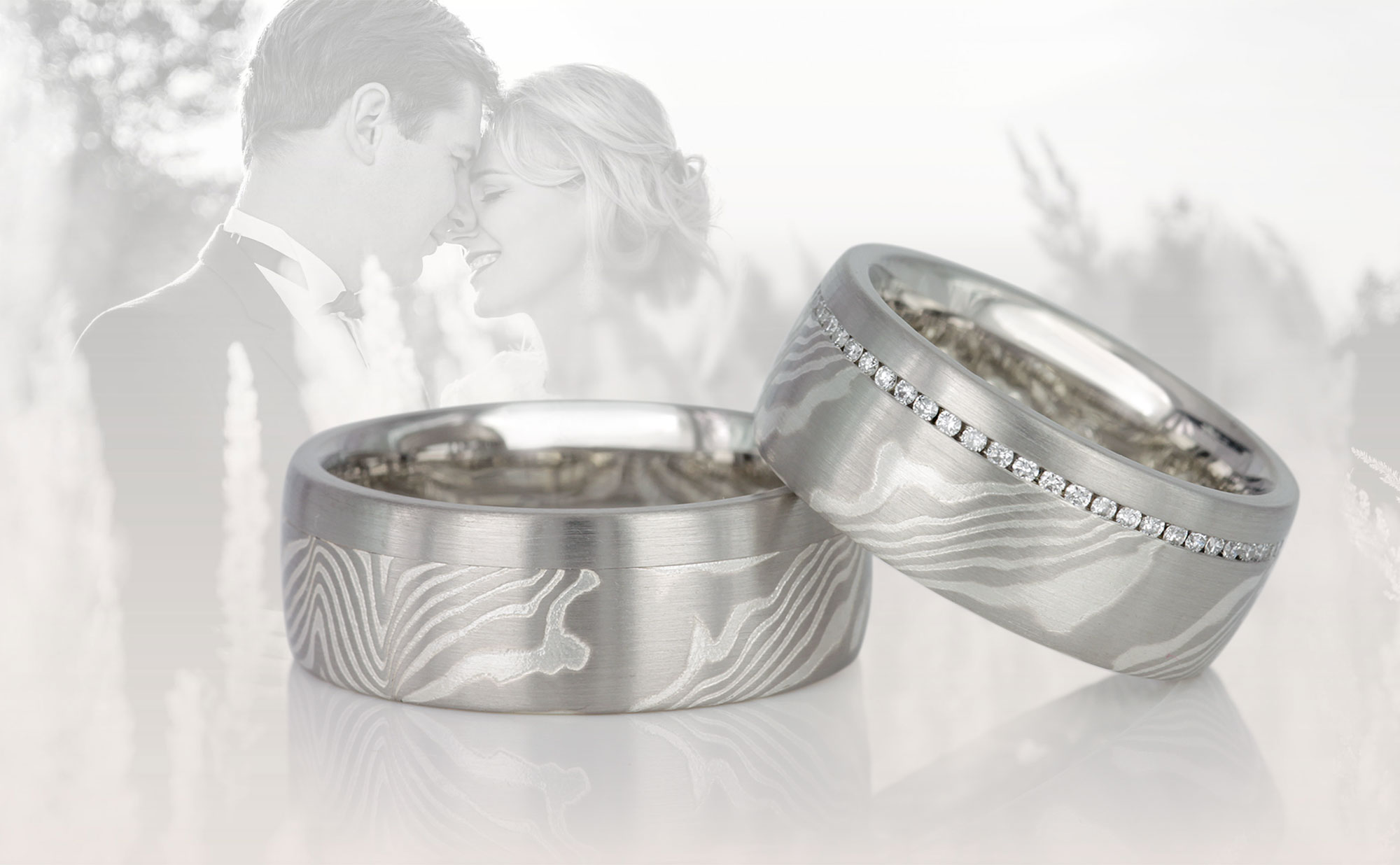
The delicate rows of diamonds on the women’s ring are deliberately and harmoniously incorporated into the Mokume Gane structure.
Thank you very much
We, Markus and Michael Wiesner, would like to conclude by once again expressing our heartfelt thanks for the commission to create such wonderful, one-of-a-kind pieces.
Best regards from the goldsmiths
An exceptionally stunning pair of wedding rings
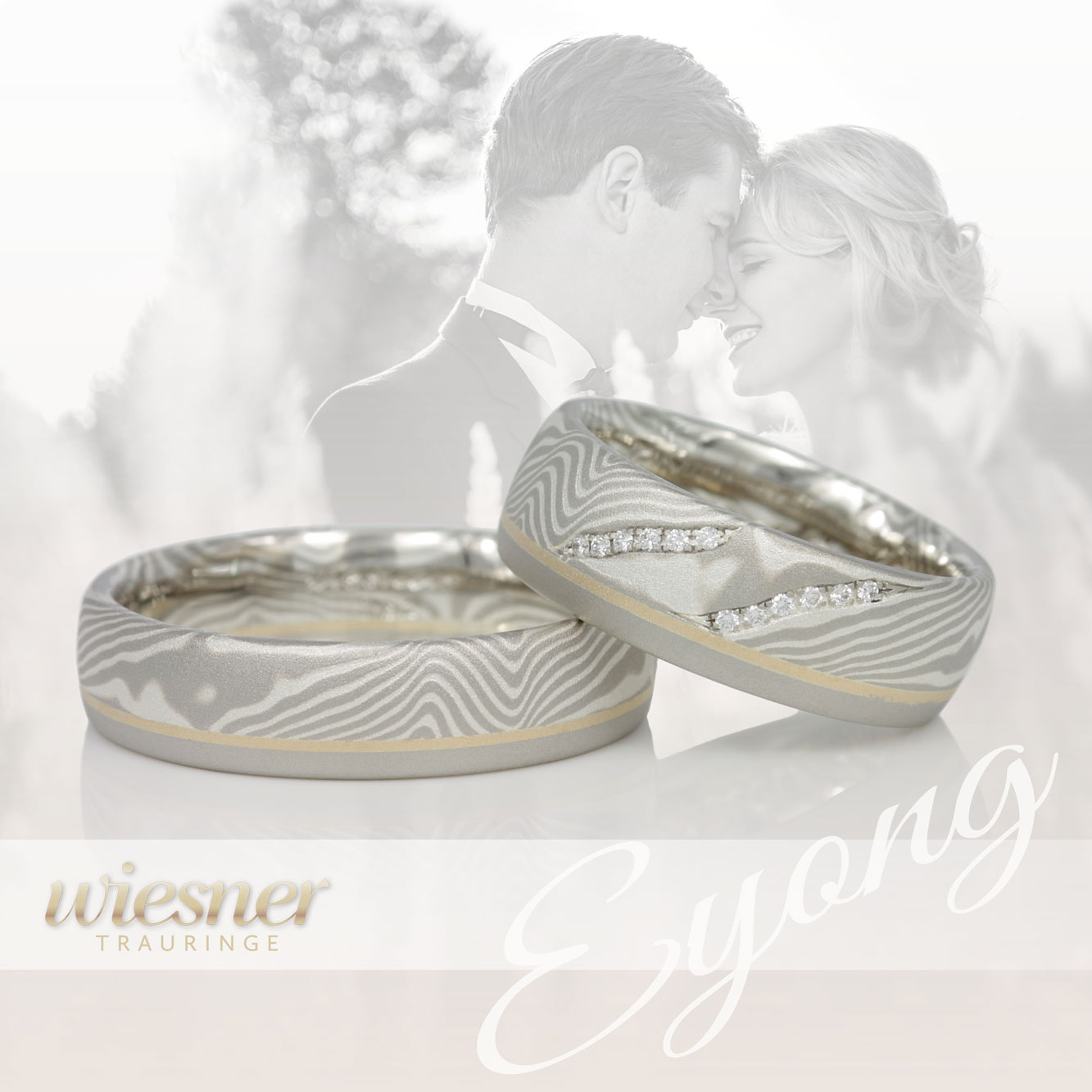
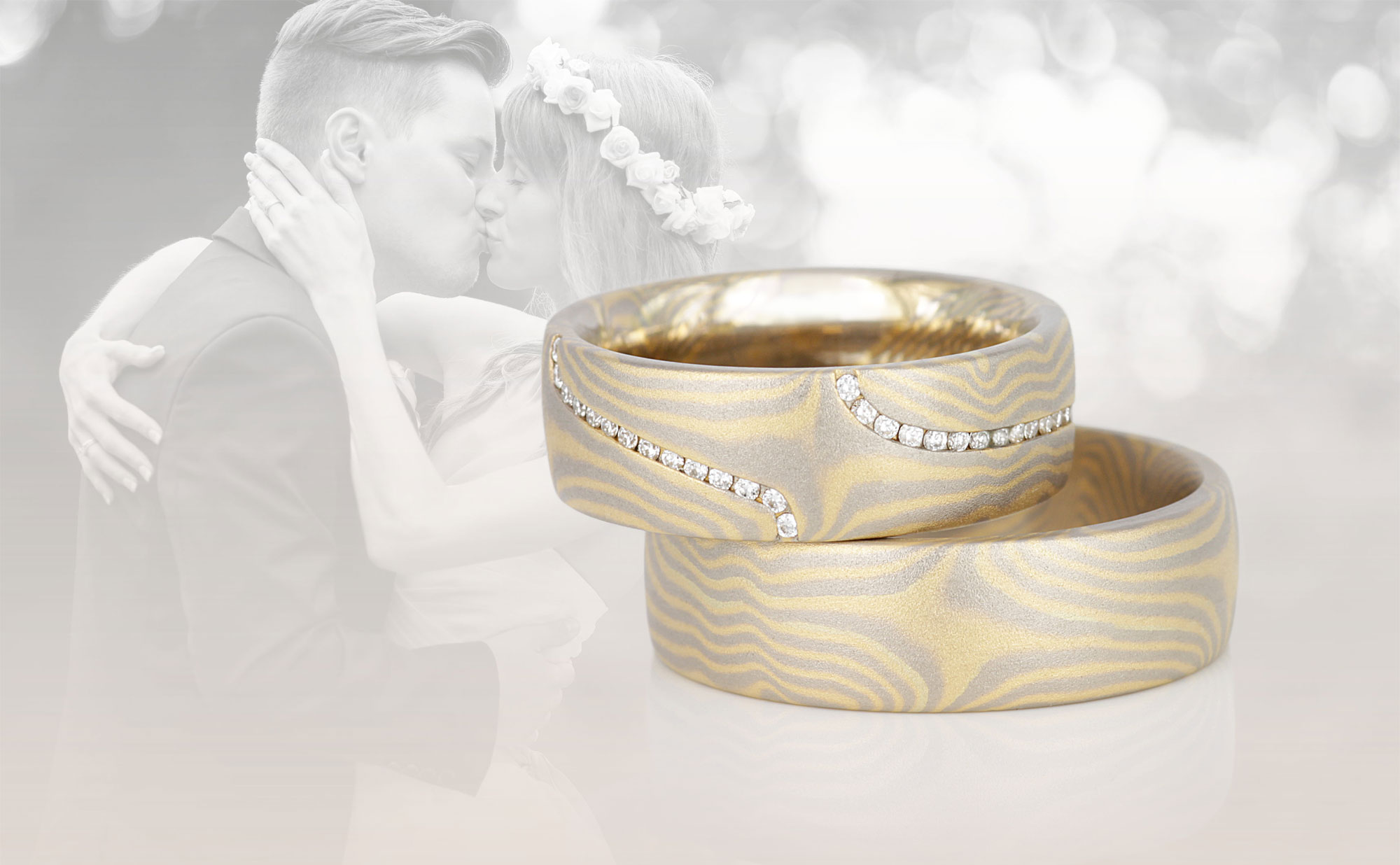
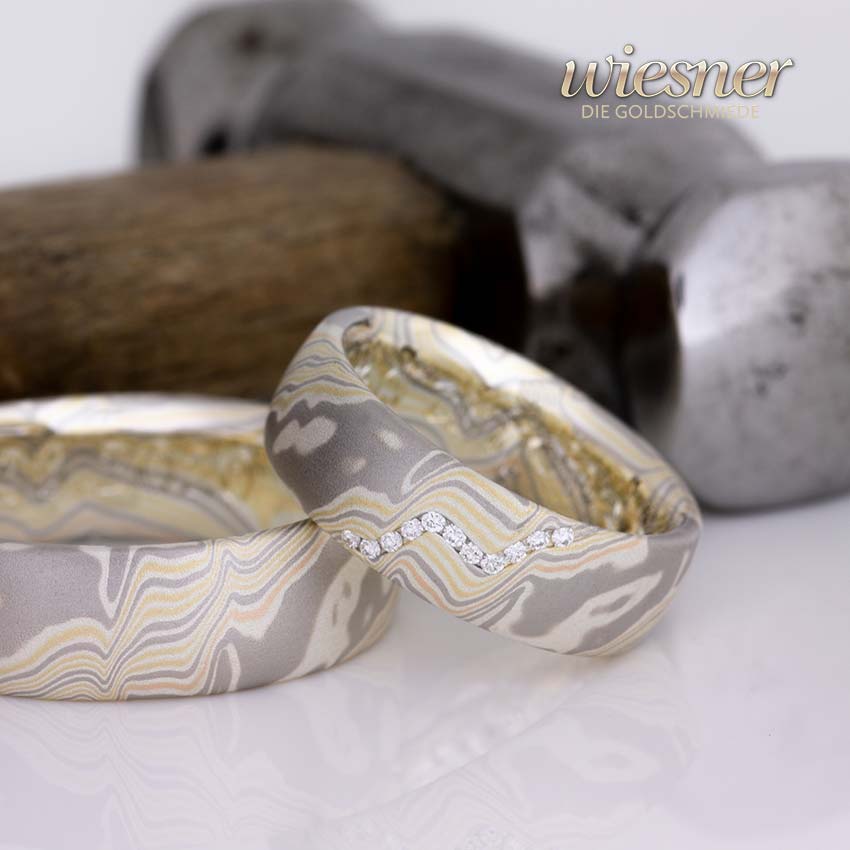
An exceptionally beautiful pair of Mokume Gane wedding rings crafted from the precious metals yellow gold | rose gold | palladium | silver. What makes them stand out is that each ring is adorned with a curved line of flawless diamonds.
While the two rings may appear identical at first glance, a closer look reveals that one of the wedding rings features a delicate line of red gold, while the other is crafted from yellow gold, palladium, and silver.
Even such differences can be achieved in a single piece of Mokume Gane ingot, from which a pair of rings can be forged—both crafted from a single piece of fused layered material.
Limba Mokume Gane rings with an additional strip of red gold and small diamonds
Reborn—Mokume Gane Wedding Bands
What a wonderfully vibrant Mokume Gane pattern. Master goldsmith Markus Wiesner experimented with a completely new Mokume Gane pattern for our collection and created the Tornillo ring pair. We are absolutely thrilled by the vibrancy of this combination of yellow gold, palladium, and silver. When creating Mokume Gane patterns, it’s always very exciting for us to see whether the original idea comes to life in the end or whether a completely different pattern emerges.
Sometimes our expectations are far exceeded, but other times our enthusiasm is more muted. Regardless, our personal taste and vision for Mokume Gane wedding rings are not the main focus. Our valued customers and bridal couples decide what suits their individual tastes. And that’s exactly how it should be. You alone decide on the colors, patterns, and shapes of your wedding rings. For example, if you like the pattern of the Tornillo rings but not the colors, Markus Wiesner will also craft the Tornillo wedding rings in:
- rose gold instead of yellow gold
- platinum instead of palladium, or
- a mixture of rose and yellow gold.
The silver between the gold and platinum layers is necessary both to maintain the overall light appearance of the Tornillo wedding ring set and to create the surface texture by subsequently reducing the silver layers with nitric acid.
During a consultation, we—Markus Wiesner and Michael Wiesner—will be happy to explain the wide range of options for Mokume Gane wedding rings from our goldsmith’s workshop.


