
First published on February 6, 2023 · comprehensively revised and technically updated on September 18, 2026 · Preview image: AI-generated illustration
What is Mokume Gane?
Mokume Gane is a traditional Japanese metalworking technique in which metals of different colors are permanently fused into a multilayered composite and then worked in such a way that the individual layers become visible as a pattern. The resulting lines often resemble wood grain—hence the name: Mokume Gane can be roughly translated as “wood grain in metal.”
What makes it special is that the pattern is not engraved, printed, or coated onto the surface. It is inherent in the material itself. Any deformation of the multilayered metal block also alters the arrangement of its layers. That is why a grain pattern, once created, can never be replicated exactly.
It is precisely this combination of metallurgy, metalworking, and a pattern that cannot be fully predicted that makes Mokume Gane so fascinating to us as goldsmiths.
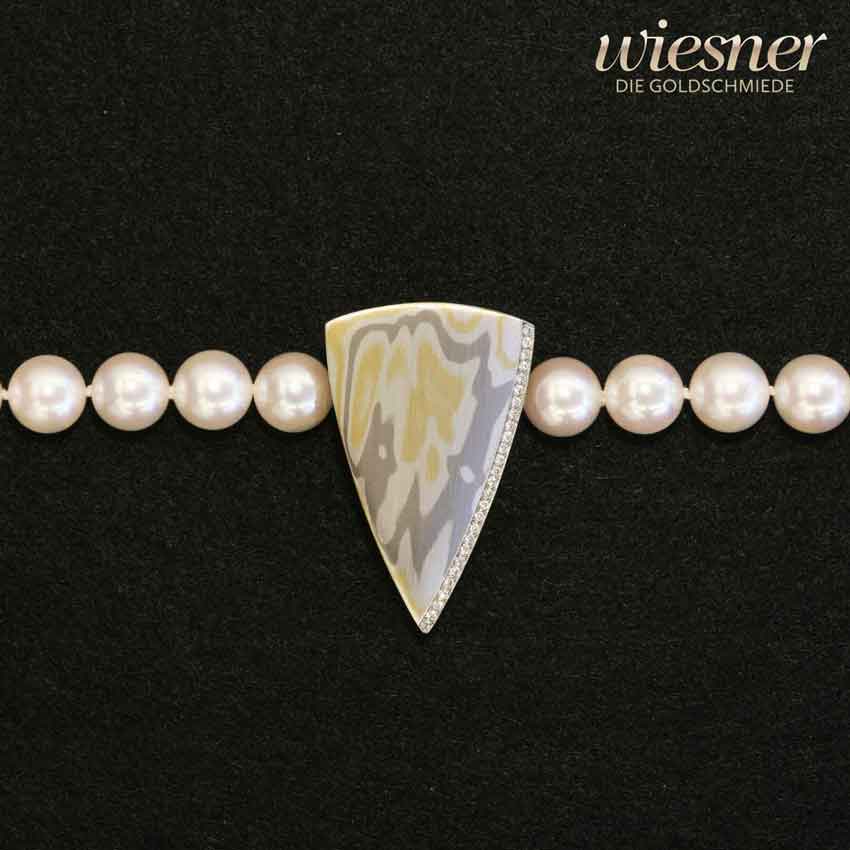
A Mokume Gane pearl clasp demonstrates that this technique is not limited to rings. In jewelry as well, the pattern is determined by the multilayered precious metal composite.
Where does Mokume Gane come from?
The technique originated in Japan during the Edo period. The metalworker Denbei Shōami is considered an important early pioneer, having worked with multilayered metal composites in the 17th century.
Originally, the focus was not on jewelry as we understand it today. Multi-layered metals were used for decorative components of Japanese swords and other artisanal metalwork. The different metal colors allowed for patterns and surfaces that could not be created with a single homogeneous metal.
As Japanese society changed, traditional sword-making also lost its significance. However, the technique did not disappear. Later, Mokume Gane was taken up and further developed by artisans and jewelry designers.
Today, Mokume Gane is used worldwide—especially for jewelry and unique rings.
How is Mokume Gane made?
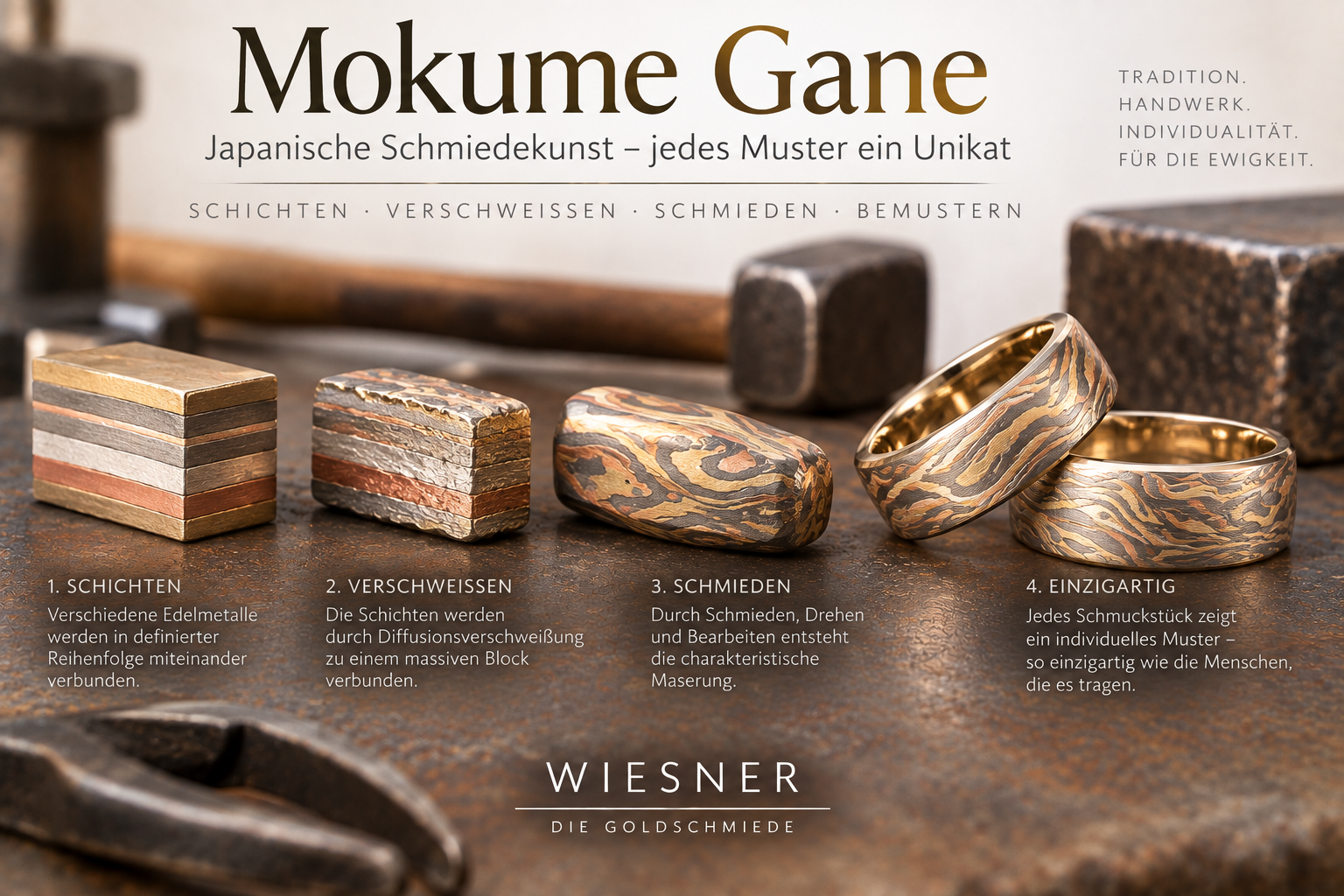
The crucial starting point is a stack of different metal sheets. The metals chosen for combination determine not only the color but also the properties of the entire material.
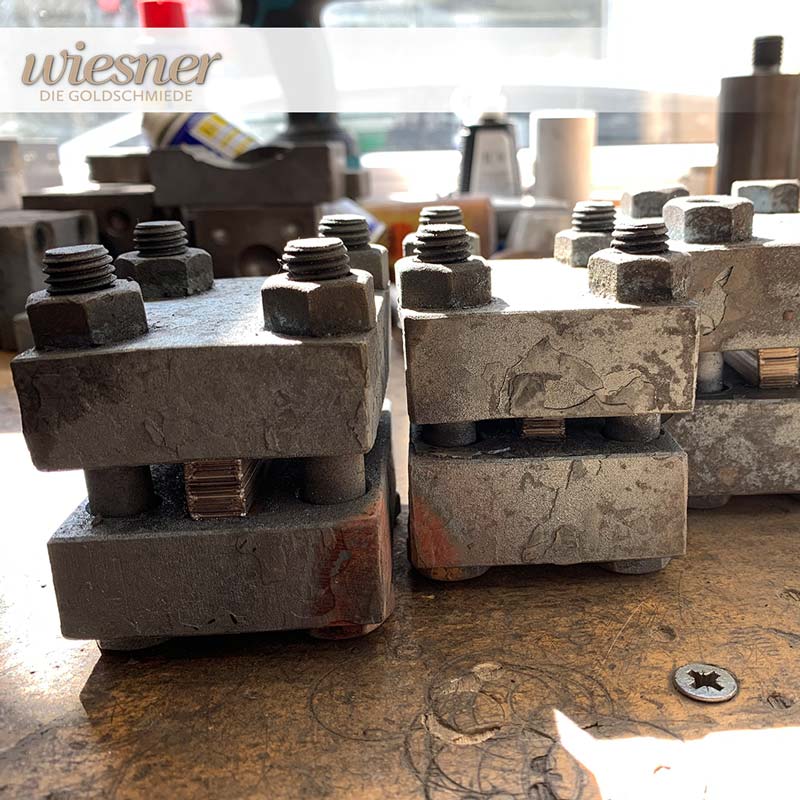
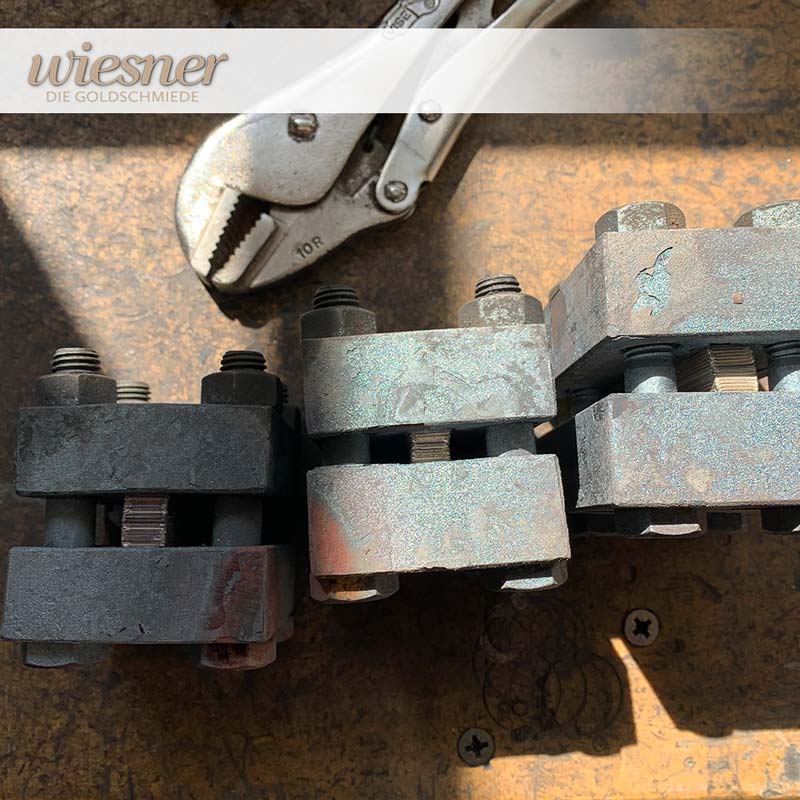
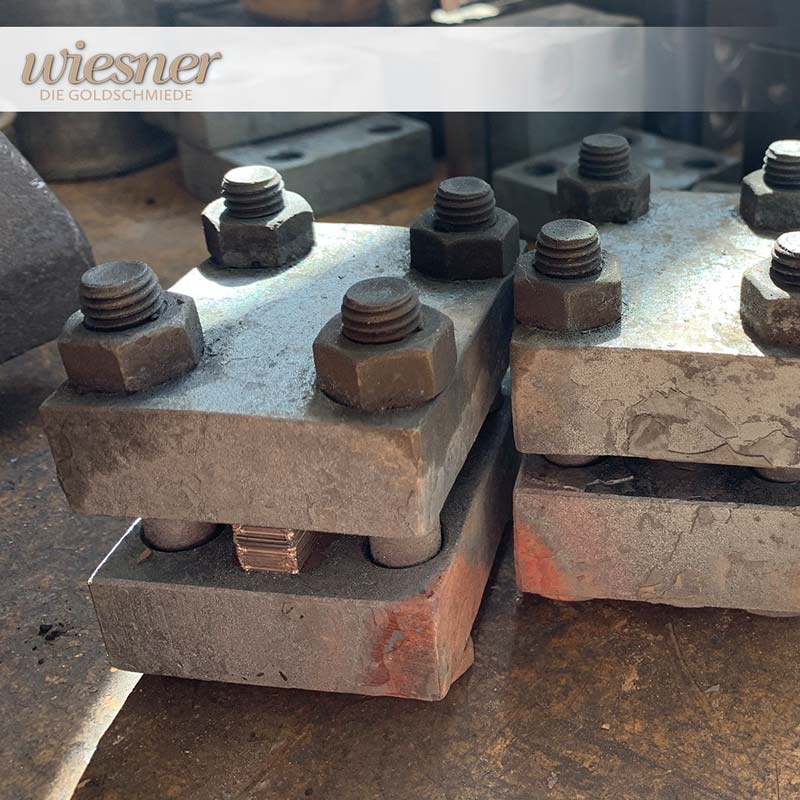
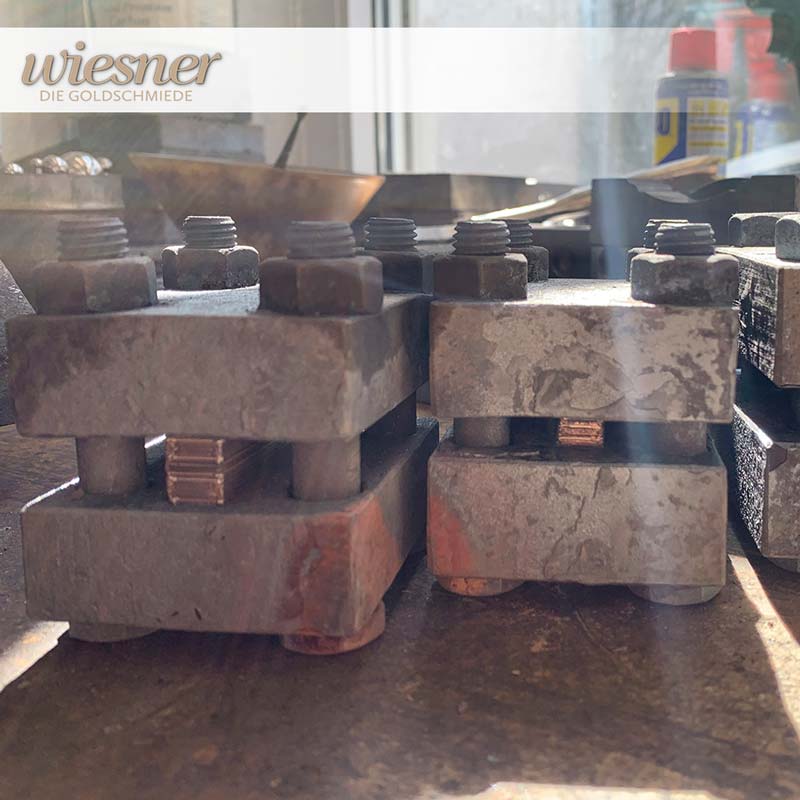
In our goldsmith’s workshop, we produce the Mokume Gane material ourselves. The prepared precious metal layers are cleaned, precisely stacked on top of one another, and then permanently bonded together under controlled conditions through diffusion welding.
This process does not simply involve soldering the metal stack together. Under temperature and pressure, a solid metallic bond forms at the interfaces between the metals.
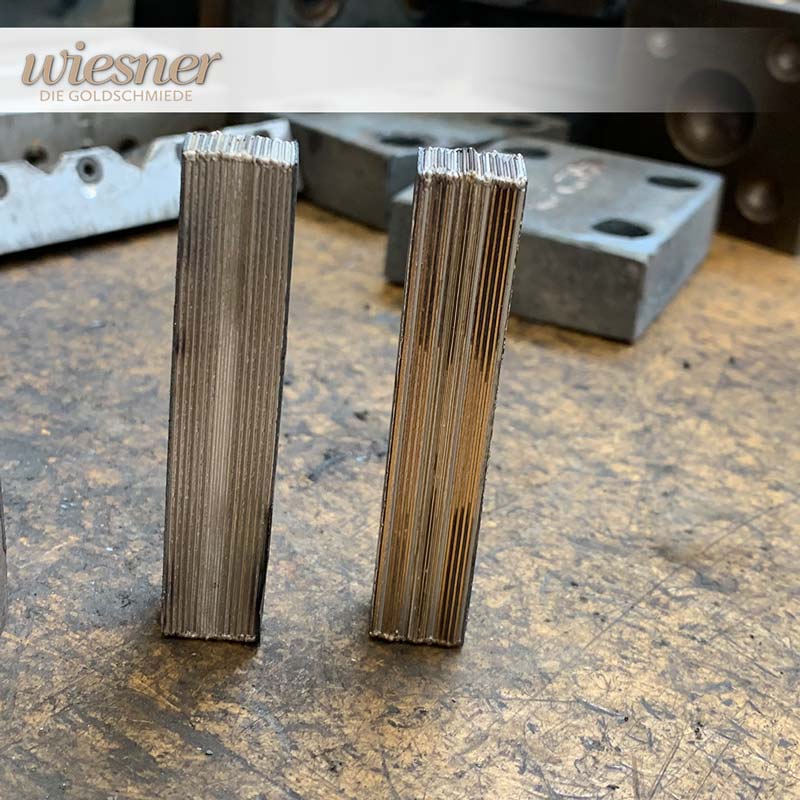
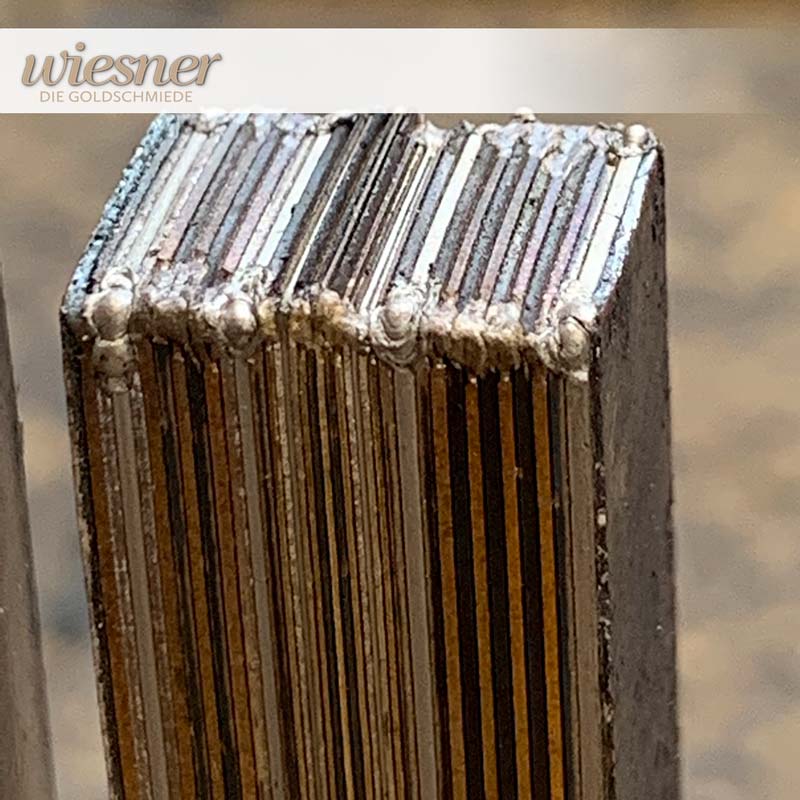
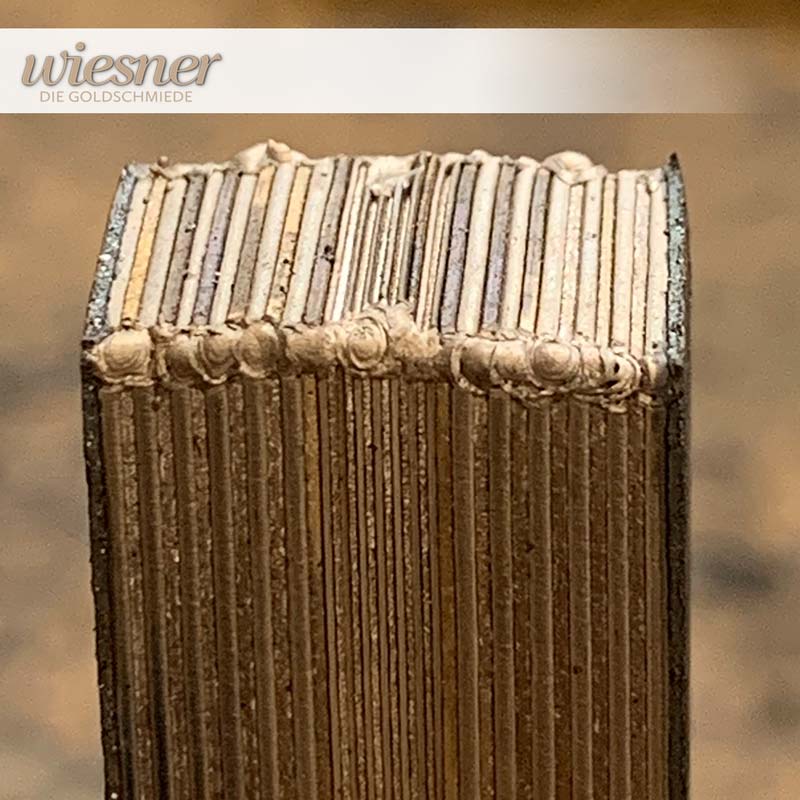
The many individual sheets are then transformed into a compact, multilayered Mokume-Gane block.
From the layered block to the pattern
However, the typical grain pattern is not yet present. Initially, the individual metal layers run largely parallel to one another.
It is only through the subsequent forging, rolling, and targeted shaping that these layers are displaced. Depending on the desired pattern, the composite is processed in different ways. Material is then removed or further rolled out and forged. This causes the differently colored layers to emerge on the surface.
This creates waves, lines, swirls, or structures reminiscent of natural wood grain.
So, we do not “fold” mokume gane. The patterns emerge from a previously welded, multi-layered metal composite, whose layers are specifically deformed and made visible through further processing.
Why does every Mokume Gane ring look different?
Even when two rings are crafted from the same block of material, their patterns develop differently. Even small variations in the forging, rolling, and final shaping processes alter the flow of the individual metal layers.
For us, however, this does not mean that the result is left entirely to chance. The character of the pattern, the combination of materials, the ring width, and the surface finish can all be specifically designed. The fine details of the grain, however, develop during the artisanal crafting process.
That is why genuine Mokume-Gane rings are unique in the truest sense: a pattern’s character can be replicated, but not exactly copied.
Which precious metals are suitable for Mokume Gane?
Not every theoretically possible metal combination is suitable for a ring worn daily. The metals involved differ in terms of hardness, malleability, melting behavior, and color, among other factors. They must therefore be compatible not only visually but also metallurgically.
In our workshop, we use combinations of yellow gold, palladium, silver, and—depending on the model—rose gold for many of our Mokume-Gane rings. Special combinations, such as those with platinum, are also possible.
A good example is our Tornillo model. Here, we combine 750 yellow gold, 500 palladium, and 925 silver into a multi-layered composite. An additional line of rose gold adds a warm color accent.
So the key is not to combine as many different metals as possible. What matters is that the material, pattern, and the future wear and tear on the piece of jewelry all work well together.
Mokume Gane for Wedding Rings
Mokume Gane holds a special appeal for wedding rings. Two rings can be forged from the same block of material, thereby sharing the same material and color palette. Nevertheless, each ring develops its own unique grain pattern.
They belong together without being identical.
Especially for wedding rings, this combination of shared qualities and individuality is a beautiful symbol. With our rings, there’s an additional concept: We craft our Mokume Gane wedding rings seamlessly.
Forged SEAMLESSLY—without a joint
A classic ring can be bent from a strip of metal, the ends of which are then soldered or welded together. This creates a seam.
With our Mokume-Gane rings, we take a different approach. The ring is shaped and forged from the material in such a way that no seam runs through the Mokume-Gane pattern.
This allows the pattern to continue uninterrupted all the way around the ring. This makes a significant visual difference, especially with a vibrant grain pattern.
For a wedding band, we also appreciate the symbolism: a closed ring with no beginning and no end has always stood for connection and permanence. The seamless craftsmanship consistently carries this idea forward in the making of the ring.
We showcase more about this process on our page dedicated to our goldsmiths’ SEAMLESS technique.
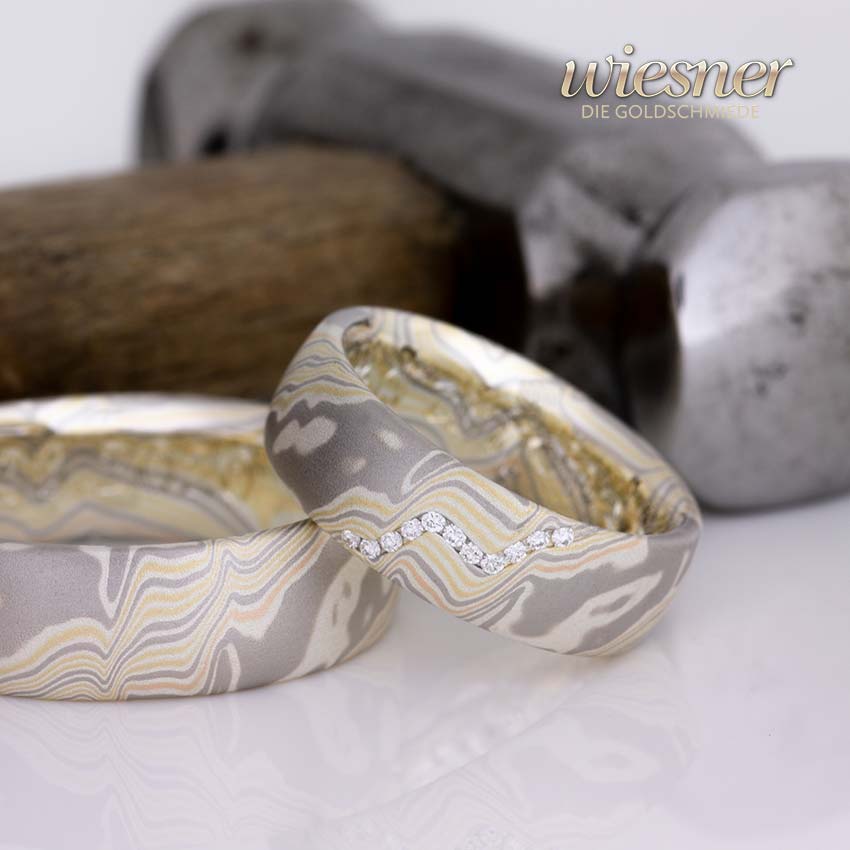
Tornillo: The dynamic pattern emerges directly within the multi-layered precious metal composite and wraps around the rings without any visible seams.
Mokume Gane is more than just a surface
In photos, it’s easy to get the impression that the visible lines are merely a surface design. In fact, the differently colored metal layers extend throughout the material.
Normal signs of wear or a subsequent restoration therefore do not simply make the characteristic structure disappear. However, any ring worn daily changes over time: matte surfaces become smoother, polished surfaces show signs of wear, and edges may appear softer after many years.
A Mokume-Gane ring can be refinished in our workshop. In doing so, we take into account the ring’s specific material composition and pattern.
Can Mokume-Gane rings be combined with diamonds?
Yes. Diamonds can create a deliberate contrast to the vibrant metal grain. In our view, it’s important that the stones complement the Mokume-Gane pattern rather than simply covering it up.
Depending on the ring design, individual diamonds, small clusters of stones, or settings along a pattern line are possible. In particular, a channel setting that follows the natural flow of the grain can further emphasize the ring’s unique pattern.
You’ll find examples of different patterns, material combinations, and diamond options among our Mokume Gane rings and wedding bands.
Mokume Gane is not only suitable for wedding bands
The technique can also be used for other pieces of jewelry. The key is always to ensure that the shape and construction leave enough space for the characteristic metal pattern.
In our goldsmith’s workshop, we therefore use Mokume Gane for rings, pendants, earrings, and special interchangeable or pearl clasps, among other items.
You can find our various jewelry designs in the Mokume Gane Jewelry category.
How durable are Mokume Gane rings?
A Mokume Gane composite crafted by a professional is suitable for long-lasting jewelry. As with any wedding band, however, its performance in everyday use depends on the precious metals used, the ring’s construction, the finish, and the amount of wear and tear it undergoes.
Therefore, it would be too simplistic to make a blanket statement that a particular metal inherently makes a Mokume Gane ring especially durable. A ring must always be considered as a single composite material.
Can the ring size be adjusted later?
In principle, Mokume-Gane rings can also be resized. However, due to the multi-layered material and the continuous pattern, such a modification requires experience with this material.
How a ring size adjustment is best carried out depends on the specific ring, its pattern, the precious metals used, and the extent of the desired change. That is why we first examine each Mokume-Gane ring individually.
Can Mokume Gane be engraved?
Yes. The inside of a Mokume-Gane wedding ring can be engraved just like other high-quality wedding rings. Options include names, dates, or personal messages. Custom engravings based on your own handwriting are also possible.
Frequently Asked Questions About Mokume Gane
What does Mokume Gane mean?
The Japanese term literally describes a wood-grain pattern in metal. It is characterized by the visible lines and structures of differently colored metal layers.
Is Mokume Gane folded?
Not in our manufacturing process. Various sheets of precious metal are first assembled into a layered block and bonded together through diffusion welding. This composite is then forged, rolled, and patterned as desired.
Is the pattern only on the surface?
No. The pattern is created by the differently colored metal layers within the composite material. It is neither an applied coating nor a printed decoration.
Are two Mokume Gane rings identical?
No. Even with a pair of matching wedding bands, the grain develops differently. The material combination and pattern characteristics may be the same, but the exact linework remains unique to each piece.
What metals do we use for Mokume Gane?
That depends on the specific model. The precious metals we use include, among others, yellow gold, rose gold, palladium, and silver. For some models, we also use other carefully selected combinations.
Does a Mokume-Gane pattern fade?
The pattern is an integral part of the multi-layered metal composite and therefore cannot simply fade like a surface-level color. However, the surface of a worn ring does change due to normal wear and tear and can be refinished if necessary.
Why is Mokume Gane particularly well-suited for wedding rings?
In addition to its unique appearance, the technique carries beautiful symbolism: two rings can be crafted from the same material yet each develop its own distinct pattern. With our seamless Mokume Gane rings, the closed band—without a visible seam—serves as a further symbol of lasting unity.
Mokume Gane from Our Goldsmith’s Workshop
For us, the fascination of Mokume Gane lies not only in its unusual grain. What matters most is the entire journey from the individual sheet of precious metal to the finished piece of jewelry.
We produce the multi-layered material ourselves in our workshop, develop various patterns from it, and forge them into custom rings and jewelry. This allows us to harmonize the material combinations, patterns, width, profile, and finish.
If you’d like to get an initial overview of our various patterns and material combinations, you’ll find them in our Mokume Gane rings.
And because the effect of a hand-forged pattern can only be fully appreciated in person, we’d be happy to consult with you in person at our goldsmith’s workshop in Beilstein regarding materials, patterns, and ring shapes.


