First published on November 17, 2025 · comprehensively revised on September 16, 2026 · Image: AI-generated illustration
Which precious metal doesn’t tarnish?
Whether a piece of jewelry appears darker, duller, or discolored over time depends heavily on the metal used and its alloy. Silver, in particular, is known for its typical dark tarnish. Platinum and palladium, on the other hand, are exceptionally resistant to corrosion. With gold, it depends primarily on which other metals are contained in the respective gold alloy.
It’s important to distinguish between tarnishing, patina, and normal signs of wear. Not every change to a piece of jewelry’s surface is a chemical reaction—and certainly not an indication of poor quality.
What does “tarnishing” mean in the context of jewelry?
Tarnishing refers to a chemical change on the surface of a metal. In this process, components of the metal react with substances in its environment. Depending on the material, oxygen or sulfur compounds, for example, may be involved.
A typical example is silver. It reacts particularly with sulfur-containing compounds and can thus form a yellowish, brownish, or even black surface coating.
Surface changes are promoted by, among other things:
- air and humidity,
- sweat and skin contact,
- cosmetics, perfume, and hairspray,
- cleaning and household chemicals,
- substances containing sulfur in the environment.
When it comes to jewelry, therefore, the specific material must always be considered. Even an alloy can behave differently than the pure precious metal of which it is primarily composed.
Silver—Why It Can Tarnish So Easily
Silver is the classic example of a jewelry metal that tarnishes. 925 sterling silver is frequently used in jewelry making. The number 925 means that the alloy consists of 92.5 percent silver.
Silver can react with sulfur compounds. This reaction produces silver sulfide on the surface, which appears as a dark coating. As a result, jewelry can tarnish even during prolonged storage without having been worn.
This is not an unusual form of damage to the material. The coating is on the surface and can be removed using appropriate methods.
To learn more about sterling silver, fine silver, alloys, and their use in our workshop, see our guide on silver as a jewelry metal.
Does gold tarnish?
Pure gold is chemically extremely stable. Fine gold with a fineness of 999 hardly reacts with its surroundings under normal everyday conditions and does not exhibit the dark tarnish typical of silver.
However, jewelry is rarely made of pure gold. For wearable jewelry, gold is alloyed with other metals. This allows the color, hardness, and workability to be specifically adjusted.
In 750 gold, 75 percent of the alloy consists of fine gold; in 585 gold, it is 58.5 percent. The remaining components can include, for example, silver, copper, or palladium.
The lower the gold content and the higher the proportion of more reactive alloy metals, the more likely surface changes are to occur under certain conditions. However, high-quality 585 and 750 gold alloys are very durable in everyday jewelry use.
You can find basic information about gold, fineness, and jewelry alloys in our guide to gold and fine gold.
What makes white gold different?
White gold is not a separate type of metal, but rather a gold alloy. The yellow color of the gold is lightened by additional alloying elements. Depending on the formulation, white gold can therefore have a more grayish-white undertone.
Many white gold jewelry pieces are also rhodium-plated. This process applies a very thin layer of rhodium to the surface, which creates a particularly bright and cool white tone.
If a ring worn daily is subjected to wear and tear over a long period of time, this rhodium layer may wear away in places. Then the natural color of the white gold alloy reappears underneath.
This is occasionally mistaken for “tarnishing,” but it is something entirely different: The white gold has not chemically discolored—the surface coating has simply been worn away mechanically.
We explain in detail how white gold and rhodium plating are related in our guide to white gold.
Platinum – naturally light in color and highly corrosion-resistant
Platinum belongs to the platinum group of metals and has a naturally light, grayish-white color. High-quality jewelry often uses 950 platinum.
Platinum is exceptionally resistant to many environmental factors and does not exhibit the typical dark tarnish seen in silver during normal daily wear.
What does change, however, is the surface that is subjected to mechanical stress. A polished platinum ring will develop scratches and fine signs of wear from daily use. Over time, this can result in a characteristic matte to silky-looking surface, often referred to as a platinum patina.
This patina is not tarnish. It results from wearing the piece of jewelry.
You can find more about the properties, weight, and craftsmanship of platinum in our guide to platinum as a jewelry metal.
Palladium – a light-colored precious metal from the platinum group
Palladium is also a member of the platinum group. It naturally has a light gray-white color and is significantly lighter than platinum.
Palladium and suitable palladium alloys are highly corrosion-resistant and, when worn as jewelry, do not exhibit the typical dark tarnish seen in silver.
However, as with any ring that is worn, scratches, dull spots, and other mechanical signs of wear will develop. These alter the surface’s reflection of light but do not fundamentally change the material’s natural color.
In our goldsmith’s workshop, palladium also plays an important role in Mokume Gane rings. There, we combine different precious metals and alloys to create the characteristic light and warm lines of the grain pattern.
For more information on the material, see our guide to palladium.
Tarnish, patina, or scratches—what’s the difference?
| Change | Cause | Example |
| Tarnish | chemical surface reaction | dark coating on silver |
| Patina | Change in the surface appearance due to use or intentional treatment | typical wear patina on platinum |
| Signs of wear | Mechanical stress | Scratches on a polished ring |
| Wear on a coating | Mechanical wear of a thin surface layer | Fading rhodium plating on white gold |
What role does the surface of a piece of jewelry play?
Even though a precious metal does not chemically tarnish, a piece of jewelry worn daily will not remain permanently as it was when it left the workshop.
Polished surfaces show fine scratches particularly clearly. Satin-finished surfaces can become smoother and shinier over time due to friction. Textured surfaces also change, but often make individual signs of wear less noticeable.
This is especially true for wedding rings: They are worn every day and come into contact with doorknobs, tools, dishes, desks, and countless other surfaces. Signs of wear are therefore not solely a matter of the precious metal itself, but a natural consequence of wearing the jewelry.
Which precious metal is particularly low-maintenance?
If you’re primarily looking for a metal that retains its bright color over time without an additional coating, platinum or palladium are very durable options. High-quality gold alloys are also exceptionally well-suited for everyday use.
Silver requires a bit more attention because dark tarnish layers can become visible. However, silver can be cleaned and restored very effectively by a goldsmith.
Nevertheless, a blanket ranking would be of little use. For a wedding ring, factors such as weight, color, ring construction, desired design, alloy, possible gemstones, and the ability to make changes later are just as crucial as the surface’s behavior.
Can tarnished or scratched jewelry be restored?
In many cases, yes. Professional restoration is part of standard goldsmithing practice.
Depending on the piece of jewelry, surfaces can be cleaned, polished, matted, or textured. In the case of rhodium-plated white gold, a new layer of rhodium can be applied after appropriate preparation.
However, the extent to which refurbishment is advisable always depends on the specific piece of jewelry. Engravings, settings, gemstones, and special finishes must all be taken into account.
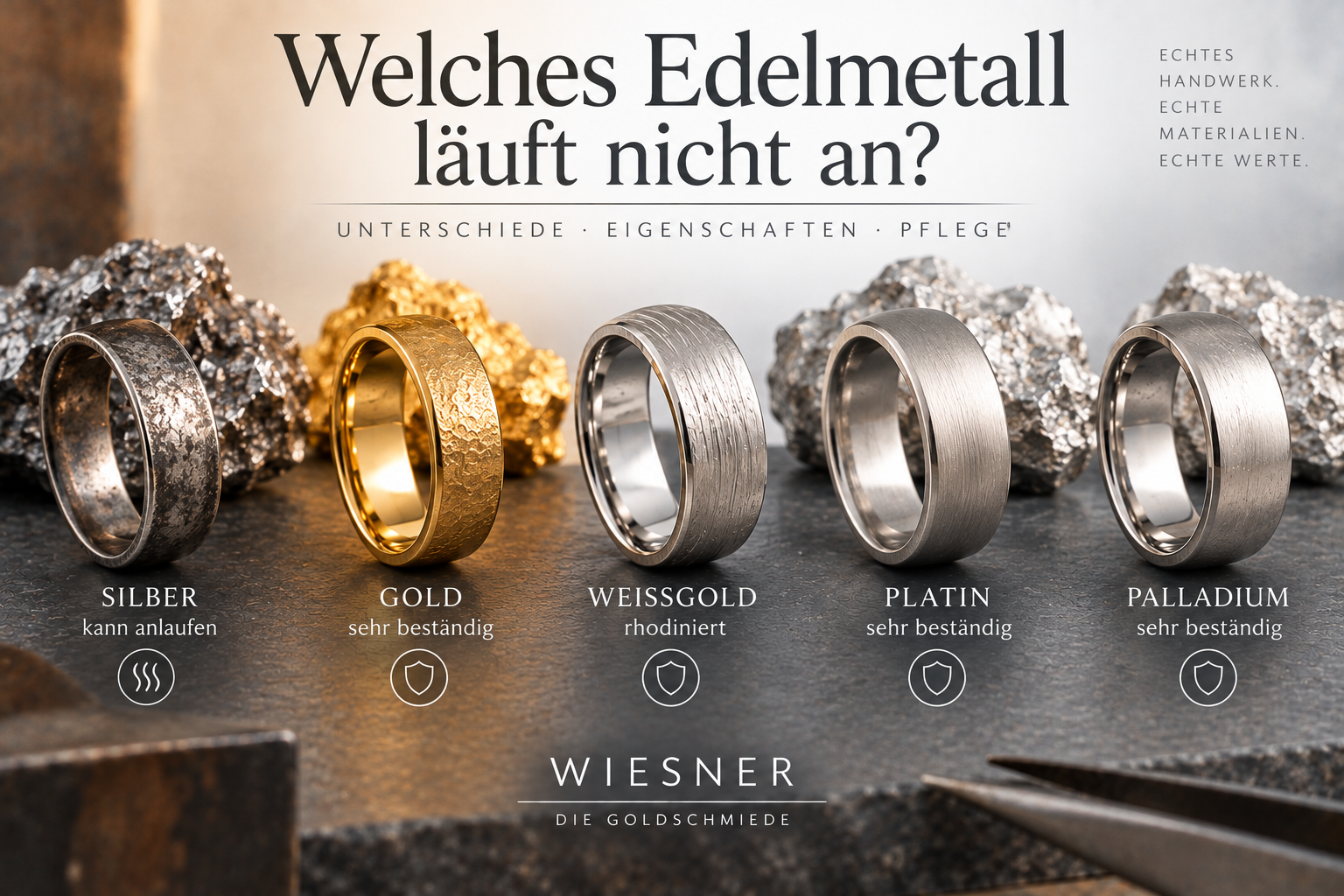
Which precious metal doesn’t tarnish?
For everyday jewelry, the question can be answered simply as follows:
- Silver: can tarnish significantly.
- Gold: is very durable; its behavior in jewelry depends on the fineness and alloy components.
- White gold: does not tarnish to a dark color like silver; however, the rhodium coating on rhodium-plated white gold can wear off.
- Platinum: highly corrosion-resistant and does not typically tarnish in everyday use.
- Palladium: also highly corrosion-resistant and naturally light in color.
Therefore, the question “Does it tarnish?” is not the only decisive factor. For a piece of jewelry intended to be worn for many years, the specific alloy, the construction, the finish, and the possibility of professional restoration at a later date are equally important.
Our Conclusion from the Goldsmiths
A change in a piece of jewelry’s surface does not automatically mean that a precious metal has tarnished. Silver can indeed form a dark reaction layer. With platinum, palladium, and high-quality gold alloys, however, we primarily see changes in everyday use caused by wear itself: scratches, loss of luster, patina, or wear on a surface coating.
Especially with wedding bands, this evolution is part of a piece of jewelry’s life. The key is to choose a material that suits the desired design and your personal wearing habits—and to know that many surfaces can be professionally restored even after many years.